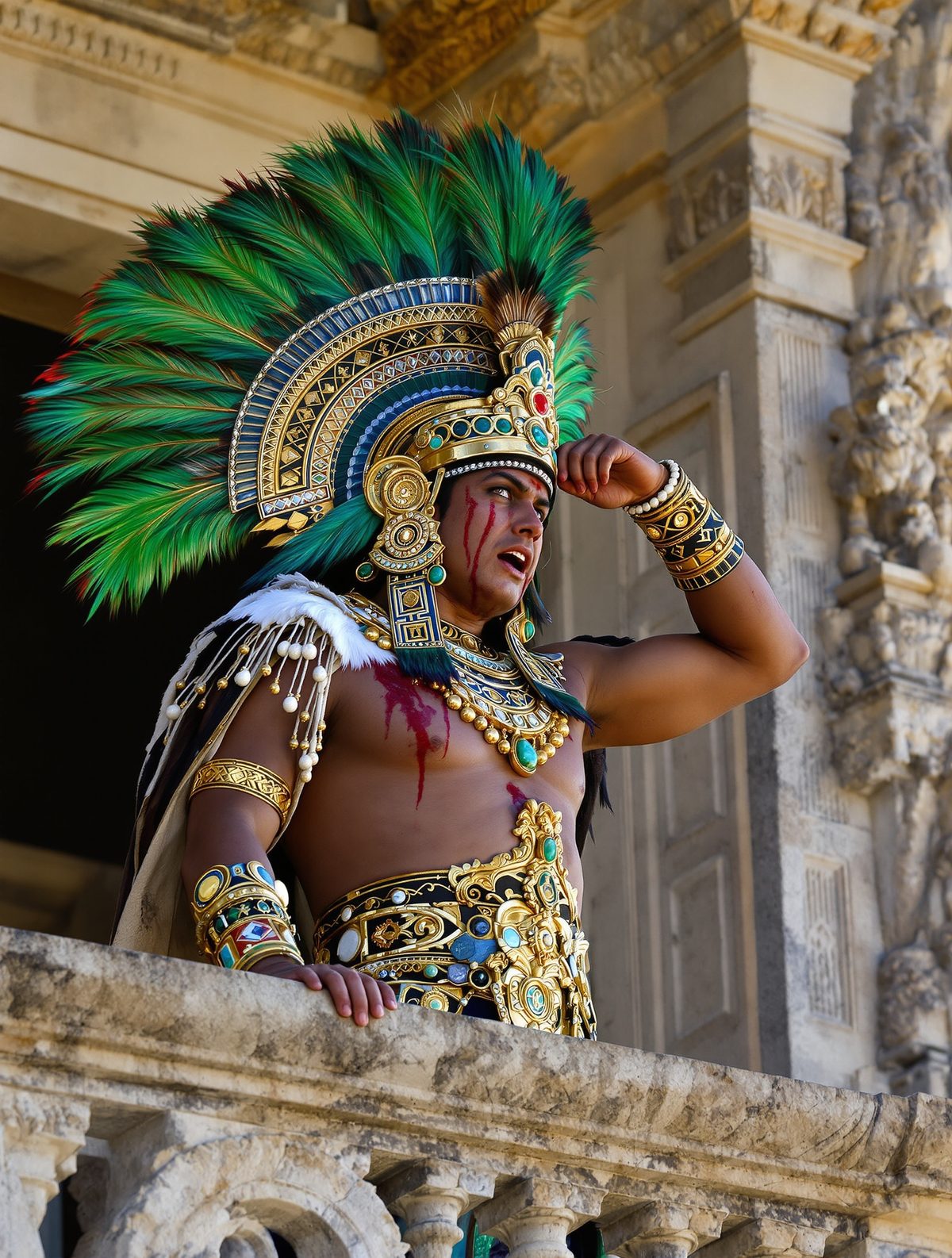
The obsidian blade caught the morning light as it rose above the captive's chest. Thousands of spectators packed the temple steps, their voices rising in anticipation. But in the city-state of Texcoco, just across Lake Texcoco from the Aztec capital of Tenochtitlan, a different scene was unfolding. There, a tall, contemplative ruler named Nezahualcoyotl was doing something unprecedented in 15th-century Mesoamerica: he was outlawing human sacrifice entirely, declaring that the gods required no blood to sustain the universe.
While his Aztec neighbors sacrificed an estimated 20,000 people annually to feed their hungry deities, this poet-philosopher-king was revolutionizing religion, law, and culture in ways that would make him one of the most remarkable rulers in human history—and one of the least known outside of Mexico.
The Making of a Revolutionary King
Nezahualcoyotl's path to power began with tragedy. Born around 1402, he was just 16 when his father, Ixtlilxochitl I, was murdered by Tezozomoc, the ruthless ruler of Azcapotzalco. The young prince spent the next decade in exile, dodging assassination attempts and building alliances. He allegedly once hid in a tree for hours while enemy soldiers searched for him below, and another time escaped disguised as a merchant carrying turkeys to market.
But this decade of hardship forged something extraordinary. Unlike many rulers who inherited power, Nezahualcoyotl had time to observe, think, and plan. He studied the great civilizations that had come before—the Toltecs, the builders of Teotihuacan—and began developing ideas that would reshape Mesoamerican civilization.
In 1429, at age 27, he finally reclaimed his throne with Aztec help, becoming tlatoani (ruler) of Texcoco. What happened next defied every expectation of how a 15th-century Mesoamerican king should behave.
The God Who Needed No Blood
Perhaps the most shocking aspect of Nezahualcoyotl's reign was his religious revolution. In a world where gods demanded constant feeding through human hearts and blood, he proclaimed belief in a single, invisible creator he called Tloque Nahuaque—"Lord of the Close and Near" or "He Who Contains All."
This wasn't just philosophical speculation. Nezahualcoyotl built temples unlike any others in Mesoamerica. The most famous was a nine-story pyramid in Texcoco with no idols, no images, no statues—just an empty sanctuary painted black and studded with stars to represent the infinite cosmos. Spanish chronicler Fernando de Alva Ixtlilxochitl later wrote that this temple "had no idol in it, but only a room whose walls and roof were black, and they said that there was the god of gods."
The king's religious reforms went far beyond architecture. He established a complex theological system that recognized multiple levels of divine reality, with his invisible creator at the top, followed by traditional gods who governed natural forces, and finally local deities. But crucially, he declared that none of these gods required human sacrifice. Flowers, incense, and prayers were sufficient offerings.
This wasn't merely humanitarian—it was revolutionary cosmology. While the Aztecs believed the universe was fundamentally unstable and required constant blood offerings to prevent cosmic collapse, Nezahualcoyotl taught that the true god was self-sufficient and benevolent.
The Athens of Ancient Mexico
Nezahualcoyotl transformed Texcoco into what many historians call the "Athens of ancient Mexico." The city became a magnet for artists, poets, philosophers, astronomers, and engineers from across Mesoamerica. The king himself was a prolific poet—over 60 of his compositions survive today, making him one of the few pre-Columbian rulers whose personal thoughts we can still read.
His verses reveal a philosophical mind grappling with mortality and meaning:
"Nothing is eternal in this world. Even gold, even jade breaks apart. Even the quetzal feathers fade. Nothing is eternal in this world."
The king established schools, libraries, and workshops. He created a legal code with 80 laws covering everything from adultery to public drunkenness. Remarkably, many of these laws were more progressive than European standards of the time. For instance, slavery was strictly regulated, and slaves could purchase their freedom or be freed for good service.
But perhaps his most impressive achievement was transforming the physical landscape. Nezahualcoyotl was history's greatest hydraulic engineer before the modern era. He constructed a massive dike across Lake Texcoco to prevent flooding of the Aztec capital, built elaborate aqueduct systems, and created terraced gardens that impressed even the Spanish conquistadors decades later.
The Philosopher King's Dilemma
Nezahualcoyotl's reforms created a fascinating paradox. As a member of the Triple Alliance with the Aztec Empire and Tlacopan, he was technically allied with the most blood-thirsty regime in Mesoamerican history. The Aztecs were simultaneously his closest political partners and his philosophical opposites.
Historical records suggest he navigated this tension carefully. He participated in military campaigns alongside his Aztec allies but insisted that captives taken by Texcoco forces would not be sacrificed. When attending ceremonies in Tenochtitlan, he reportedly found ways to absent himself during the bloodiest rituals.
This delicate balance lasted throughout his 43-year reign. The Aztecs seemed to tolerate his religious eccentricities, perhaps because Texcoco's military support and engineering expertise were too valuable to lose. Or perhaps they recognized that forcing conformity might spark a civil war that would benefit their mutual enemies.
Nezahualcoyotl also faced resistance within his own kingdom. Traditional priests saw their power and prestige diminished by religious reforms that eliminated human sacrifice. Some nobles probably viewed the king's philosophical interests as weakness. But his combination of military success, economic prosperity, and cultural achievement gave him the political capital to sustain his revolution.
The Gardens of Paradise
Nothing captured Nezahualcoyotl's unique vision better than his botanical gardens at Texcotzingo. Carved into a mountainside east of the capital, these terraced gardens combined practical agriculture with aesthetic beauty in ways that amazed Spanish chroniclers.
The complex featured over 300 species of plants from across Mexico, watered by an ingenious system of canals, fountains, and pools. There were medicinal herb gardens tended by royal physicians, experimental agricultural plots testing new crop varieties, and ornamental areas where the king composed poetry while surrounded by hummingbirds and butterflies.
But Texcotzingo wasn't just beautiful—it was a statement of philosophical principle. While Aztec gardens typically featured plants associated with war and sacrifice (like the red flowers used to represent blood), Nezahualcoyotl's gardens celebrated life, growth, and natural beauty as expressions of divine creativity.
The gardens included carved stone poems, astronomical observation platforms, and meditation spaces. One surviving poem carved into the rock translates roughly as: "Truly do I say that this house which I have built will endure forever, and these groves I have planted will grow forever, in memory and in sign of my name and of my posterity."
Legacy of the Poet King
Nezahualcoyotl died in 1472, just 49 years before Spanish conquistadors would arrive to destroy the world he had helped create. His son, Nezahualpilli, continued many of his father's policies, but the unique cultural flowering of Texcoco gradually faded under pressure from increasingly militant Aztec neighbors.
When Hernán Cortés arrived in 1519, he found a civilization already divided against itself. The Aztecs' demands for sacrificial victims had created enemies throughout central Mexico—enemies who would eagerly ally with Spanish invaders against Tenochtitlan. One wonders whether Nezahualcoyotl's more humane approach might have created a more unified resistance to European conquest.
Today, Nezahualcoyotl's story challenges everything most people think they know about pre-Columbian Mexico. He proves that the complex civilizations of ancient America were not monolithic cultures locked into unchanging traditions, but dynamic societies capable of profound philosophical and social evolution.
His vision of religious tolerance, scientific inquiry, and humane governance offers a glimpse of what might have been—a Native American civilization that achieved the cultural sophistication of Renaissance Europe while maintaining its own unique character. In our own age of religious conflict and environmental crisis, the poet-king who worshipped an invisible god while tending his mountain gardens seems remarkably modern.
Perhaps most remarkably, Nezahualcoyotl accomplished his revolution without violence, proving that even the most entrenched cultural practices can be transformed through the power of ideas, example, and patient leadership. His empty temple still stands in the Mexican imagination as a monument to the possibility that human beings can choose wisdom over tradition, compassion over custom, and hope over fear.