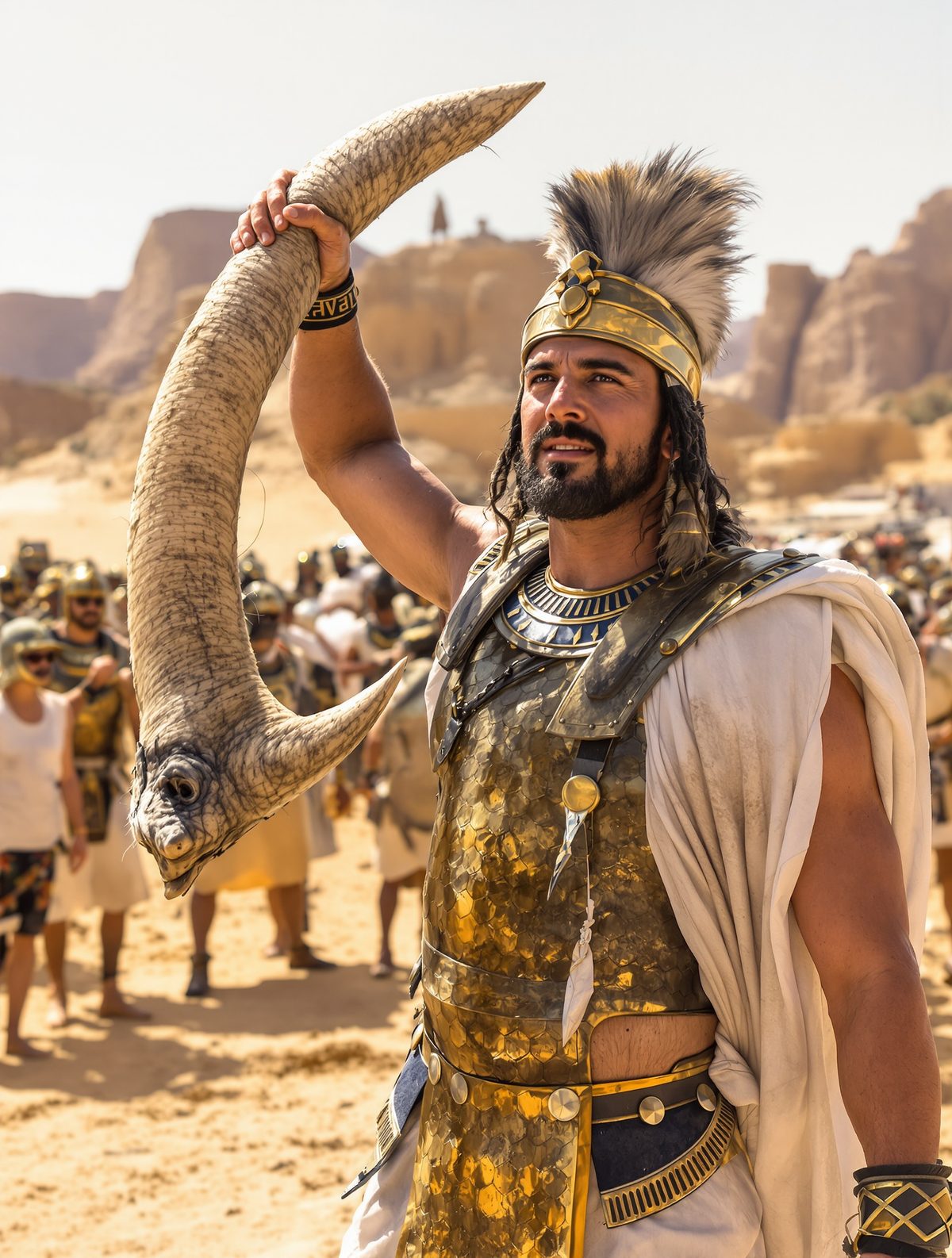
Picture this: You're the absolute ruler of the most powerful empire on Earth. Your capital city, Babylon, boasts walls so thick that two chariots can race side by side along their tops. The Hanging Gardens—one of the Seven Wonders of the World—cascade through your royal courtyards. You command armies that stretch from the Persian Gulf to the Mediterranean Sea. What do you do with all this power?
If you're Nabonidus, the last king of Babylon, you pack a bag and disappear into the Arabian desert for ten years to dig up old ruins. While your empire slowly crumbles, you're out there with a brush and trowel, carefully excavating temples that were already ancient when your grandfather was born.
This isn't fiction. This actually happened. And it might be history's most expensive midlife crisis.
The King Who Preferred Artifacts to Armies
When Nabonidus seized the Babylonian throne in 556 BC, nobody expected him to become history's first royal archaeologist. Born into nobility but not royal blood, he had clawed his way to power through political maneuvering and married into the right family. At first, he seemed like any other ancient Near Eastern despot—building projects, military campaigns, the usual kingly pursuits.
But Nabonidus harbored a secret obsession that would have seemed bizarre to his subjects: he was utterly fascinated by the past. Not just any past, but the deep past. While most kings focused on conquering new territories, Nabonidus spent his time poring over ancient inscriptions and studying crumbling ziggurats that were already relics when Hammurabi ruled.
The first signs of his unusual interests appeared early in his reign. Royal inscriptions from this period show Nabonidus boasting not about military victories, but about discovering foundation stones laid by kings who had ruled a thousand years before him. He wrote with genuine excitement about finding a foundation cylinder of Naram-Sin, buried for 3,200 years. Imagine a modern president abandoning state dinners to personally excavate colonial-era artifacts with the same enthusiasm.
The Great Abandonment: When a King Became a Digger
In 553 BC, Nabonidus made a decision that shocked the ancient world. He appointed his son Belshazzar as regent of Babylon, packed up his archaeological tools, and headed south into the Arabian desert to the oasis city of Tayma (in modern-day Saudi Arabia). His stated reason? He wanted to restore ancient temples and uncover the religious practices of civilizations that had vanished before Babylon even existed.
This wasn't a short research trip. Nabonidus stayed in Tayma for ten years, from 553 to 543 BC. Ten years! While Persian armies massed on his borders and his own capital seethed with discontent, the king of Babylon was living in a desert oasis, meticulously excavating ancient Mesopotamian temples and documenting artifacts with the precision of a modern archaeologist.
His methods were surprisingly sophisticated for the 6th century BC. Nabonidus carefully recorded the locations of his finds, copied ancient inscriptions verbatim, and even attempted to date artifacts by comparing architectural styles. He established what might be the world's first museum in a corner of his palace, displaying ancient statues and foundation stones arranged by historical period. His collection included artifacts spanning over a millennium of history.
The Mad King's Divine Obsession
But there was more to Nabonidus's archaeological passion than mere antiquarian interest. He believed the ancient artifacts held divine messages—clues to proper religious practices that had been forgotten over the centuries. His particular obsession was with Sin, the moon god, whom he considered superior to Marduk, Babylon's chief deity.
This religious fixation proved politically catastrophic. Babylon's powerful priestly class, who controlled vast temple complexes and wielded enormous influence, were horrified by their king's heretical preferences. The priests of Marduk watched in growing fury as Nabonidus lavished attention on restored shrines to Sin while neglecting Babylon's traditional religious ceremonies.
The breaking point came when Nabonidus repeatedly failed to appear for the annual New Year festival in Babylon—a ceremony where the king's presence was considered essential for the prosperity of the empire. For ten consecutive years, the most important religious celebration in Babylon proceeded without its king, who was hundreds of miles away brushing dust off ancient pottery shards.
Contemporary inscriptions reveal the priests' outrage. They accused Nabonidus of madness, claiming he had been struck by divine punishment for his neglect of proper religious duties. One priestly text describes him as "the king who does not fear the lord of lords," while another calls his archaeological activities "works of deceit."
While the King Played in the Sand, an Empire Crumbled
As Nabonidus pursued his archaeological passion project, the geopolitical situation around Babylon deteriorated rapidly. Cyrus the Great of Persia was systematically conquering territory after territory, building what would become the largest empire the world had yet seen. The Lydians fell to Cyrus in 546 BC. The Greek cities of Asia Minor submitted one by one. The Persian war machine was clearly targeting Babylon next.
Any competent ruler would have returned to organize defenses, rally allies, or negotiate treaties. Nabonidus remained in Tayma, absorbed in his excavations. His son Belshazzar, ruling as regent, lacked both the authority and experience to handle the mounting crisis. Military commanders received contradictory orders. Provincial governors switched their loyalty to whoever seemed likely to win. The administration of the empire descended into chaos.
The situation became so desperate that Babylon's own citizens began to view Persian conquest as preferable to continued rule by their absent, archaeology-obsessed king. Cyrus, a skilled propagandist, encouraged this sentiment by portraying himself as a restorer of proper religious practices—a direct attack on Nabonidus's theological innovations.
The King Who Dug His Own Empire's Grave
When Nabonidus finally returned to Babylon in 543 BC, it was too late. His decade-long absence had alienated virtually every powerful group in his empire: the priests hated his religious reforms, the military despised his negligence of defense, and ordinary citizens blamed him for the economic disruption caused by his mismanagement.
The end came with shocking swiftness. In 539 BC, Cyrus's armies approached Babylon's seemingly impregnable walls. But there was no siege. The city's gates opened from within. Priests, merchants, and nobles welcomed the Persian conqueror as a liberator. Contemporary sources suggest that some of Babylon's own commanders actually guided Cyrus's forces through the city's defenses.
Nabonidus was captured without a fight. In one of history's great ironies, the man who had spent ten years studying the rise and fall of ancient civilizations had orchestrated the fall of his own. Cyrus, showing unusual mercy, allowed the deposed king to live out his remaining years as a provincial administrator in the Persian Empire—far from any ancient ruins he might be tempted to excavate.
The Archaeological Legacy of a Failed King
Despite his political failures, Nabonidus's contributions to archaeology were genuinely groundbreaking. His careful documentation of ancient inscriptions preserved historical records that would otherwise have been lost forever. Modern archaeologists working in Iraq and Saudi Arabia still reference his meticulous copies of Akkadian texts. His systematic approach to excavation—recording findspots, comparing architectural styles, and attempting chronological dating—wouldn't look out of place in a modern archaeological report.
More surprisingly, some of his historical conclusions were remarkably accurate. His dating of certain Mesopotamian rulers, based purely on architectural and textual evidence, has been confirmed by modern scholarship. His identification of forgotten deities and religious practices filled crucial gaps in our understanding of ancient Near Eastern religion.
But perhaps most remarkably, Nabonidus understood something that many of his contemporaries missed: the past held lessons for the present. His obsessive study of how previous empires had risen and fallen reflected a sophisticated understanding of historical patterns. The tragic irony is that his insights into the collapse of ancient civilizations perfectly predicted the collapse of his own—caused by his very obsession with studying that collapse.
Why the World's First Royal Archaeologist Still Matters
Nabonidus's story resonates today in ways that might make us uncomfortable. We live in an era when leaders routinely prioritize personal obsessions over public responsibilities, when expertise is dismissed in favor of ideology, and when long-term institutional stability is sacrificed for short-term individual gratification. The image of a ruler abandoning his duties to pursue a passion project while his empire burns feels distinctly contemporary.
But there's another lesson here about the tension between intellectual curiosity and practical responsibility. Nabonidus wasn't evil or stupid—he was genuinely brilliant, with insights that advanced human knowledge. His archaeological work had lasting value. Yet his single-minded pursuit of that work destroyed everything he was supposed to protect.
Perhaps the real tragedy of Nabonidus isn't that he was a bad king who happened to like archaeology. It's that he was a great archaeologist who happened to be king at exactly the wrong moment in history. In any other era, his intellectual achievements might have been celebrated. Instead, he became history's cautionary tale about the price of abandoning responsibility for obsession—even noble obsession.
The next time you read about a leader whose personal interests seem to eclipse their public duties, remember Nabonidus, alone in the desert, carefully brushing sand away from artifacts of civilizations that, like his own, had fallen because their leaders lost sight of what really mattered.