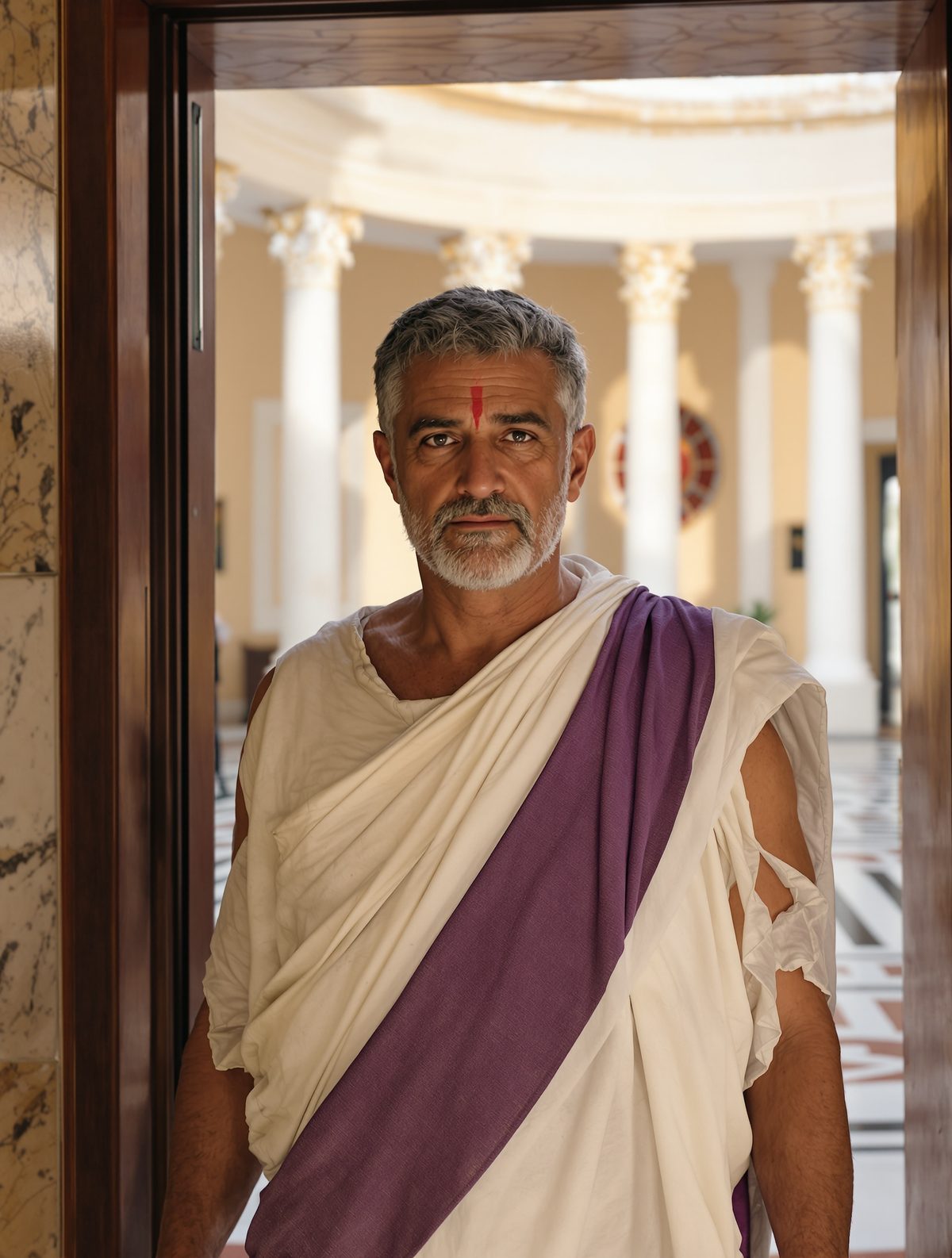
Picture this: a man in flowing robes stands at the rim of Mount Etna, Sicily's towering volcano, as molten lava bubbles and hisses below. The year is around 444 BC, and this isn't just any man—it's Empedocles of Acragas, one of ancient Greece's most brilliant philosophers. He's convinced his followers he's immortal, a god among mortals. Now, to prove it once and for all, he's about to make the ultimate leap of faith. Literally.
What happened next would become one of history's most spectacular backfires—and give us a story so outrageous that even the ancient Greeks couldn't decide if it was true or just the perfect metaphor for human hubris.
The Making of a Renaissance Man (Before the Renaissance)
Empedocles wasn't your typical philosopher wandering around in sandals pontificating about the meaning of life. Born around 494 BC in Acragas (modern-day Agrigento) on Sicily's southern coast, he was what we'd call today a true polymath—part scientist, part mystic, part politician, and full-time showman.
This was a man who claimed to have invented the four classical elements that would dominate Western thought for over two millennia: earth, air, fire, and water. He correctly theorized that light travels at a finite speed—a concept that wouldn't be proven until the 17th century. He understood that solar eclipses were caused by the moon blocking the sun, and he even grasped the basic principles of evolution, suggesting that creatures with beneficial traits survived while others perished.
But Empedocles wasn't content with mere scientific fame. In the competitive world of ancient Greek intellectuals, where philosophers were rock stars and crowds gathered to hear their latest theories, he needed a brand. And what a brand he created.
He dressed in purple robes—a color so expensive it was reserved for royalty—and wore bronze sandals that caught the light as he walked. A golden belt cinched his waist, and he crowned himself with a Delphic laurel wreath typically reserved for victorious athletes and poets. When he entered a room, conversations stopped. This wasn't just confidence; this was a man who had convinced himself he was divine.
The Miracle Worker of Ancient Sicily
By the 450s BC, Empedocles had moved beyond philosophy into what could only be called performance art—if performance art involved claiming to raise the dead and control the weather.
According to contemporary accounts, he arrived in the city of Selinus during a plague and allegedly ended the epidemic by engineering better drainage for the city's sewers and redirecting two rivers to flush out the stagnant water that bred disease. Perfectly logical by today's standards, but to the ancient Sicilians watching their friends and family suddenly stop dying, it looked like divine intervention.
Word spread quickly across Sicily. Here was a man who could cure the incurable, who understood the secrets of life and death. When a woman named Pantheia fell into a death-like coma in the city of Acragas, local doctors declared her dead. Empedocles disagreed. He kept her body from burial and, after thirty days, she reportedly awakened. Whether this was an early understanding of catalepsy or simply excellent timing, the people of Sicily were convinced they were witnessing resurrections.
The philosopher began styling himself as a daimon—not a demon in the Christian sense, but a divine being who had once lived among the gods before being banished to Earth for some cosmic transgression. He claimed he could remember his past lives: once a boy, once a girl, once a bush, once a bird, once "a mute fish in the sea."
The God Complex Takes Root
Success, as they say, went to his head—though in Empedocles' case, his head was already pretty full of itself.
By 445 BC, he was openly proclaiming his divinity. "I go among you all as an immortal god, mortal no more," he declared to crowds in the agora. This wasn't metaphorical speaking; Empedocles genuinely believed he had transcended human limitations. His followers, dazzled by his apparent miracles and undeniably brilliant scientific insights, were happy to play along.
But there was a problem with claiming to be an immortal god in ancient Greece: eventually, someone was going to ask for proof. The Greeks had seen enough false prophets and wannabe deities to develop a healthy skepticism. They wanted demonstrations, not just declarations.
Empedocles found himself in a philosophical corner. How do you prove you're immortal without dying? How do you demonstrate godhood to mortals who are increasingly demanding evidence? The pressure was mounting, and whispers of doubt were beginning to circulate among his followers.
It was then that Empedocles conceived what he believed would be his masterstroke—a plan so audacious that it would cement his divine reputation for all eternity. He would throw himself into Mount Etna, survive the unsurvivable, and emerge triumphant to the gasps and worship of all Sicily.
The Fatal Miscalculation
Mount Etna in the 5th century BC was exactly what you'd expect from Europe's most active volcano: a 10,900-foot monster of fire and brimstone that the locals believed was the forge of Hephaestus, god of metalworking. The Greeks thought the Cyclopes worked their anvils beneath its slopes, and that the giant Typhon was buried underneath, his breathing causing the mountain's eruptions.
It was, in other words, the perfect stage for a divine demonstration.
According to the account passed down by later historians, including Diogenes Laërtius, Empedocles made his way to Etna's crater sometime around 444 BC. The exact details of what happened next vary depending on who's telling the story, but the outcome was consistent across all versions: Empedocles jumped, expecting his divine nature to protect him from the molten rock below.
The volcano had other plans.
Instead of emerging triumphant, Empedocles simply... didn't emerge at all. His followers waited. And waited. Hours passed, then days. Where was their immortal master? Where was the dramatic reappearance that would silence all doubters?
Then Mount Etna erupted.
When Volcanoes Have the Last Laugh
What happened next became the stuff of ancient legend—and ancient comedy. According to multiple sources, including the poet Horace, the eruption that followed Empedocles' leap literally spat out evidence of his mortality.
One of his distinctive bronze sandals—the same expensive, gleaming footwear that had been part of his divine costume for years—came flying out of the crater, landing at the feet of the very people who had gathered to witness his triumphant return. If the gods were trying to send a message, it couldn't have been clearer: "Here's your immortal philosopher. Well, what's left of him."
The irony was exquisite and immediate. The man who had claimed to transcend death had been undone by the very forces of nature he claimed to understand and control. The volcano had provided the ultimate peer review of his divine thesis, and the results were not favorable.
News of the bronze sandal spread across the Greek world faster than wildfire. Empedocles had wanted to be remembered as a god; instead, he became history's most spectacular example of terminal overconfidence. The playwright Aristophanes later mocked him in comedies, and even centuries later, Roman poets were still chuckling about the philosopher who tried to convince a volcano he was immortal.
The Eternal Question Mark
But here's where the story gets interesting: we don't actually know if any of this happened.
Some ancient historians, including Aristotle's student Eudemus, claimed Empedocles died peacefully in his bed in the Peloponnese, far from any volcanic activity. Others suggested he disappeared mysteriously, perhaps fleeing Sicily after political troubles. The volcano story might be entirely apocryphal—a tale too perfect to be true, crafted by later generations to make a point about the dangers of intellectual pride.
What we do know is that Empedocles was real, his scientific contributions were genuine, and his claims of divinity were well-documented by contemporary sources. Whether he actually jumped into Etna or whether the story was invented as the perfect metaphor for his hubris, it captured something essential about the man and his times.
The ancient Greeks lived in a world where the line between the natural and supernatural was constantly blurred, where brilliant men could make genuine scientific discoveries and still believe they were gods. Empedocles embodied both the potential and the peril of human ambition—the same intellectual confidence that led him to groundbreaking insights about the natural world also convinced him he could transcend natural law entirely.
Whether he died in Mount Etna or lived quietly elsewhere, Empedocles achieved a kind of immortality after all. Not the divine transcendence he sought, but something perhaps more valuable: he became an eternal reminder that brilliance and hubris often walk hand in hand, and that the universe has a way of humbling those who mistake knowledge for omnipotence. In an age when we're constantly promised that technology and human ingenuity can solve any problem, the story of the philosopher and the volcano feels surprisingly contemporary. Some forces, it turns out, are bigger than our ambitions—and they have bronze sandals to prove it.