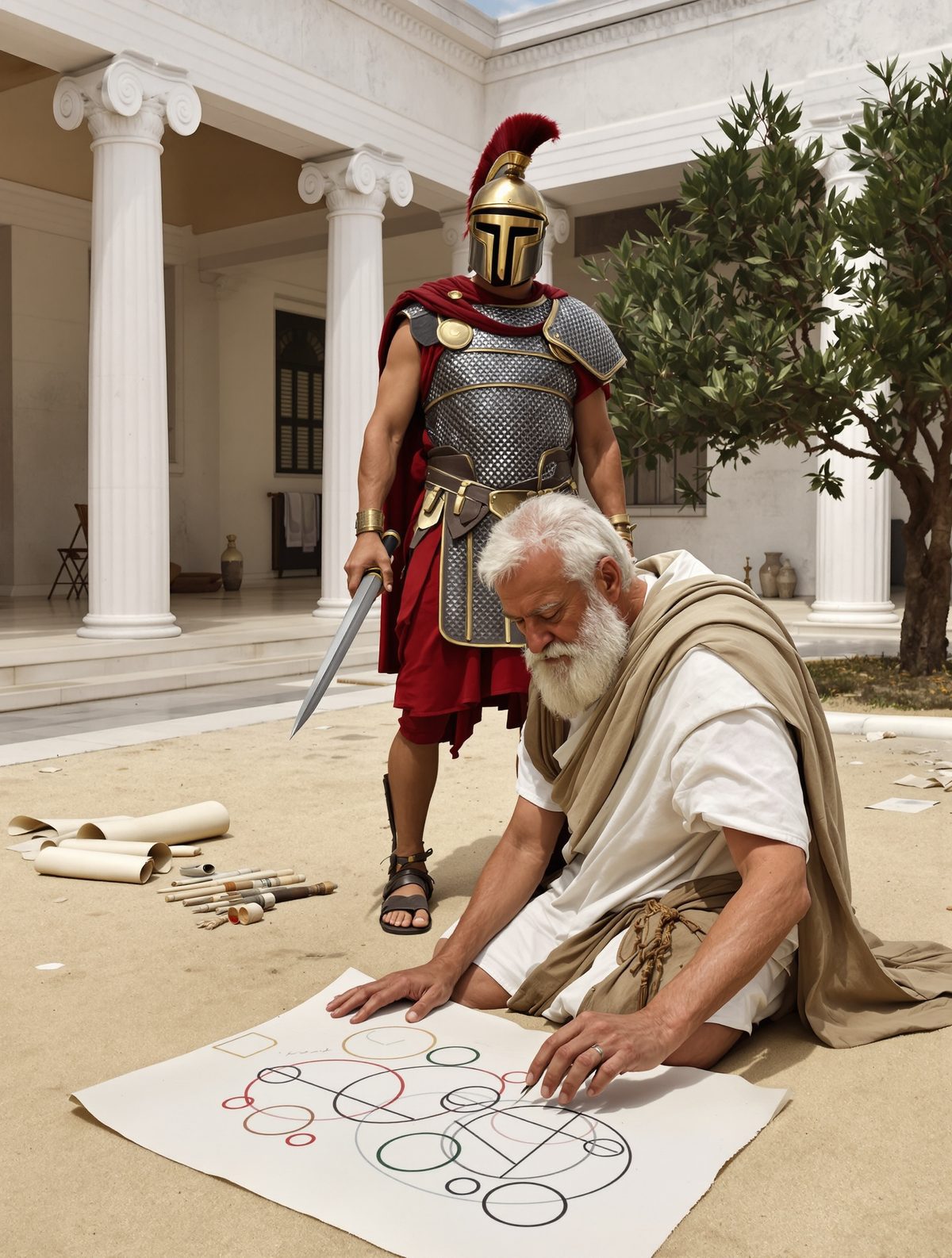
The smell of smoke drifts through the narrow streets of the Subura, Rome's crowded slum district. Wooden tenements, stacked six stories high and packed with the city's poor, creak ominously in the Mediterranean heat. Suddenly, orange flames burst from a third-floor window. Within minutes, the fire spreads like a hungry beast, devouring everything in its path. Panicked residents flee into the streets, clutching whatever possessions they can carry, their screams echoing off the stone walls.
Then, like a savior from the gods themselves, Marcus Licinius Crassus arrives. Behind him march 500 expertly trained slaves, carrying buckets, hooks, and demolition tools. The crowd surges forward, desperate for salvation. But Crassus doesn't move. Instead, he calmly approaches the property owner, whose life's work is literally going up in smoke, and makes an offer. Not to help—but to buy. And until that sale is complete, his firefighters will stand idle, watching Rome burn.
This wasn't just opportunism. This was the most ingenious protection racket in ancient history, orchestrated by a man who would become Rome's richest citizen and reshape the very foundations of the Republic.
The Man Who Owned Rome's Salvation
Marcus Licinius Crassus understood something about 1st century BCE Rome that others missed: the city was a tinderbox waiting to explode. With over one million inhabitants crammed into a space roughly the size of modern-day Manhattan, Rome was the largest city in the ancient world. Wooden apartment buildings called insulae towered precariously over winding streets, their upper floors rented to Rome's working poor. Cooking fires burned constantly, oil lamps flickered through the night, and furnaces blazed in countless workshops. Yet Rome had no public fire department.
While the city's elite lived in sprawling villas with private courtyards that acted as natural firebreaks, ordinary Romans were packed into death traps. A single dropped lamp or overturned brazier could consume an entire city block within hours. The Roman historian Pliny would later write that fires in Rome were so common that "one could almost set one's calendar by them."
Crassus saw opportunity where others saw disaster. Born around 115 BCE into a wealthy plebeian family, he had already proven his ruthlessness during the bloody proscriptions of Sulla in the 80s BCE, when he acquired vast estates from executed political enemies at rock-bottom prices. But property speculation was just the beginning. Around 60 BCE, Crassus established Rome's first organized fire brigade—not as a public service, but as a private business venture that would make him legendary.
The Art of the Disaster Deal
Crassus's fire brigade wasn't just a collection of helpful slaves with buckets. It was a sophisticated operation that combined military precision with cutthroat business acumen. His 500 firefighting slaves were organized into specialized units: some carried water and sand, others wielded demolition tools to create firebreaks, and still others were trained in the delicate art of removing valuables from burning buildings. They could respond to fires faster than any improvised neighborhood effort, and they knew exactly what they were doing when they arrived.
But here's where Crassus's genius turned sinister. When his brigade reached a fire, they wouldn't lift a finger until the property owner agreed to sell—at whatever price Crassus deemed fair. With flames roaring and neighbors screaming, property owners faced an impossible choice: lose everything to the fire, or sell to Crassus for a fraction of the property's value and at least salvage something from the disaster.
The Roman writer Plutarch, writing decades later, described the scene with barely concealed admiration for Crassus's audacity: "He would offer to buy houses that were on fire and those adjoining them at a very low price, and when the owners, in their fear and uncertainty, would accept his terms, he would then put out the fire with his numerous workers and make the houses inhabitable again."
Once Crassus owned the properties, his slaves would spring into action, often saving not just the building he'd purchased but the surrounding structures as well. He'd then rebuild, renovate, and rent out the properties at enormous profit. Some estimates suggest that at his peak, Crassus owned over 7,000 properties in Rome alone.
Building an Empire on Ashes
The scale of Crassus's wealth was staggering even by today's standards. By 55 BCE, his fortune was estimated at 200 million sestertii—equivalent to roughly $2 billion in modern currency. To put this in perspective, a Roman legionnaire earned about 900 sestertii per year, meaning Crassus's wealth equaled the combined annual salaries of more than 220,000 soldiers.
But Crassus's fire brigade was just one tentacle of a vast economic empire. He owned silver mines in Spain, vast agricultural estates across Italy, and even operated what might be considered Rome's first real estate development company. When he acquired fire-damaged properties, he didn't just rebuild them—he improved them. His architects pioneered new construction techniques using brick and concrete that made buildings more fire-resistant, ironic given how he'd acquired them in the first place.
The man himself was a study in contradictions. Contemporary accounts describe him as personally modest, even frugal in his habits. He wore simple togas, ate common food, and was known for his phenomenal memory—he reportedly could recall the names of every Roman citizen. Yet this same man would watch buildings burn while calculating profit margins, and once famously declared that "no man should be called rich who cannot maintain an army on his income."
Crassus also understood that in Rome, wealth without political power was meaningless. He used his fortune to fund gladiator schools (including the one that produced Spartacus), finance political campaigns, and provide loans to ambitious young politicians who couldn't afford their own. Among his debtors was a rising star named Gaius Julius Caesar, who owed Crassus so much money that the older man essentially bankrolled Caesar's early political career.
When Firefighting Became Politics
Crassus's monopoly on fire services gave him power that extended far beyond mere wealth. Property owners throughout Rome knew that their fate in case of fire rested entirely in his hands. This created a network of obligation and dependence that reached into every corner of Roman society. Shopkeepers, landlords, and even senators found themselves beholden to the man who controlled the difference between salvation and ruin.
The political implications were enormous. In a society where prestige was measured by one's ability to provide public services and spectacles, Crassus had cornered the market on one of Rome's most essential needs. He regularly leveraged this position, offering favorable firefighting services to political allies while letting the properties of enemies burn to the ground.
Perhaps most remarkably, his fire protection racket operated entirely within Roman law. There were no statutes requiring assistance to fire victims, no regulations governing emergency services, and no legal obligation to sell fire protection at fair prices. Crassus had identified a gap in Rome's social contract and filled it with ruthless efficiency.
This legal immunity allowed him to expand his operation with impunity. By the 50s BCE, his organization had grown to include not just firefighters, but also property assessors who could quickly evaluate buildings during emergencies, architects who specialized in rapid reconstruction, and even what we might today call insurance adjusters who helped determine compensation for fire damage—all, naturally, working for Crassus's benefit.
The Burning Ambition That Consumed a Fortune
For all his cunning in business, Crassus harbored one fatal weakness: military glory. While his partners in the First Triumvirate—Pompey and Caesar—had won fame on distant battlefields, Crassus remained known primarily as Rome's banker. The man who had helped crush Spartacus's slave rebellion craved the kind of triumph that only military conquest could provide.
In 55 BCE, now in his sixties, Crassus used his vast wealth to secure appointment as governor of Syria, seeing it as his gateway to military immortality. His plan was audacious: invade Parthia (modern-day Iran), Rome's greatest rival, and claim the kind of eastern riches that had made Pompey famous. He funded the entire expedition from his personal fortune, equipping seven legions and auxiliary troops at a cost that would have bankrupted most nations.
The campaign was a disaster of epic proportions. At the Battle of Carrhae in 53 BCE, Crassus's forces were annihilated by Parthian horse archers using tactics the Romans had never encountered. Of the approximately 40,000 Romans who crossed into Parthia, only about 10,000 survived to return home. Crassus himself was killed during post-battle negotiations, reportedly when the Parthians poured molten gold down his throat—a fitting end, they believed, for Rome's greediest man.
With Crassus's death, his carefully constructed business empire began to crumble. His heirs lacked both his ruthless vision and his intricate knowledge of Rome's property markets. Within a generation, most of his holdings had been sold or lost to other investors.
The Flame That Never Dies
Crassus's legacy extends far beyond his personal fortune or even his role in the fall of the Roman Republic. He pioneered what we might today recognize as disaster capitalism—the practice of profiting from emergencies and human suffering. His fire brigade represented perhaps history's first example of the privatization of essential public services, complete with all the moral hazards that such arrangements entail.
The echoes of Crassus's model resonate uncomfortably in our modern world. From private ambulance services that check insurance before providing care, to companies that profit from natural disasters by buying damaged properties at below-market prices, the ghost of Crassus haunts contemporary debates about the role of profit in essential services. Even today's private firefighting services, employed by wealthy Californians during wildfire season while public resources are stretched thin, bear an uncomfortable resemblance to Crassus's ancient protection racket.
Perhaps most troubling is how Crassus's story reveals the fragility of social contracts we take for granted. In our world of public fire departments, emergency services, and disaster relief, it's easy to forget that these protections are relatively recent innovations. Crassus's Rome reminds us that without deliberate social organization and public oversight, even the most essential services can become tools of exploitation.
The next time you hear sirens rushing toward an emergency, remember Marcus Crassus—the man who proved that in the gap between human need and human greed, fortunes can be built on the ashes of other people's desperation. His fire brigade saved countless buildings and lives, but it also demonstrated how easily salvation can become extortion when society fails to protect its most vulnerable members. In the end, Crassus's greatest fire was his own ambition—and like so many blazes in ancient Rome, it consumed everything in its path.