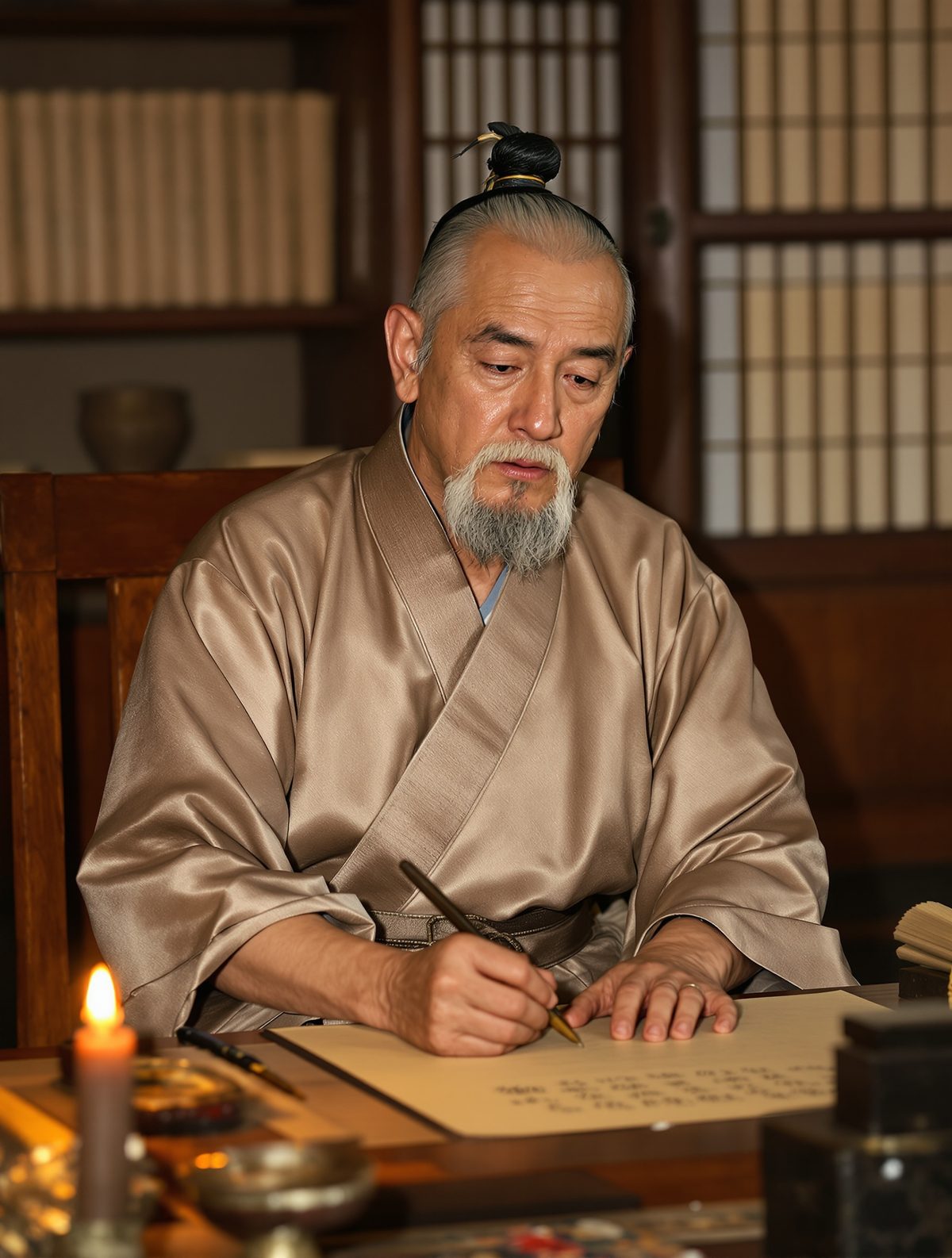
In the flickering light of an oil lamp, an 80-year-old Roman senator hunched over a scroll, his weathered fingers tracing unfamiliar Greek letters. The same hands that had once penned speeches denouncing Greek culture as poison to Roman virtue now struggled to decode the opening lines of Homer's Iliad. If his political enemies could see Marcus Porcius Cato now—the man who had spent decades as Rome's most vocal opponent of Greek influence—they would have thought the old warrior had finally lost his mind.
But this wasn't madness. It was perhaps the most human moment in the life of one of Rome's most stubborn figures. After eight decades of fierce resistance to everything Greek, Cato the Elder was secretly, desperately trying to learn what he had spent a lifetime rejecting. His servants would find him night after night, squinting at Greek texts by candlelight, racing against time and his own mortality to understand the very culture he had publicly branded as Rome's greatest threat.
The Making of a Cultural Warrior
Marcus Porcius Cato wasn't born into the Roman elite—he clawed his way there with the tenacity of a man who had everything to prove. Born around 234 BC in the small town of Tusculum, about 15 miles from Rome, Cato came from farming stock. His family raised him with the traditional Roman values of discipline, frugality, and suspicion of foreign influence. These weren't just abstract principles—they were survival skills for a people who had spent centuries fighting off invasions and building an empire through sheer bloody-minded determination.
When Cato arrived in Rome as a young man, the city was drunk on victory and Greek culture. Rome had just defeated Hannibal and was expanding rapidly across the Mediterranean. Suddenly, Greek tutors, Greek philosophy, Greek art, and Greek ideas were flooding into Roman society. The wealthy were hiring Greek slaves to educate their children, adopting Greek customs, and even speaking Greek at dinner parties. To Cato, this wasn't sophistication—it was cultural suicide.
He built his political career on this fear. As censor in 184 BC, Cato wielded his power like a moral sledgehammer, investigating the private lives of citizens and punishing those who indulged in what he saw as Greek decadence. He expelled senators for kissing their wives in public (too Greek!), raised taxes on luxury goods, and tore down unauthorized buildings that smacked of foreign architectural influence. His colleagues nicknamed him "Cato the Censor," and not always affectionately.
The Crusader's Daily Ritual
For nearly forty years, Cato ended every speech in the Roman Senate the same way, regardless of the topic at hand. Whether discussing grain subsidies, military budgets, or municipal drainage, he would pause dramatically and declare: "Carthago delenda est"—Carthage must be destroyed. But his hatred of Carthage was nothing compared to his fear of Greece.
In his surviving writings, Cato warned that Greek culture would destroy Roman character from within. He called Greek philosophy "empty chatter" that made young Romans soft and indecisive. He banned Greek teachers from Rome multiple times, arguing that their schools were training grounds for moral corruption. When his son showed interest in Greek literature, Cato supposedly told him that reading Homer would make him unfit to be a Roman soldier.
Cato practiced what he preached with almost comical intensity. He refused to speak Greek even when visiting Greek cities as a Roman ambassador—forcing translators to relay his Latin speeches word by word to bemused Greek audiences. He wrote the first Roman history book in Latin specifically to give Romans an alternative to Greek historical texts. At home, he personally supervised his son's education, teaching him reading, writing, and combat skills rather than hiring Greek tutors like other wealthy Romans.
The Enemy's Seductive Power
But here's what Cato's biographers rarely emphasize: his anti-Greek crusade required him to know his enemy intimately. To effectively argue against Greek philosophy, he had to understand it. To critique Greek literature, he had to be familiar with its themes and techniques. To warn Romans about the dangers of Greek rhetoric, he had to recognize its persuasive power.
This created a fascinating psychological tension. Cato was clearly intelligent enough to see why Greek culture was so attractive to his contemporaries. Greek poetry was more sophisticated than early Roman verse. Greek philosophy offered complex frameworks for understanding ethics and politics. Greek art achieved levels of beauty that Roman craftsmen were still learning to match. The very effectiveness of Cato's opposition suggests he grasped exactly what he was fighting against.
Roman society was changing around him whether he liked it or not. By the 150s BC, educated Romans routinely spoke both languages. Greek slaves commanded premium prices as tutors and secretaries. Roman artists were adapting Greek techniques. Even Roman religion was absorbing Greek elements, with Roman gods taking on the characteristics and stories of their Greek counterparts. Cato was watching his worst nightmare unfold in real time.
The Secret Student's Midnight Studies
Then came the night that changed everything—or rather, the many nights that his household slaves began noticing their elderly master's strange new routine. According to Plutarch, who recorded this remarkable story decades later, Cato's servants started finding him in his study long after the rest of the household had gone to bed, bent over Greek texts with the concentrated focus of a much younger student.
Imagine the scene: Rome's most famous opponent of Greek culture, now in his eighties, squinting at Greek letters by the unsteady light of oil lamps. His fingers, gnarled from decades of farming and writing, slowly tracing the lines of Homer's epic poetry. The same man who had once declared that Romans who read Greek literature were betraying their ancestors was now struggling through the adventures of Achilles and Odysseus.
Why the sudden change of heart? Plutarch suggests that Cato finally realized he was running out of time. At 80, with death approaching, he was seized by an almost frantic curiosity about what he had spent his life rejecting. Was it possible that Greek culture contained wisdom worth preserving? Had he been wrong to dismiss an entire civilization's intellectual achievements? Or was he simply satisfying the suppressed curiosity of a brilliant mind that had always wondered what lay behind the enemy's attractive facade?
The Irony of a Lifetime's Work
The tragic irony is that Cato's late-night Greek studies came too late to change his legacy. He had already spent decades shaping Roman attitudes toward Greek culture, and his influence would outlast him by centuries. Roman writers would continue citing Cato's warnings about Greek "corruption" long after the old man died in 149 BC. His agricultural manual, De Agricultura, became a foundational text precisely because it represented "authentic" Roman values unspoiled by foreign influence.
But Cato's secret studies also reveal something profound about the nature of cultural exchange. Despite his public posturing, he couldn't entirely escape the gravitational pull of Greek intellectual achievement. Even Rome's greatest cultural warrior was ultimately drawn to the beauty and complexity of what he had spent his life opposing. His clandestine Greek lessons represent a kind of intellectual surrender—an admission that some things transcend political and cultural boundaries.
We don't know how far Cato progressed in his Greek studies before his death. Did he ever make it through Homer's epics? Did he try to read Greek philosophy or drama? Did he come to regret his lifelong opposition to Greek influence? The historical record is frustratingly silent on these questions, leaving us to imagine the internal struggle of a brilliant, stubborn old man confronting the limitations of his own convictions.
When Enemies Become Teachers
Cato's story resonates today because we live in our own age of cultural anxiety and intellectual walls. Like ancient Rome, we're constantly debating which foreign influences to embrace and which to resist. We build barriers against ideas we fear might corrupt our values, while simultaneously being drawn to the very things we claim to oppose.
Perhaps Cato's midnight Greek lessons offer a different model: the possibility that wisdom can come from unexpected sources, that our "enemies" might have something to teach us, and that intellectual curiosity doesn't have to die with age. His secret studies suggest that even the most committed cultural warriors occasionally wonder if they've been fighting the wrong battle.
In the end, Cato's legacy isn't just his fierce defense of Roman values—it's also his final, private acknowledgment that no culture has a monopoly on truth or beauty. Sometimes the most powerful lesson comes not from what we publicly defend, but from what we secretly seek to understand. At 80, with trembling hands and failing eyesight, Marcus Cato discovered that learning never ends—even when it means admitting that everything you've stood for might need reconsideration.