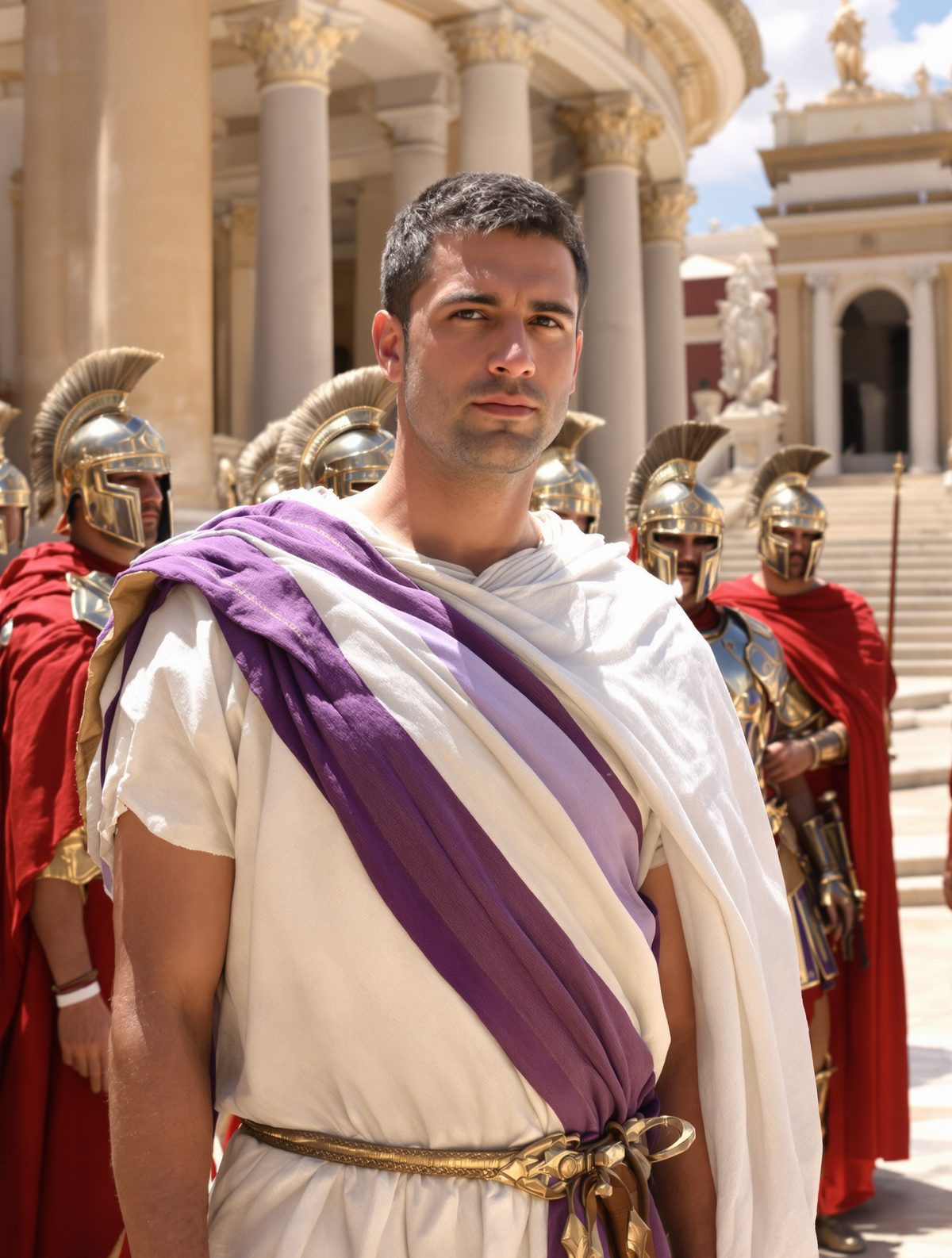
The marble floors of the Roman Senate house echoed with sandaled footsteps as Marcus Atilius Regulus walked toward his own death sentence. The year was 255 BC, and this weathered general had just returned from eighteen months of Carthaginian captivity with an offer that could save his life. All he had to do was convince Rome's senators to accept a prisoner exchange. Instead, he was about to deliver the most consequential speech of his career—one that would doom him to unimaginable torture while cementing his place in history as the embodiment of Roman virtue.
What happened next would become legend, a story so powerful it would be retold for centuries as the ultimate example of duty over self-preservation. But the true tale of Marcus Atilius Regulus is far stranger and more complex than the sanitized version taught to Roman schoolchildren.
The General Who Couldn't Win for Winning
Marcus Atilius Regulus should have been celebrating. In 256 BC, he had led one of Rome's most successful military expeditions, landing 15,000 Roman legionnaires on the shores of North Africa itself—the first time Roman boots had touched Carthaginian soil. His mission was audacious: strike at the heart of Carthage while their forces were distracted elsewhere, and end the grinding First Punic War that had already consumed a generation.
At first, everything went according to plan. Regulus's forces swept across the North African countryside like a Mediterranean wildfire, capturing over 20,000 Carthaginians and seizing 74 elephants—the ancient world's equivalent of capturing an enemy's tank division. Town after town surrendered, and Carthage itself seemed within reach. The Roman Senate, drunk on victory reports, made a fateful decision: they recalled most of Regulus's fleet, leaving him with a skeleton force of just 2,500 men to finish the job.
It was a catastrophic miscalculation. Carthage hadn't survived 500 years by rolling over at the first sign of trouble. They hired Xanthippus, a Spartan mercenary general whose tactical genius would soon turn Regulus's triumph into disaster. What the Romans didn't realize was that they had just handed their best general to their worst enemy.
When the Unstoppable Force Met the Immovable Object
The Battle of Tunis in 255 BC was a masterclass in how geography and tactics could trump Roman courage. Xanthippus chose his ground carefully—a vast plain where Carthage's 100 war elephants and superior cavalry could operate freely. The Romans, accustomed to fighting in Italy's hills and forests where their disciplined infantry reigned supreme, found themselves as helpless as fish flopping on dry land.
The Carthaginian elephants, each one a four-ton battering ram guided by a trained mahout, smashed through the Roman lines like they were made of papyrus. Behind them came waves of Numidian cavalry, their horses' hooves thundering across the African plain as they encircled the scattered Roman forces. In a single afternoon, Regulus's entire army was destroyed—2,000 Romans lay dead, and only 500 escaped. The rest, including Regulus himself, were marched away in chains.
For the Carthaginians, capturing Rome's commanding general was like winning the lottery. Regulus wasn't just any Roman—he was a consul, a member of the Republic's highest office, and his family name carried weight that echoed through the marble halls of power. He was, in modern terms, a five-star general and cabinet member rolled into one.
The Prisoner Who Became a Diplomat
For eighteen long months, Regulus languished in Carthaginian captivity. We can only imagine what those months were like—the gradual realization that rescue wasn't coming, the daily humiliation of being paraded before his captors, the slow erosion of hope. But the Carthaginians had bigger plans than simply letting their prize prisoner rot in a cell.
By 255 BC, both sides were exhausted. The First Punic War had been raging for nine years, draining treasuries and filling graveyards across the Mediterranean. Carthage, despite their victory at Tunis, desperately wanted their own prisoners back—men who could rebuild their shattered forces. The solution seemed obvious: a prisoner exchange, with Regulus as the star negotiator.
The terms Carthage offered were generous, almost too generous. They would release Regulus and other high-ranking Roman prisoners in exchange for Carthaginian captives held in Rome. If the Romans refused, Regulus would return to Carthage to face execution. It was, they believed, an offer Rome couldn't refuse. After all, what man wouldn't argue for his own life?
They had fatally misunderstood their prisoner.
The Speech That Defied Human Nature
Picture the scene: the Roman Senate house, with its soaring columns and painted frescoes depicting past glories, filled with the most powerful men in the Mediterranean world. At the center stood Regulus—thinner than when he'd left, perhaps bearing the marks of captivity, but still every inch the Roman general. The assembled senators leaned forward, expecting to hear passionate arguments for accepting Carthage's offer.
Instead, Regulus delivered a speech that defied every instinct of self-preservation. According to the historian Cicero, who recorded the event decades later, Regulus argued that the prisoner exchange would be a catastrophe for Rome. The Carthaginian prisoners, he claimed, were young and vigorous, while he and his fellow Roman captives were old men whose best fighting days were behind them. Trading fresh enemy soldiers for worn-out Romans would hand Carthage a military advantage they didn't deserve.
But there was something else, something that cut to the heart of what it meant to be Roman. Regulus had given his word—his fides—that he would return to Carthage if the negotiations failed. In Roman culture, a man's word was literally more valuable than his life. To break it would be to cease being Roman in any meaningful sense.
The senators sat in stunned silence as this man argued for his own death sentence with the same tactical precision he'd once used to plan military campaigns. It was a display of virtue so pure, so uncompromising, that it seemed to transcend human nature itself.
The Walk Back to Hell
The Senate voted as Regulus recommended: no prisoner exchange. As word spread through Rome's seven hills, crowds gathered to watch the general's departure. Citizens lined the streets, some weeping openly, others calling for him to break his oath and remain in safety. Roman tradition tells us that friends and family physically tried to restrain him, but Regulus brushed aside their pleas with the same iron determination that had carried him through a lifetime of military service.
The journey back to Carthage must have been surreal—a condemned man traveling voluntarily toward torture and execution, escorted by the very enemies who would soon kill him. Did he have second thoughts during those long days of sailing across the Mediterranean? Did he watch the Italian coastline disappear and wonder if he was the greatest fool who ever lived?
We'll never know, because Regulus never spoke of doubt. When he reached Carthage, the full horror of his situation became clear. The Carthaginians, enraged by the failure of their diplomatic gambit and perhaps genuinely shocked that anyone would choose death over compromise, devised punishments that were creative in their cruelty. According to Roman sources, they cut off his eyelids and left him to stare into the blazing African sun until he went blind, then rolled him down a hill in a barrel studded with spikes.
Modern historians debate whether these accounts are accurate or propaganda designed to demonize Carthage, but the essential truth remains: Regulus died horribly because he chose to honor his word rather than preserve his life.
Why a Dead Roman Still Matters
In our age of flexible ethics and situational morality, Marcus Atilius Regulus seems like a relic from another planet. Who chooses certain death over a comfortable compromise? Who values abstract concepts like honor and duty above the basic human instinct for survival?
But perhaps that's exactly why his story has endured for over two millennia. In a world where public figures routinely break promises and abandon principles when the stakes get high, Regulus represents something we've almost forgotten: the idea that some things are literally more important than life itself. He reminds us that integrity isn't just a nice idea for good times—it's only truly tested when honoring it costs us everything.
The Romans understood this instinctively. They built an empire not just on military might, but on the reputation that a Roman's word was inviolable. Regulus became the gold standard of that reputation, the man who proved that Roman virtue wasn't just propaganda but a lived reality worth dying for.
Today, as we grapple with questions of leadership, sacrifice, and moral courage in our own turbulent times, the ghost of Marcus Atilius Regulus still has something to teach us. Sometimes the most important victories aren't won on battlefields or in boardrooms, but in the quiet moments when we choose who we're going to be, regardless of the cost.