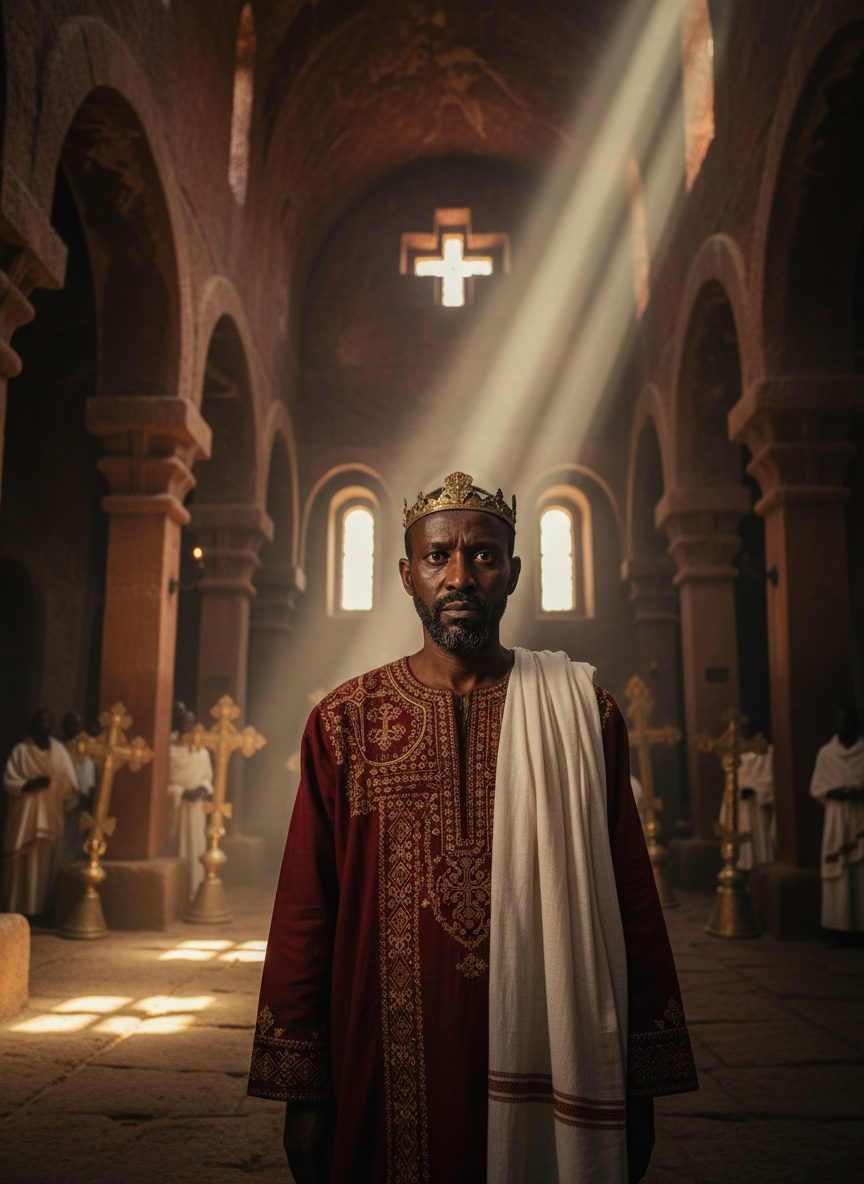
He never set foot in the Holy Land. Instead, King Lalibela set his mind to creating it under his own feet.
Chiseling a Dream into Reality
High in the rugged, sun-kissed highlands of medieval Ethiopia, where the sun casts intricate shadows over jagged peaks and wide, sweeping vistas, King Lalibela envisioned a divine undertaking. Surrounded by the mountainous terrain of his ancestors, he would build a new Jerusalem, not in timber and stone, but carved directly from the living volcanic rock beneath him. This vision did not spring from ambition alone but from a dream—a celestial pilgrimage taking place while the king lay in a deep sleep, his spirit carried away to the biblical city itself. The message was clear; if he could not tread the sacred stones of Jerusalem, he would sculpt it anew in his homeland.
With fervor that defied comprehension, Lalibela embarked on his monumental labor of love around the turn of the 12th century. His plan was extraordinary and arduous: eleven monolithic churches, each hewn from solid rock, designed to echo the holy sanctity of Jerusalem. The project was monumental, requiring not only a visionary king but an army of devoted craftsmen, all driven by faith as much as royal decree. Legend suggests that angels lent their strength, allowing the laborers to work twice as swiftly. Rather than constructing these churches stone by stone, the builders gouged giant trenches to isolate enormous blocks, which were then carved and hollowed into the sanctuaries we see today.
The centerpiece of Lalibela's holy creation is Bete Giyorgis, the House of St. George. The cross-shaped church, impeccably carved with stunning precision, is often draped gently by the afternoon sun filtering through a natural rock trench. Each chisel mark whispers tales of devotion, the sweat and toil of workers who believed they were touching the divine with every strike. The layout of these churches was no mere matter of chance. Meticulously connected by a network of tunnels and passageways, the entire complex mimics a sacred map of Jerusalem, each part suffused with intention and spiritual symbolism.
A World Carved in Faith
Despite lacking modern tools and technology, the craftsmanship of Lalibela’s churches exhibits an astonishing level of skill and understanding. The grand architectural feat was intertwined with spiritual symbolism. Each church possessed unique attributes and dedications, not only providing a place of worship but setting the stage for the complex tapestry of rites and rituals practiced by Ethiopian Orthodox Christians throughout the ages. One might enter Bete Medhane Alem, reminiscent of a grand basilica, purported to be the largest monolithic church in the world. The impossibly thick stone columns, despite their size and solemnity, feel ethereal, as though Lalibela’s dream was caught and crystallized within them.
Much remains unknown about the exact chronology and methods employed in the construction of the churches. Oral traditions and legends fill in gaps left by time’s erasure. Some stories suggest divine guidance, even supernatural assistance, during the construction period. While we rely on these tales to grasp the extent of Lalibela's vision and abilities, what remains undisputed are the intricate decorations and beautiful reliefs etched into the stone faces, each telling timeless biblical stories thoughtfully curated by the artisans of faith.
The churches not only served as places of worship but as pillars of daily life, offering refuge and solace to pilgrims and locals alike. They stand as a testament to the resilience of a civilization and their unwavering faith, which, much like the volcanic rock from which the churches emerge, remains unyielding and steadfast against the relentless flow of time. Visitors navigating the labyrinthine pathways between these subterranean marvels are enveloped by an overwhelming sense of serenity—a tranquility lingering on the air, echoing with whispers of countless seekers' prayers offered over centuries.
Timeless Guardians of Divine Aspiration
Lalibela’s churches didn’t merely emerge as heirlooms from a bygone era, they actively shaped the cultural and spiritual identity of the region they stand in. Throughout the centuries, these rock-hewn marvels have borne witness to the shifting tides of history. Ethiopia, cradled within the Horn of Africa, stood as a focal point of trade, cultural exchange, and, inevitably, conflict. Yet, the complex has remained a bulwark of peace, serenity amid tumult—a testament to the enduring power of the human spirit guided by faith.
Today, pilgrims and tourists alike flock to witness these stone churches, still vibrant with life. During key festivals like Genna (Ethiopian Christmas), the complex hums with spiritual energy as thousands of worshipers gather to partake in timeless rituals, melding past and present in a living tapestry of devotion. The air vibrates with the low hum of reverent prayer, a chorus that affirms the sacred legacy of a king who dared to craft his divine vision in stone.
As much as they are artifacts of exceptional human achievement, Lalibela’s churches reflect a profound philosophical statement—transcending physical boundaries through faith, imagination, and enduring craft. While we may never fully unravel the mystery behind their creation, the message they impart resonates with immovable clarity. In a world where the miracle of faith often feels distant or abstract, these ancient stone edifices ground us, hewed from the earth, lifting spirits skyward toward the dream that inspired them. Lalibela gifted the world not just with churches but with a message carved deep into the heart of stone itself: that vision knows no limits when anchored by faith.