The sands of Ullais stretched beneath an unrelenting sun, the heat dancing in waves off the ground. A chorus of cicadas buzzed persistently, underscoring the stillness that had descended after the chaos of battle. Fine dust floated in the air, disturbed by the scuffle of worn boots and the distant sound of men tending to their wounds. Here, in the heart of the desert, human ambition met its harshest adversary: the will to conquer in a land that offered no mercy. In 633 CE, this was the site of one of Khalid ibn al-Walid’s most renowned battles, where victory came not from mere conquest but from an unexpected act of grace.
The Unyielding Sword of God
Khalid ibn al-Walid was a name that struck fear across the sands of the early Islamic period. Known as the "Sword of God," he was a general who orchestrated victories with a precision that seemed predestined. His tactical genius had never known defeat, and his presence on the battlefield was often described as a harbinger of doom for those who opposed him. This was the reputation that preceded him to Ullais. The stakes were clear; another victory would cement his legacy, while failure was not an option entertained by a man of Khalid’s caliber.
The battle itself, fierce and closely contested, was finally swayed by Khalid’s strategic acumen. As the clash of steel faded and the cries of war gave way to the groans of the wounded, a stark reality emerged from the dust of battle: the harsh silence of death punctuated by the living who remained. Khalid's reputation as an indomitable force was affirmed once more. However, it was not the victory he would be remembered for that day.
A Moment of Mercy
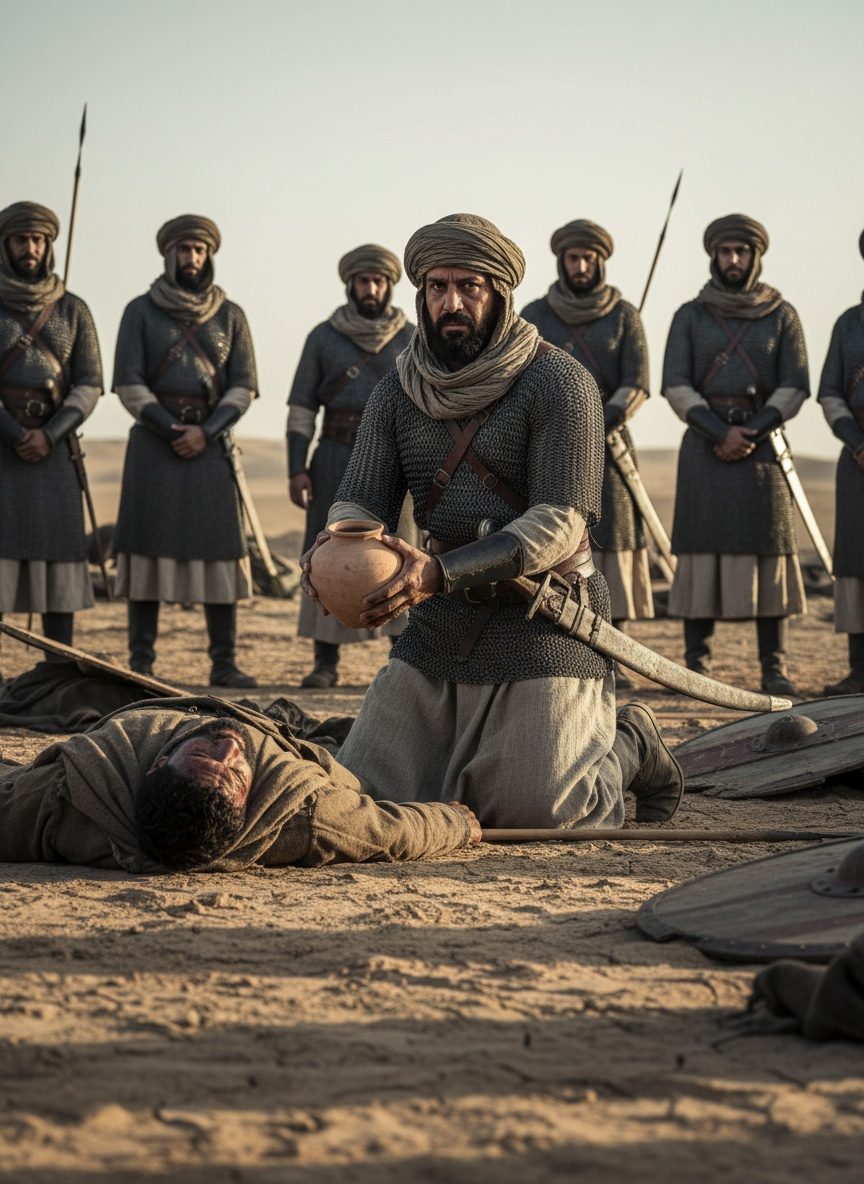
Amidst the field of outpacing corpses and the injured, Khalid encountered the enemy commander. He lay captured and wounded, yet defiant even in his weakened state. This was the moment when warfare turned unexpectedly humane. Against what many would expect from a conqueror whose sobriquet alluded to divine wrath, Khalid knelt beside his fallen adversary. The heat and exhaustion that marked the day could not suppress this act of unexpected kindness—he offered the man water.
In the arid expanse where thirst could mean a difference between life and death, the act was monumental. It was more than just quenching physical thirst; it was a gesture that transcended enmity. In those brief moments shared over a simple cup of water, Khalid ibn al-Walid displayed a profound understanding of honor and humanity. In respecting his foe in a moment of profound vulnerability, he demonstrated leadership that valued respect as much as it did victory.
The Burial of the Fallen
With the battle concluded, Khalid turned his gaze upon the countless dead who lay strewn across the battlefield. Victory could not eclipse the silent testament of lives lost on both sides. He ordered his men to bury the dead, affording them dignity in death regardless of allegiance. This act of honoring the dead sent ripples through the collective consciousness of those who would hear tales of the Battle of Ullais.
Here was a warrior whose ferocity in battle was matched by his compassion in its aftermath. In a world where the defeated could expect little mercy, Khalid's decision to bury his enemies with honor contradicted the brutal norms of warfare at the time. This gesture highlighted the complex nature of leadership in an age where one’s worth was often measured by the number of enemies vanquished and lands conquered.
What the Sands Remember
The accounts of the battle and Khalid’s actions traversed the desert, carried on the lips of travelers and traders. Stories of his prowess and unmatched tactical brilliance were told alongside those of his unexpected acts of compassion. The tales, weathered and shaped by time, etched his legacy into a narrative of duality: the unwavering Sword of God tempered by moments of profound humanity.
To the tribes and factions of the time, such actions became touchstones of a form of chivalry not widely expected in the harsh theatres of war. Khalid ibn al-Walid, through these acts, left a legacy that resonated beyond the battlefield—illustrating how leadership and honor could coexist alongside military strength.
Beyond Victory
The tale of Khalid at Ullais stands out in the annals of history not just for its outcome, but for the manner in which it was achieved. In the relentless realm of warfare, where victory so often overshadowed humanity, Khalid's gestures served as a reminder of the potential for grace amidst conflict. His actions prompted those who followed to reconsider notions of victory and what it truly meant to be gallant in warfare.
Thus, the sands of Ullais hold more than the memory of battle; they preserve the moment when a leader defined a victory not only by the territories gained but by the humanity exhibited amidst desolation. It asks of us a timeless question—how do we wish to be remembered when the dust settles and the echoes of our pursuits dim? In Khalid, we see the enduring power of compassion, even within the crucible of war. For history, after all, is not just about what was overcome, but who we chose to be amidst the struggle.