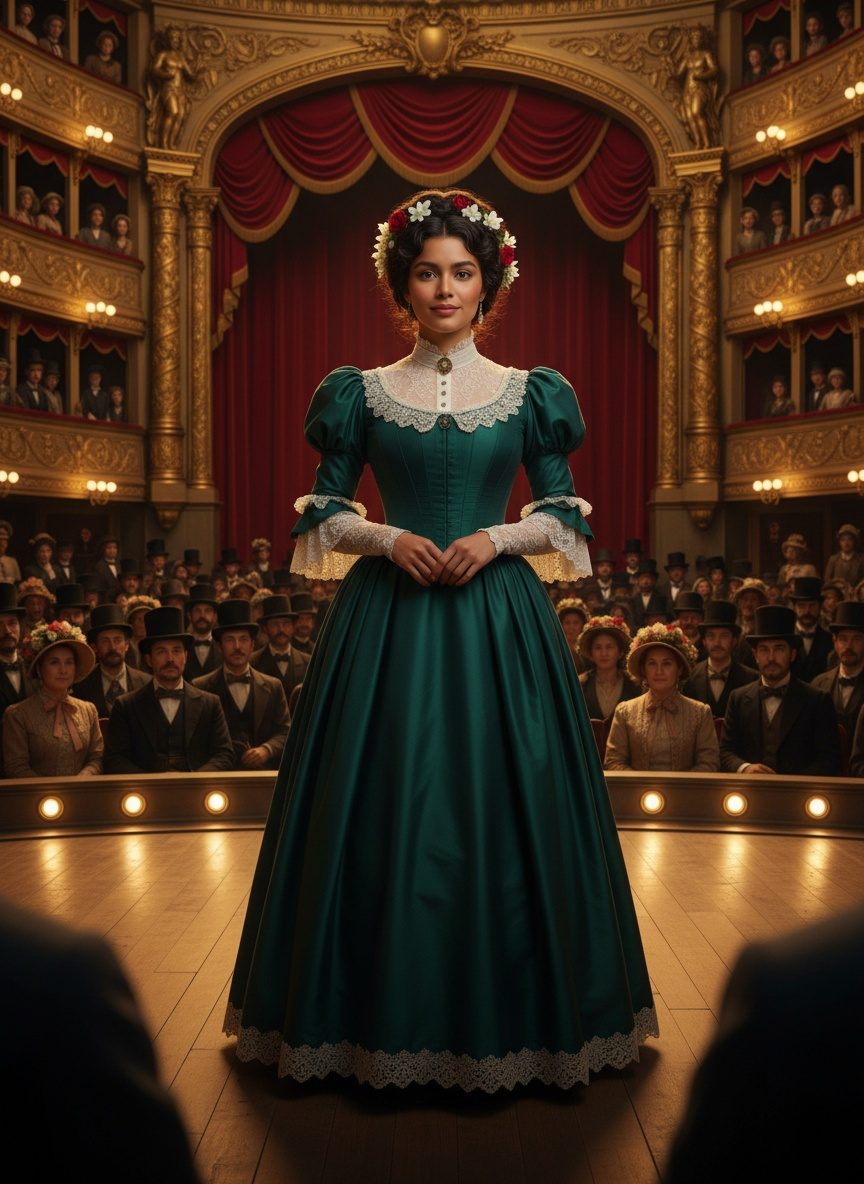
The theaters of Victorian Europe hummed with anticipation, the air thick with the mingling scents of burning gas lamps and anticipation. Outside, the glow of twilight draped cobblestone streets in shades of auburn and grey, as patrons shuffled past opulent façades and into their evening's entertainment. In a world dazzled by spectacle and unfathomable curiosities, audiences awaited an experience unlike anything they had encountered before. Standing poised behind the thick velvet curtain, Julia Pastrana steadied herself for another performance. She was no ordinary performer set to dance and sing for the crowds. As the curtain rose to reveal her presence, an audible gasp rippled through the auditorium; her voice would soon captivate them, but it was her appearance that had lured them here tonight.
A Captivating, Elusive Star
Julia Pastrana hailed from a remote corner of Mexico, an enigmatic figure with an unrivaled talent for performing. She possessed a haunting contralto voice and a grace that danced upon the stage with the lightness of a breeze. But it was her unique condition that set her apart. She had a rare affliction known as hypertrichosis, causing her face and body to be covered with a thick layer of black hair, alongside gingival hyperplasia, which enlarged her lips and gums. In an era consumed by the oddities and wonders of the human condition, her distinct appearance propelled her into the public eye.
Touring through Europe and the United States, Julia performed in the grandest venues of the Victorian circuit. Critics and audiences alike debated her merits — some praised her voice, while others fixated on her appearance. Yet, what she offered night after night was an artistry that demanded to be recognized, an unwavering spirit in a world that at once revered and ridiculed her visage.
The Woman Behind the Veil
Beyond the stage lights and beneath the costumes, Julia Pastrana was a woman of intelligence and depth. Despite the exploitation she faced, she remained dedicated to her craft, constantly honing her singing and dancing. Pastrana sent the earnings from her performances back to her family in Mexico, a testament to her resilience and her desire to transform an often-cruel reality into a source of support and goodwill.
She married Theodore Lent, her manager, a man whose motivations remain muddled between exploitation and alleged affection. He played a critical role in her career, negotiating performances and managing the logistics of her tours. Some historical accounts suggest he saw her as a mere commodity. Yet, little did anyone know that her story with Lent was to take a darker turn even beyond her life.
The Theater's Cruel Curtain Call
In 1860, in the midst of her captivating career, tragedy struck. Julia Pastrana fell ill and passed away shortly after giving birth to a son who inherited her condition and tragically did not survive infancy. Rather than allowing her legacy to rest, Lent sought to further capitalize on her death. Preserving her body and that of their infant son through embalming, he continued to exhibit them across Europe, transforming what was once a performance into a morbid spectacle.
This was a grim reflection of Victorian society’s urge to consume and commodify even in death, blinded by the bizarre over the boundaries of dignity. It was not until much later that her remains were finally returned to Mexico for a proper burial, over a century after her life had ended. A poignant chapter in an already extraordinary life story, one that raised questions about humanity's relationship with the peculiar and the morally dubious nature of such a fascination.
The Echoes of An Unlikely Legacy
In those darkened theaters full of gawking eyes and whispered derision, Julia Pastrana sang with a voice that demanded attention, a talent that transcended the superficial allure of her appearance. Her life reflects broader themes of acceptance, beauty, and exploitation—issues that still resonate today. The inevitability of fame through vaudeville-like manipulation, the deliberate blurring of human dignity, and the public's complicit participation in both lifting and ultimately binding her under the weight of its own gaze.
Julia Pastrana’s story, resting now with a belated dignity, serves as a contemplation of our collective intersection with the diverse and the extraordinary. How we choose to embrace difference, recognize talent beyond surface perceptions, and honor a legacy not for its spectacle but for the individual behind it—that, perhaps, is the true moral echo imbued within her haunting performance long disbanded curtains might never mask.