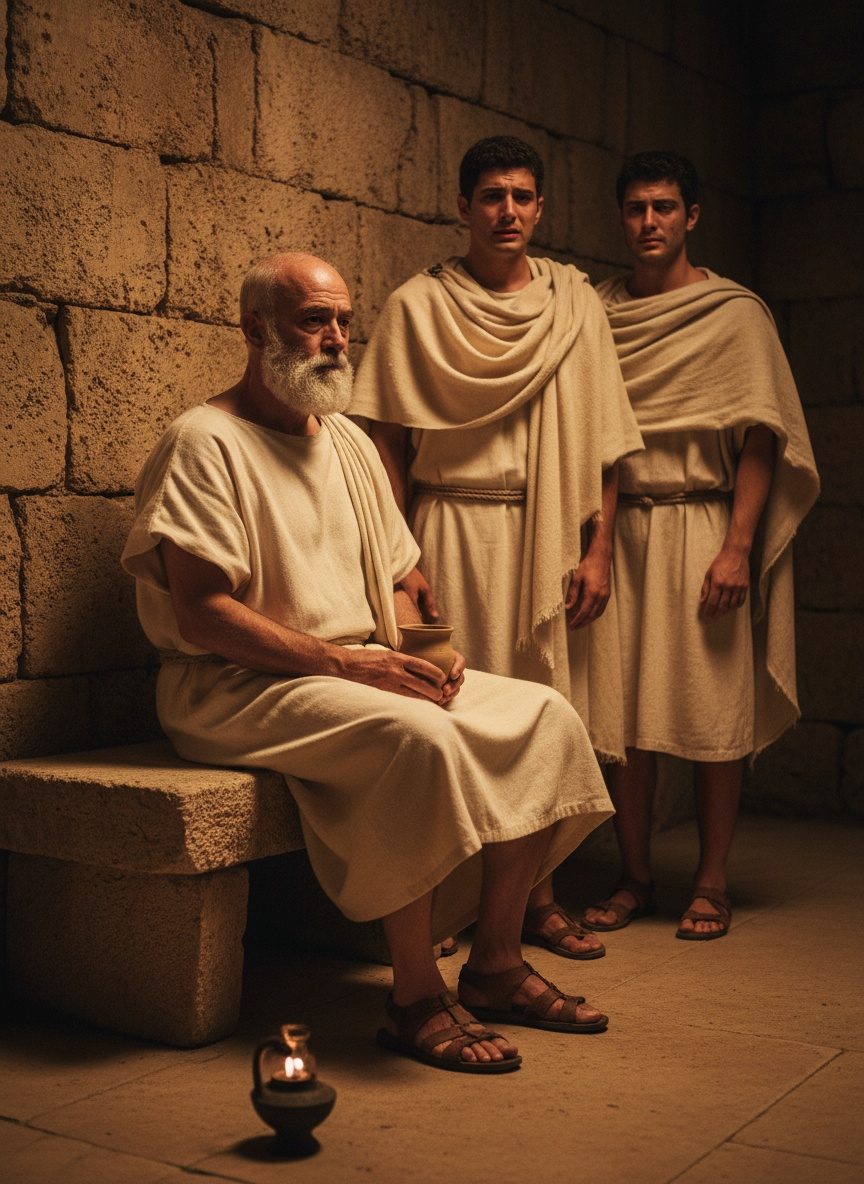
The cool stone of the Athenian prison cell bit into Socrates’ skin as he leaned back against the wall, slipping into thought. Outside, the hum of the city carried on, a throbbing pulse of life, oblivious to the disquiet simmering within these walls. Athens was changing, the bright embers of its Golden Age now faintly glowing, tinged with the haze of political upheaval and war weariness. And here he sat, untouched by it all, ready to embrace the fate allotted to him by the city's own hand.
Truth on Trial
Socrates' trial had been a spectacle of philosophical inquiry colliding with civic duty. Accused of "corrupting the youth" and impiety, he stood resolute before the jury of his peers. The words he delivered were not those of a defendant but of a social critic and teacher. When faced with the possibility of banishment, Socrates refuted it, equating the cessation of his dialogues with the death of the very spirit he sought to inspire in Athens. The city could silence him but could not force him to flee from the search for truth.
This great thinker willingly embraced the Athenians’ verdict, a stark symbol of his devotion to the laws he had spent a lifetime questioning and dissecting. To many, Socrates' trial and execution marked a turning point, a moment where democratic principles buckled under fear and retribution.
Friends in High Places
Even as the execution loomed, a cadre of Socrates' friends concocted plans for his escape. These were not outlaws or rabble-rousers but some of Athens' finest minds. Complicit in this conspiracy of compassion were personalities like Crito, whose loyalty knew no bounds. They had pooled resources, loosened the morals of jailers with gold, and secured a vessel ready to spirit Socrates away to safety. Liberties had been taken for his deliverance; opinions hushed as plans whispered through quivering lips.
Yet, Socrates, with an unflinching eye, gazed upon the sea of concerned faces and, without hesitation, poured forth the rhetoric of dreams larger than mortality. An escape, he posited, embodied betrayal of his own values. To flee was to admit guilt, to bolster the idea that one's convictions could sway under the threat of punishment. The hemlock, in sharp contrast, would gift him a paradoxical form of liberty—an enduring stand for truth that imprisonment or exile could not dilute.
The Hemlock Cup
The warden pretended to be engrossed in the tedious repetition of daily duties as the odor of bitter hemlock rose in the dimly lit cell. The atmosphere turned solemn, the rustling of Socrates’ robes a soft whisper in the stark quiet of impending death. Socrates held the cup aloft, as if dissecting its contents with the rumination of a lecture. This was the final lesson—one not of words but of action, a silent syllogism of fidelity to law and philosophy.
In consuming the hemlock, Socrates transcended his temporal bonds, binding his essence to the very city that condemned him. He did not leave this world with a plea for pardon nor a condemnation of Athenians, but with an enduring question: what is worth living—and dying—for?
The Echoes of Silence
The ramifications of his death resounded through Athens, an unsettling silence that nagged at its conscience. The unrest had not been quenched by his execution; rather, his absence became a chasm into which Athens' soul seemed to tumble. His philosophies continued to flourish, etched into the minds of students like Plato, but the vibrancy of debate that once challenged and animated Athenian society seemed subdued.
The city found itself adrift between the rigid adherence to tradition and the inescapable currents of change, internal conflicts mirroring the larger battles on its borders. Democracy in Athens endured, yet it was a weary and introspective entity—a reminder that the cost of silencing dissent might indeed be the city's most haunting legacy.
A Lasting Reflection
The decision that Socrates made was more than an act of personal integrity; it was a catalyst to Western philosophical thought—a bright flash that ignited centuries of discourse on ethics, governance, and the individual's role within society. His death did not snuff out his teachings but instead immortalized them, offering them to future generations as a timeless critique of power and the pursuit of wisdom.
In refusing the escape, Socrates gifted Athens, and the world, a lesson not easily relegated to the annals of history. His choice compels introspection and dialogue, reminding us that the truest forms of freedom are carved out in the quiet resilience of conviction, standing unyielding against even the mightiest tides of fear and repression.