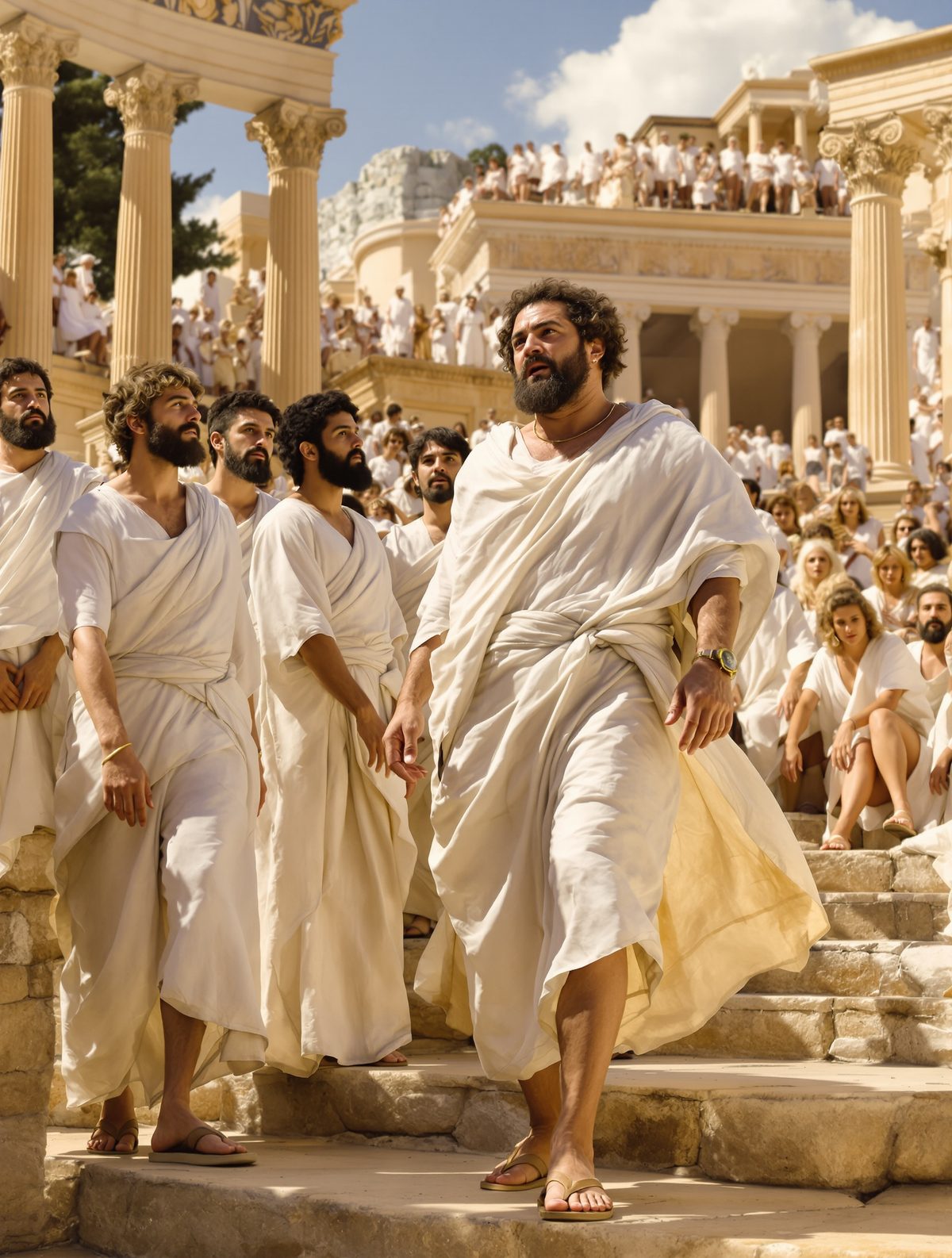
Imagine walking from New York to Los Angeles—then doing it again twenty-eight more times. That's roughly the distance Ibn Battuta covered on foot in the 14th century, when a "long journey" meant walking to the next village. This young Moroccan scholar left Tangier in 1325 with enough money for a simple pilgrimage to Mecca. When he finally returned home nearly three decades later, he had become perhaps history's most epic traveler, covering 75,000 miles across a medieval world that would make today's most extreme backpackers weep.
His journey began with the kind of wanderlust that changes everything. What started as religious devotion became an insatiable hunger to see what lay beyond the next horizon. By the time Ibn Battuta hung up his walking stick, he had served as a judge to island sultans, survived pirates in the Indian Ocean, been robbed by bandits more times than he could count, and witnessed the rise and fall of empires most Europeans didn't even know existed.
The Pilgrimage That Never Ended
On June 14, 1325, twenty-one-year-old Abu Abdullah Muhammad Ibn Battuta kissed his parents goodbye in Tangier and set off for Mecca. Like millions of Muslims before and after him, he was undertaking the Hajj—one of Islam's five pillars. The journey typically took a year or two. Ibn Battuta wouldn't see Morocco again until 1354.
What happened? Simple: he caught the travel bug in the most extreme way possible. After completing his pilgrimage in 1326, Ibn Battuta found himself in Damascus, faced with a choice. He could return home with the spiritual satisfaction of a completed Hajj, or he could keep walking. He kept walking.
His timing was extraordinary. The medieval world was experiencing what historians call the "Pax Mongolica"—a period when the Mongol Empire's vast trade networks made long-distance travel safer than it had been in centuries. Still, "safer" is relative when your mode of transportation is your own two feet and the world is full of bandits, wild animals, and political upheaval.
Ibn Battuta's first extended detour took him through Iraq and Persia, where he joined various caravans and learned the essential survival skills of medieval travel: how to spot trustworthy merchants, which routes avoided the worst bandits, and how to talk your way out of trouble when talking was your only weapon.
The Judge of the Maldives
Perhaps no episode in Ibn Battuta's travels sounds more like fiction than his time in the Maldive Islands. In 1343, after years of wandering through India and Southeast Asia, he washed ashore on this remote archipelago in the Indian Ocean. What happened next reads like a medieval romantic comedy with serious political undertones.
The Maldives were ruled by a series of powerful sultanas—queens who wielded absolute power over their island paradise. Ibn Battuta, with his impressive education and legal training, was quickly appointed as chief judge. But the job came with an unexpected requirement: marriage to a member of the royal family.
Over the course of nine months, Ibn Battuta married into the ruling dynasty three times. Medieval politics in small kingdoms often involved strategic marriages, but Ibn Battuta's romantic life in the Maldives was complicated even by those standards. His legal decisions often put him at odds with the sultana, and his foreign ways didn't always mesh with local customs.
The situation reached a breaking point when Ibn Battuta tried to leave the islands. The sultana, apparently not finished with her foreign judge, forbade him from departing. What followed was a months-long political standoff that ended only when Ibn Battuta managed to escape on a departing ship, leaving behind wives, property, and what must have been very awkward family dinners.
Surviving the Impossible
Reading Ibn Battuta's account of his travels is like watching someone repeatedly cheat death in increasingly creative ways. He survived at least three major shipwrecks, countless bandit attacks, several wars, multiple cases of serious illness, and the constant threat of starvation in an era when travelers often went days without food.
During his time in India, serving in the court of the Sultan of Delhi, Ibn Battuta witnessed political intrigue that would make Game of Thrones look tame. Sultan Muhammad bin Tughluq was notorious for his paranoia and tendency to execute officials without warning. Ibn Battuta watched colleagues disappear overnight and knew that a single wrong word could mean death.
The sultan eventually assigned Ibn Battuta as his ambassador to China—a job that nearly killed him before he left Indian territory. Bandits attacked his diplomatic convoy, stealing everything and leaving Ibn Battuta hiding in a mosque with nothing but the clothes on his back. For a man who had already traveled thousands of miles, starting over with absolutely nothing must have felt like the ultimate test.
But perhaps his closest call came during a shipwreck off the coast of India. Ibn Battuta described watching his ship break apart in a storm while pirates attacked the survivors in the water. He managed to swim to shore, only to discover that everything he owned—including years of collected notes and gifts from various rulers—was at the bottom of the ocean.
The World Through Medieval Eyes
Ibn Battuta's travels offer us a unique window into the 14th-century world—a perspective that challenges many assumptions about medieval life. Far from being isolated and provincial, the world he describes was connected by trade routes that linked Morocco to China, filled with polyglot merchants, international scholars, and sophisticated legal systems.
In Delhi, he encountered a cosmopolitan court where scholars from Central Asia debated philosophy with theologians from Egypt. In the East African city-states of Kilwa and Mogadishu, he found prosperous kingdoms built on Indian Ocean trade, with architecture that rivaled anything in Europe. In Andalusian Spain, he witnessed the twilight of Islamic civilization in Europe, just decades before the final Christian reconquest.
His detailed observations reveal a world where a Moroccan scholar could find work as a judge in India, marry into royalty in the Maldives, and conduct diplomatic missions to China. The medieval world was far more interconnected and culturally diverse than most people realize.
Ibn Battuta also documented the devastating effects of the Black Death, which he encountered during his travels through the Middle East in the 1340s. His firsthand accounts provide historians with crucial information about how the plague spread along trade routes and affected different regions.
The Ultimate Homecoming
When Ibn Battuta finally returned to Morocco in 1354, he discovered that the world had changed dramatically during his absence. The Black Death had swept through North Africa, killing his parents and transforming the society he remembered. He was a stranger in his own land, a man whose experiences had no parallel in his homeland.
At the command of the Moroccan Sultan, Ibn Battuta dictated his memoirs to a scholar named Ibn Juzayy. The resulting work, known as the Rihla (meaning "journey"), became one of the most important travel accounts in history. But even then, Ibn Battuta couldn't stay still. He made two more journeys—one to Andalusian Spain and another across the Sahara to the kingdoms of West Africa.
His final journey, to the Mali Empire in 1352, took him to Timbuktu and the legendary kingdom of gold that had captured imaginations across the medieval world. Even as an aging man, Ibn Battuta was still pushing boundaries and exploring regions that few outsiders had ever seen.
Why Ibn Battuta Matters Today
In our age of Google Earth and global connectivity, it's easy to forget that the world was once truly vast and unknowable. Ibn Battuta's journey reminds us what exploration meant when every horizon held genuine mystery, when travelers disappeared for decades and returned with stories that sounded impossible.
His travels also challenge Western-centric views of medieval history. While Europeans were just beginning to venture beyond their continent, Ibn Battuta was documenting a sophisticated global civilization that connected three continents. His account reveals a world where knowledge, goods, and people moved across vast distances, creating the first truly global economy.
Perhaps most importantly, Ibn Battuta's story is about the transformative power of curiosity. He began as a young religious scholar seeking spiritual fulfillment and ended as a global citizen who had seen more of the world than almost any human in history. In an age when it's easy to explore the world virtually, his journey reminds us that real discovery still requires the courage to step into the unknown—even if we're only walking to the next village.