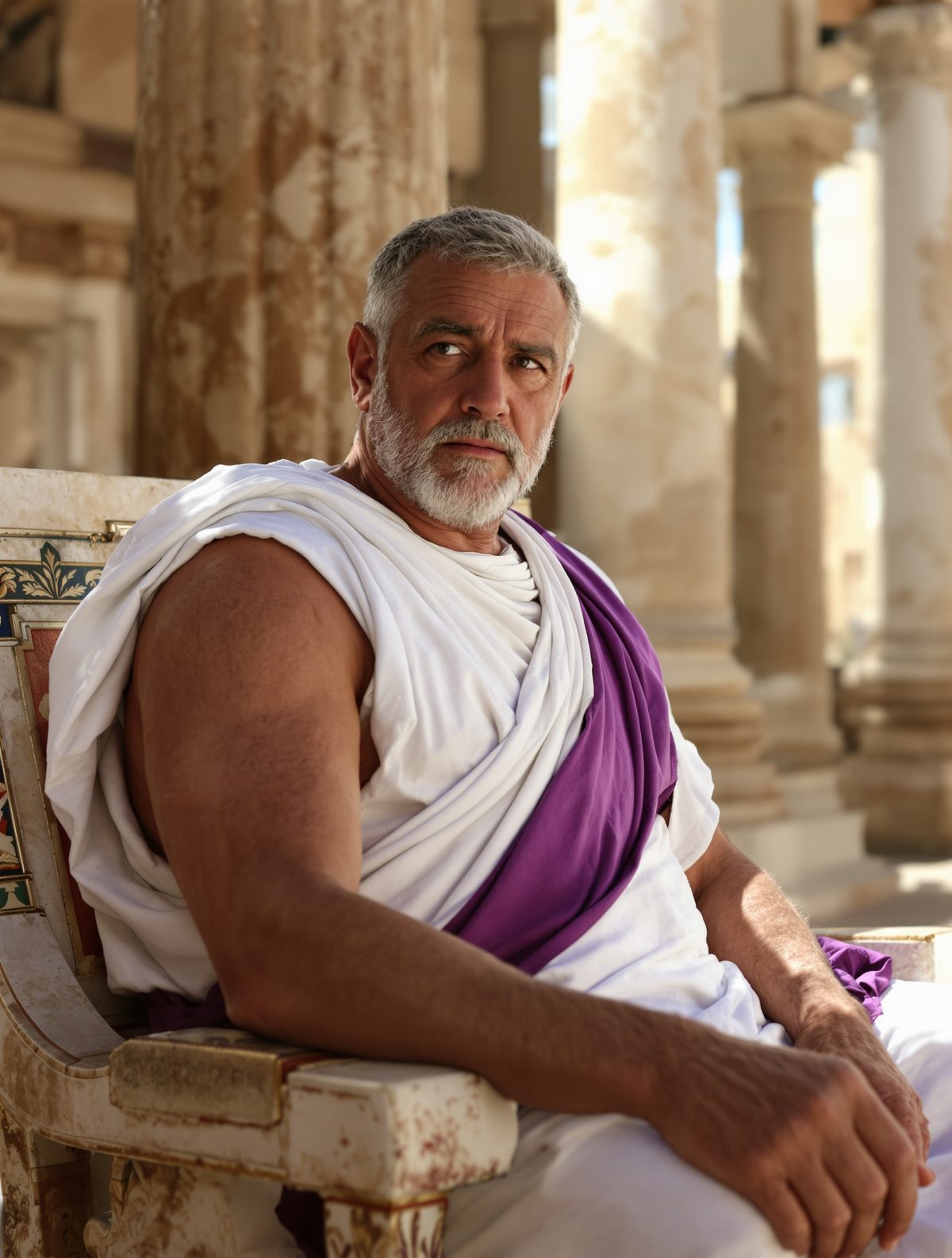
Picture this: the year is 220 AD, and in the marble halls of the Roman Senate, distinguished men in togas are watching their emperor—draped in silk, adorned with jewelry, and painted with cosmetics—declare himself a bride. The teenage ruler has just publicly married his charioteer, a blonde Syrian named Hierocles, in an elaborate ceremony that would make even modern tabloids blush. Welcome to the reign of Elagabalus, the most scandalous emperor Rome ever produced.
While most Romans were struggling to understand their ruler's devotion to an obscure Syrian sun god, they were about to witness something that would shake the very foundations of imperial tradition. The emperor who had already horrified the Senate by wearing makeup and Eastern robes was about to take things one step further—he was going to play wife to a former slave.
The Boy Who Would Be Empress
Marcus Aurelius Antoninus Augustus, better known to history as Elagabalus, became Roman Emperor at the tender age of fourteen in 218 AD. But this wasn't your typical coming-of-age story. Born in Syria to a family of powerful women who manipulated their way to the throne, Elagabalus arrived in Rome carrying more than just imperial ambitions—he brought with him the worship of Elagabal, a Syrian sun god represented by a black meteorite.
From the moment he set foot in the capital, Romans knew something was different about their new emperor. He refused to wear the traditional purple-striped toga, preferring instead flowing silk robes embroidered with gold. He painted his eyes with kohl, rouged his cheeks, and adorned himself with jewelry that would make a Persian princess envious. The Senate whispered nervously among themselves—what kind of emperor had they inherited?
But Elagabalus was just getting started. The teenage ruler seemed determined to challenge every social convention Rome held sacred, and his personal relationships would prove to be the most explosive battleground of all.
Enter Hierocles: From Slave to "Husband"
Sometime around 220 AD, a young charioteer caught the emperor's eye. Hierocles was everything Roman aristocrats looked down upon—a former slave, possibly a blonde Carian, whose only claim to fame was his skill with horses and his striking good looks. In the rigidly hierarchical world of ancient Rome, charioteers occupied the same social stratum as actors and prostitutes: entertaining, perhaps, but hardly suitable company for an emperor.
Elagabalus didn't just ignore these social boundaries—he obliterated them. The emperor became completely infatuated with Hierocles, elevating him from the dusty floors of the Circus Maximus to the marble halls of the imperial palace. But this wasn't merely a case of imperial favoritism or even a discreet affair. Elagabalus had something far more radical in mind.
According to the historian Cassius Dio, who witnessed these events firsthand, Elagabalus began referring to Hierocles as his husband. The emperor would greet senators and dignitaries with painted face and elaborate hairstyles, then casually mention his "marriage" to the former charioteer. But if the Roman elite thought this was merely the eccentric language of a besotted teenager, they were in for a shock.
A Wedding That Scandalized an Empire
What happened next was unprecedented in Roman history. Elagabalus didn't just live with Hierocles—he married him. And not in some private ceremony hidden away in the palace gardens, but in a public spectacle that forced the Roman establishment to confront their emperor's radical vision of marriage and gender.
The wedding ceremony itself was a masterpiece of calculated provocation. Elagabalus appeared dressed as a bride, complete with a wedding veil and women's clothing. He had his body hair carefully removed, wore makeup that would have impressed Cleopatra, and conducted himself with all the demure mannerisms expected of a Roman matron. Hierocles, meanwhile, played the role of the traditional Roman husband—the paterfamilias who would now, theoretically, have authority over the most powerful person in the known world.
Senators who had survived the brutal reigns of Caligula and Nero found themselves witnessing something entirely new. This wasn't just sexual deviance or political theater—this was a fundamental challenge to Roman concepts of gender, power, and social order. The emperor wasn't just having a same-sex relationship; he was redefining what it meant to be masculine, feminine, and imperial all at once.
Playing House in the Imperial Palace
After the wedding, Elagabalus threw himself into the role of imperial wife with the same enthusiasm he brought to religious reform. He reportedly took pleasure in being "caught" in compromising positions with Hierocles, ensuring that palace servants and visiting dignitaries would witness his submission to his "husband." This wasn't accidental—it was a carefully orchestrated performance designed to challenge Roman sexual norms.
The emperor even went so far as to inquire about surgical procedures that might give him female anatomy. Roman physicians, presumably terrified of both performing such an operation and refusing their emperor, found creative ways to avoid the request. But the very fact that Elagabalus made such inquiries reveals the depth of his commitment to his chosen gender role.
Palace life during this period must have been surreal. Picture Roman senators arriving for official business, only to find their emperor braiding Hierocles' hair or playfully arguing about domestic matters. The traditional Roman marriage dynamic—where the husband held absolute authority over his wife—was being performed daily in the heart of the empire, with the most powerful person in the world taking the submissive role.
The Empire Strikes Back
While Elagabalus may have been ahead of his time in matters of gender and sexuality, he was living in an empire built on rigid social hierarchies and traditional values. The Roman military, the Senate, and the general population were not ready for an emperor who challenged the very foundations of Roman masculinity.
The marriage to Hierocles became a symbol of everything the Roman establishment feared about their young emperor. It wasn't just about sexual morality—it was about power, tradition, and the stability of the empire itself. How could Rome project strength to its enemies when its emperor was playing the role of a submissive wife to a former slave?
The relationship with Hierocles also created practical political problems. Traditional Roman marriages were about alliances, bloodlines, and succession. By marrying a male former slave, Elagabalus was effectively declaring that none of these considerations mattered. This wasn't just personal rebellion—it was political revolution.
As opposition to his reign mounted, Elagabalus's relationship with Hierocles became increasingly central to his critics' complaints. The emperor who had already outraged Rome with his religious reforms and extravagant lifestyle had given his enemies a perfect symbol of his unfitness to rule.
A Legacy Written in Scandal and Blood
Elagabalus's reign ended as dramatically as it had unfolded. In March 222 AD, just four years after becoming emperor, he was assassinated by the Praetorian Guard at the age of eighteen. His body was dragged through the streets of Rome and thrown into the Tiber River—the ultimate dishonor for a Roman citizen.
After his death, the Roman establishment did everything possible to erase Elagabalus from history. His name was struck from official records, his portraits were destroyed, and his reforms were reversed. The Senate's official verdict was damnatio memoriae—let his memory be damned.
But here's what makes this story remarkable: nearly eighteen centuries before the modern LGBTQ+ rights movement, a Roman emperor publicly challenged binary concepts of gender and sexuality. While we must be careful not to impose modern categories on ancient people, Elagabalus's behavior suggests someone who would today might identify as transgender or gender non-conforming.
The emperor's marriage to Hierocles represents one of history's most public same-sex unions, performed at a time when such relationships existed in the shadows of even the most tolerant societies. Whether driven by love, politics, or personal identity—or some combination of all three—Elagabalus forced an entire empire to confront questions about gender and sexuality that many societies are still grappling with today.
Perhaps that's why his story was so thoroughly suppressed, and why it remains so compelling now. In an age when marriage equality and transgender rights dominate headlines, the tale of a teenage emperor who married his male lover and proudly played the role of wife reminds us that human diversity has always existed—even when societies tried their best to ignore it.