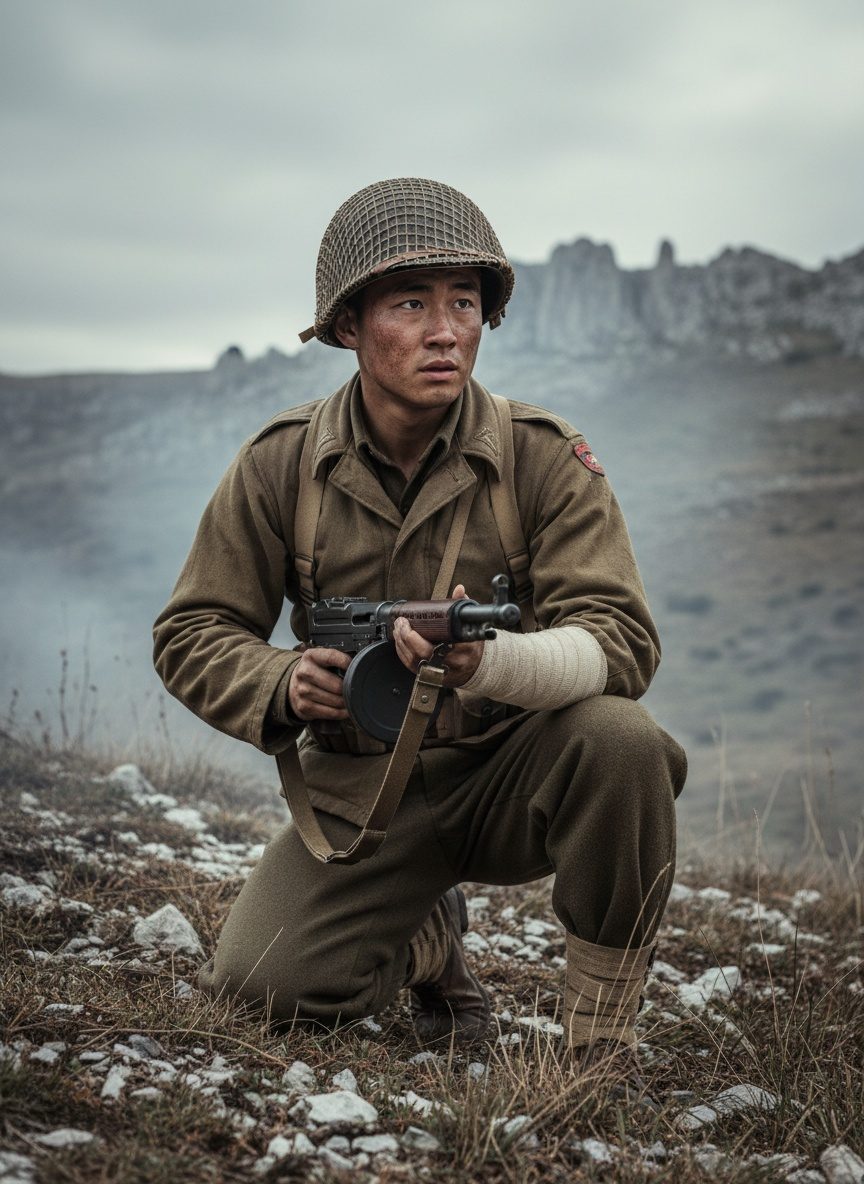
The explosion ripped through the dense jungle air, a deafening roar that reverberated down the ridge. Dirt and debris rained down in a shower of chaos, swallowing the sounds of human struggle. In the eye of this maelstrom, a young man lay prone, his left hand gripping the pull ring of a grenade, his breath quick and steady despite the hell unfolding around him. Ahead, machine gun nests belched fire — a wall of death that could spell doom for any who dared to rise and charge. Yet, rise he did. His right arm hung useless, numb from the ferocious artillery strike that had torn through their ranks moments before. Undeterred, he pushed forward into the storm.
With Honor in the Shadows
On December 7, 1941, as the sun rose over the Hawaiian Islands, seventeen-year-old Daniel listened intently as the hum of aircraft engines grew ever louder. The planes sliced through the sky above Honolulu with an ominous determination, and soon the air was filled with the cacophony of war. Daniel spent that harrowing day running through the streets, carrying the wounded to safety while the fiery onslaught continued overhead. Yet, to his great dismay, the home he knew so well now viewed him through a lens of suspicion — not as a proud American, but as someone whose face mirrored that of the enemy.
Shortly after the attack on Pearl Harbor, Japanese Americans across the country found themselves branded as "enemy aliens," regardless of their loyalty. Coerced into internment camps, they faced mounting discrimination and distrust. Daniel, possessing an unyielding determination to prove his allegiance, sought to join the fight against the Axis powers. Initially, he was barred from enlisting due to his ancestry. It was only after persistent effort and changing attitudes that he and others were allowed to enlist in the segregated Japanese American units formed to demonstrate their loyalty through courage on the battlefield.
Training with his unit was rigorous and transformative. Daniel honed his skills, preparing for the day he would face the enemy not as a mere soldier, but as a symbol of resistance against the tides of prejudice that threatened to drown his country from within. As prejudice burned bright in the home front, he and his brethren were on the front lines, entrusted with missions many deemed near-impossible, driven by a cause greater than themselves.
The Price of Valor
In early 1945, Daniel's unit found itself thrust into the heat of battle in Europe. Their assignments were perilous, their tenacity renowned, earning first from respect and then reverence from their peers. One mission required his unit to dismantle a cluster of enemy machine gun nests that terrorized the landscape. Advancing through the rolling hills and treacherous forests of the European theater, Daniel displayed unwavering valor. In the darkest hours before dawn, they were tasked with clearing the ridge. That night would witness a brutal orchestration of bravery as they sought to dismantle fortified enemy positions against a symphony of artillery and gunfire.
As Daniel charged, incapacitated by his lifeless right arm, he rallied his men forward, grenade in hand. With every motion, his body defied the crippling absence of his dream: to become a surgeon, using the hands he now wielded in war to mend rather than destroy. But in this moment, he leaned into the discipline, the focus, honing all his intentions as he hurled the grenade with ferocity. The explosion cleared their path, cascading through the enemy's hold with a ferocious declaration of their indomitable will. It was in these crucibles of combat, as machine gun nests were silenced one by one, that Daniel and his comrades carved out a legacy of loyalty and sacrifice enveloping every inch of ground they covered.
In the aftermath of that brutal engagement, Daniel found himself in the medical tent, his right arm irrevocably damaged and ultimately sacrificed. His body bore the scars of battle, a testament to the extraordinary bravery he displayed. Yet for Daniel, this was only the prelude to his real fight — the fight to rebuild and redefine himself in a country that had doubted him, a country he had never stopped trying to serve.
A Nation Rebuilt with One Hand
After returning home to America, the war over, but the battles for justice and equality far from won, Daniel faced a nation still smoldering with the embers of prejudice. He emerged from its ashes more resolved than ever, channeling his fervor not into the dreams of surgery abandoned, but into the greater project of reshaping a fractured nation. Daniel's focus shifted from the micro—mending flesh and bone—to the macro, where he would knit together a tapestry of legislative reforms and advocate for civil rights that would serve as the arteries of a renewed future for his community.
His efforts were vital in revoking draconian policies that had segregated and stigmatized Japanese Americans and other minorities. Through tireless advocacy, educational outreach, and the founding of various support organizations, Daniel ushered in a new era of empowerment. These initiatives laid the groundwork for desegregation and restitution, helping to restore dignity to those who had been unjustly interned. He leveraged his wartime experiences and the camaraderie forged in adversity to foster lasting change, creating opportunities and fostering dialogue across cultural divides.
In the decades that followed, the once-ostracized community began to flourish, contributing richly to the nation’s cultural and political tapestry. The stories of courage and resilience from people like Daniel became the fuel for a transformational shift in public consciousness of diversity and inclusion. He bridged divides with the single hand that had carried him through war, and in doing so, he etched an indelible mark on the canvas of American history.
The lessons from Daniel’s journey hold immense significance today. In an era where division often overshadows unity, his story serves as a poignant reminder of the enduring power of perseverance and the capacity of one individual, one community, to catalyze monumental change. It is a legacy of hope and fortitude, of never bowing to the tempest of prejudice but standing firm, with resilience as your ally and integrity as your guide. Daniel lost an arm on that ridge, but he gained a nation’s soul. And with every bold step afterwards, he became a testament to enduring heroism, proof that the human spirit can indeed rebuild, redefine, and rise anew.