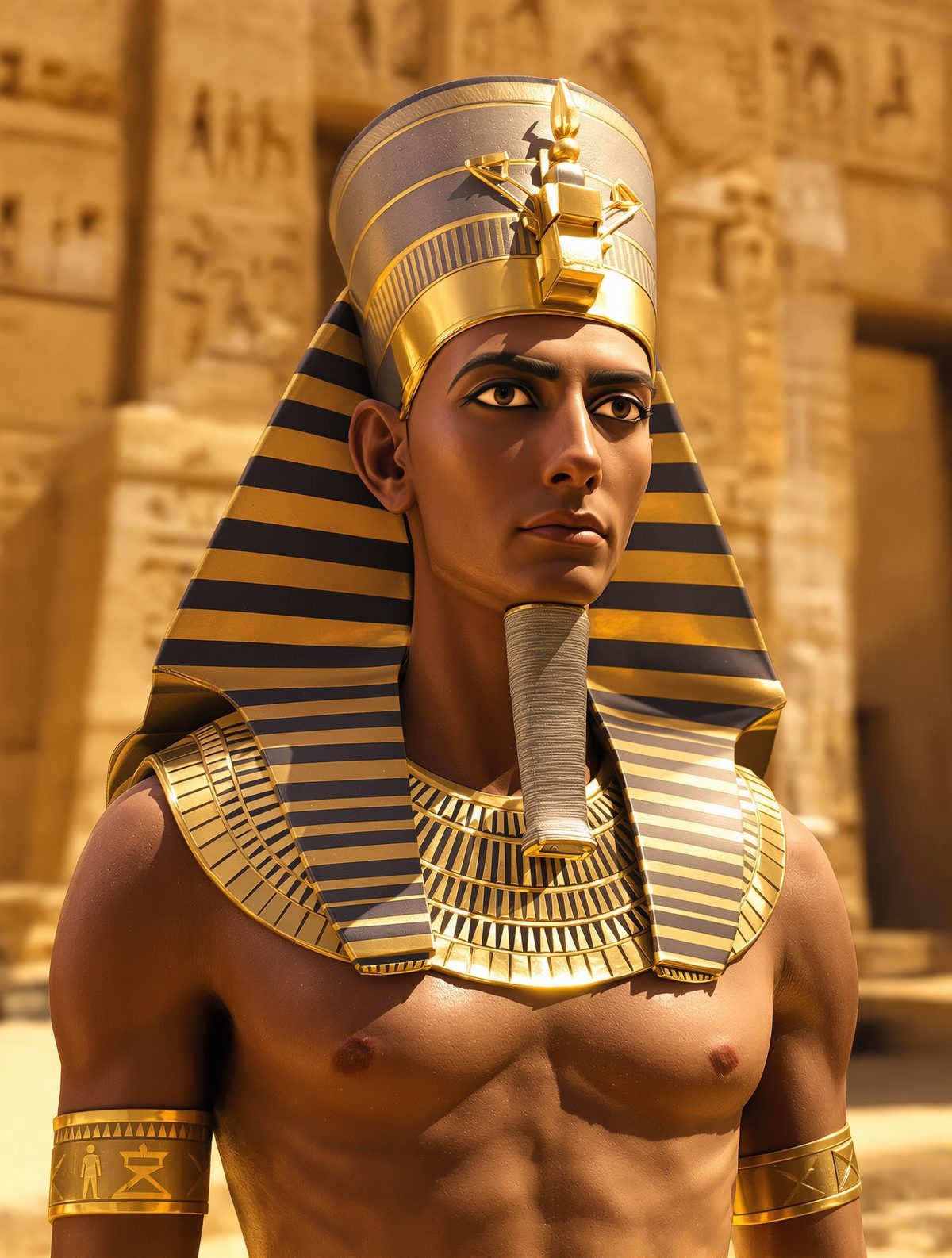
Picture this: You're standing in the throne room of ancient Egypt's most magnificent palace. The year is 1473 BC, and before you sits a figure that defies everything you thought you knew about pharaohs. Adorned in the traditional nemes headdress, clutching the crook and flail of divine kingship, and sporting the ceremonial false beard that marks Egypt's god-king—yet underneath all this royal regalia sits a woman who has pulled off perhaps history's most audacious act of political theater.
Her name was Hatshepsut, and for 22 years, she convinced one of the world's most powerful civilizations that their female ruler was not just acceptable, but divinely ordained. In a world where women were expected to bear children and manage households, she commanded armies, commissioned monuments, and ruled an empire that stretched from Nubia to the Euphrates River.
The Accidental Pharaoh
Hatshepsut never intended to become pharaoh. Born around 1507 BC as the daughter of Thutmose I, she was groomed for the traditional role of a royal woman—to marry her half-brother Thutmose II and provide him with male heirs to continue the dynasty. The plan seemed to work perfectly at first. She became queen, bore a daughter named Neferure, and settled into the expected life of supporting her husband's reign.
But fate had other plans. When Thutmose II died unexpectedly around 1479 BC after ruling for just three years, the succession crisis that followed would reshape Egyptian history. The throne should have passed to his son, Thutmose III—but there was a problem. The boy was only about seven years old, far too young to rule an empire that required constant military campaigns and complex diplomatic negotiations.
Following Egyptian custom, Hatshepsut stepped in as regent, essentially serving as the boy-king's guardian and advisor until he came of age. It was supposed to be a temporary arrangement. Instead, it became the launching pad for one of history's most remarkable political transformations.
From Queen to King: The Great Deception
What happened next was unprecedented in Egyptian history. Sometime around 1473 BC, roughly six years into her regency, Hatshepsut made a decision that would have seemed impossible to her contemporaries: she declared herself pharaoh, not merely regent, but the actual divine ruler of Egypt.
The logistical challenges were enormous. Egyptian kingship wasn't just a political position—it was a religious one. The pharaoh was considered the earthly incarnation of the god Horus, the son of Ra, the divine intermediary between the gods and mortals. Every aspect of royal iconography, from clothing to ceremonial objects, was designed around the assumption that this god-king would be male.
Hatshepsut's solution was breathtakingly bold: she would simply become male, at least in official representation. Royal artists began depicting her wearing the traditional false beard of kingship—a braided, rectangular piece that attached to the chin with leather straps. She adopted masculine royal regalia, including the nemes headcloth and the crossed crook and flail. Most remarkably, she began using masculine grammatical forms in hieroglyphic inscriptions, literally rewriting her gender in stone.
But the transformation went deeper than costume changes. Hatshepsut commissioned official artwork showing her with a male physique—broad shoulders, flat chest, muscular arms. She took on the traditional royal names and titles reserved for male pharaohs. In temple reliefs, she appears performing the ritual acts that only a male pharaoh was supposed to perform, including the ceremonial running that symbolically renewed the king's divine power.
The Divine Marketing Campaign
Perhaps most ingeniously, Hatshepsut didn't just claim male authority—she claimed it was divinely ordained. She commissioned elaborate temple reliefs at Deir el-Bahari that told a remarkable story: the god Amun-Ra himself had chosen her to be pharaoh before her birth. These "divine birth" scenes showed Amun-Ra announcing to the gods that he had selected Hatshepsut to rule Egypt, essentially creating ancient Egypt's most sophisticated propaganda campaign.
The reliefs go even further, depicting the god Khnum physically creating Hatshepsut and her ka (life force) on his potter's wheel, while the frog goddess Heqet breathes life into them. The message was unmistakable: Hatshepsut's rule wasn't just politically legitimate—it was cosmically predetermined.
She also crafted a clever narrative around her relationship with Thutmose III. Rather than presenting herself as a usurper, she positioned their rule as a divinely ordained co-regency. Temple inscriptions show both figures performing pharaonic duties, sometimes even depicting them making offerings to the gods side by side. It was a masterful political move that neutralized potential opposition from Thutmose III's supporters while establishing her own legitimacy.
The Prosperous Reign They Don't Teach
Here's what your history textbook probably didn't tell you: Hatshepsut was spectacularly successful as pharaoh. While later male rulers would try to erase her from history, the archaeological evidence tells a story of unprecedented prosperity and achievement during her 22-year reign.
Unlike many of her predecessors and successors who focused on military conquest, Hatshepsut prioritized trade and construction. She launched ambitious trading expeditions to the mysterious land of Punt (likely modern-day Somalia or Ethiopia), bringing back exotic goods that hadn't been seen in Egypt for generations. These expeditions returned with 31 live frankincense trees—the first successful attempt to transplant these valuable incense-producing plants to Egyptian soil—along with gold, ivory, ebony, and live animals including monkeys and leopards.
Her building projects rivaled those of any pharaoh in Egyptian history. The magnificent mortuary temple at Deir el-Bahari, with its revolutionary terraced design built into the cliffs of the Valley of the Kings, still takes visitors' breath away today. She erected more obelisks than any pharaoh except Ramesses II, including pairs at the temple of Karnak that stood nearly 100 feet tall and weighed approximately 350 tons each.
Perhaps most telling, Egypt enjoyed an extended period of peace during her reign. The usual records of military campaigns and conquered territories are notably absent from Hatshepsut's inscriptions, replaced instead with accounts of successful trade missions and completed construction projects. She proved that pharaonic power could be expressed through prosperity and cultural achievement, not just military might.
The Systematic Erasure
Hatshepsut died around 1458 BC, and what happened next reveals just how threatening her success had been to traditional gender roles. Approximately 20 years after her death, someone—likely Thutmose III, who finally assumed sole power—launched a systematic campaign to erase her from history.
This wasn't just casual neglect; it was deliberate, methodical destruction of her legacy. Workers chiseled her name and image from temple walls, replacing them with the names of Thutmose I, II, or III. Her statues were smashed and buried. Her obelisks were walled up to hide their inscriptions. The famous statue of her in full pharaonic regalia, complete with false beard, was found in 1927 buried in a pit near her temple—suggesting it had been deliberately hidden rather than destroyed.
The erasure was so thorough that Hatshepsut disappeared from historical records for over 3,000 years. When early Egyptologists compiled lists of pharaohs from temple inscriptions, her name was simply missing. It wasn't until archaeological discoveries in the 19th and 20th centuries gradually reconstructed her story that the full scope of her achievements became clear.
Why Hatshepsut's Fake Beard Still Matters
Hatshepsut's story resonates today not just because she was a successful female ruler in an ancient world, but because of how she achieved and maintained power. Faced with a system that excluded her based on gender, she didn't try to change the system—she found a way to work within it while fundamentally subverting it.
That false beard wasn't just a costume piece; it was a revolutionary act wrapped in traditional symbolism. By adopting male royal iconography, Hatshepsut separated the concept of pharaonic power from biological gender, proving that divine kingship was about capability, not chromosomes. She demonstrated that leadership skills—vision, administrative ability, diplomatic acumen, economic management—had nothing to do with being male.
Perhaps most remarkably, she managed to maintain this fiction for over two decades in a civilization where the pharaoh was constantly visible to thousands of courtiers, officials, priests, and foreign dignitaries. Her success suggests she had broad support among Egypt's power brokers, who were apparently willing to accept effective female leadership as long as it was packaged in acceptably masculine symbolism.
In our modern era of ongoing conversations about gender, leadership, and representation, Hatshepsut's story offers both inspiration and sobering reflection. She proved that women could wield absolute power with remarkable success—but also revealed how thoroughly patriarchal societies could erase inconvenient evidence of female achievement. Her fake beard was simultaneously a tool of empowerment and a symbol of the compromises that powerful women have always had to make to succeed in systems designed to exclude them.