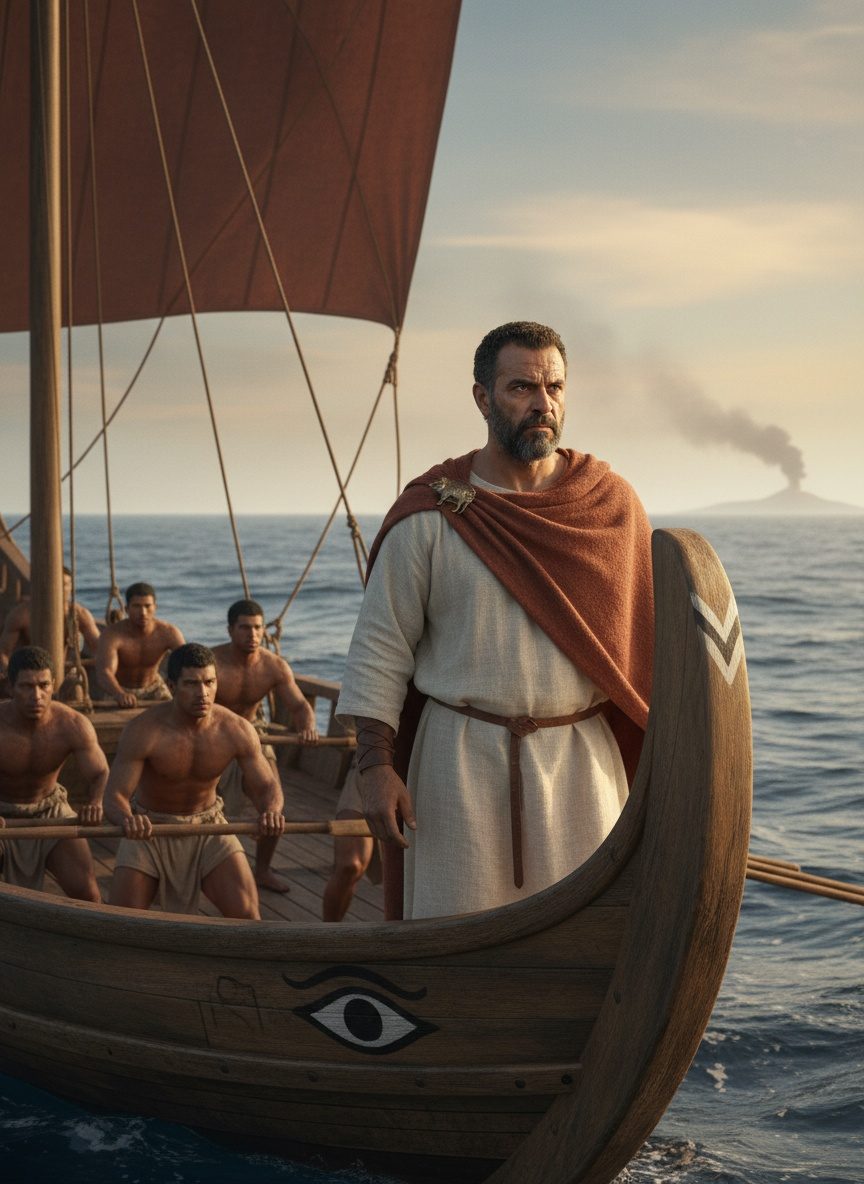
Carthage was a powerful force in ancient times. Yet, few today remember its intrepid explorers.
The Call of the Unknown
In around 500 BCE, Hanno the Navigator set sail with a fleet that dwarfed many others of its day, commanding sixty ships and leading 30,000 colonists on a voyage that beckoned to the edge of the known world. Imagine the anticipation in the bustling port of Carthage as the ships prepared to depart, the air vibrating with a mixture of fear and excitement. At that time, the known world to the Carthaginians—the heirs of the great Phoenician mariners—stretched no further than the familiar confines of local trade routes. Yet beyond the Pillars of Hercules (the modern Strait of Gibraltar), the great unknown lay waiting.
The mission was clear: to explore and colonize the coast of what we now know as West Africa. The journey was as much about ambition as it was survival; Carthage needed new settlements to support its burgeoning population and commerce. As the ships turned southward past the boundary of familiar waters, the crew had little idea of the wonders and perils that lay beyond the horizon.
Not only was Hanno driven by the allure of untamed territories, but by the hopes of establishing Carthaginian supremacy through expansion. It was an audacious undertaking, fraught with potential hazards—from unpredictable weather to the specter of unknown peoples and creatures. Each mile southward was a step further into a world uncharted and unconquered, a testament to Hanno’s leadership and courage.
Into the Uncharted Waters
The unfolding of the journey, recorded in a periplus—a navigational and travel log—was unlike any tale known at the time. As Hanno led his expedition down the African coastline, the landscape transformed dramatically; familiar shores gave way to dense forests and expansive deserts that seemed to stretch on forever. The overwhelming newness of it all, the unfamiliar skies, and the strange cries of unknown animals must have both fascinated and terrified those aboard. Here was a world untouched by Phoenician hands, its secrets guarded by time itself.
Remarkably, Hanno progressed further than any of his contemporaries had before, establishing new colonies along the way to secure footholds for his countrymen and extending the influence of Carthage deep into new territory. At every hastily constructed settlement, new communities took root, each holding the promise of prosperity and survival. But this was only the beginning of the surprises that Hanno and his men would encounter.
As they ventured onwards, they came across otherworldly sights—a mountain that belched fire (perhaps Mount Cameroon) and exotic local tribes whose cultures remained unaffected by the empires of the Mediterranean. Each new discovery was a chapter in a fresh story, one that broadened the comprehension of geography and diversity for those who took the perilous journey and those they left behind in Carthage.
Returning with Tales of Wonder
When Hanno finally turned back and eventually returned to the Carthaginian capital, he brought with him more than just stories. His voyage forged a path that would inspire and provoke curiosity for generations. The atramentous scroll detailing his navigation and the lands he saw—accompanied by enigmatic descriptions of "gorillae"—ignited imagination as much as it did skepticism. What beings could live beyond the borders of familiarity? Were they gods or monsters?
Hanno's account, later read by Greeks and Romans, demonstrated not only the physical reach of ancient exploration but also the daring spirit intrinsic to human nature. While many may have dismissed parts of his narrative as fantastical, such stories inspired a generation of explorers. It was this blend of skepticism and curiosity that propelled humanity beyond the comfort of the known world into the embrace of the extraordinary.
Today, Hanno the Navigator's journey still invites contemplation. It's a reminder of the endless drive for discovery, the courage to traverse into lands unknown, and the realities faced when confronting the unknown’s allure and terror. His journey is more than a historical footnote; it's an enduring testament to the human spirit's longing to explore—and redefine—the boundaries of its world. In a modern age marked by new frontiers in technology and space, Hanno's adventure captures the timeless essence of exploration: the quest for knowledge and the courageous steps into the unknown that each generation must brave anew.