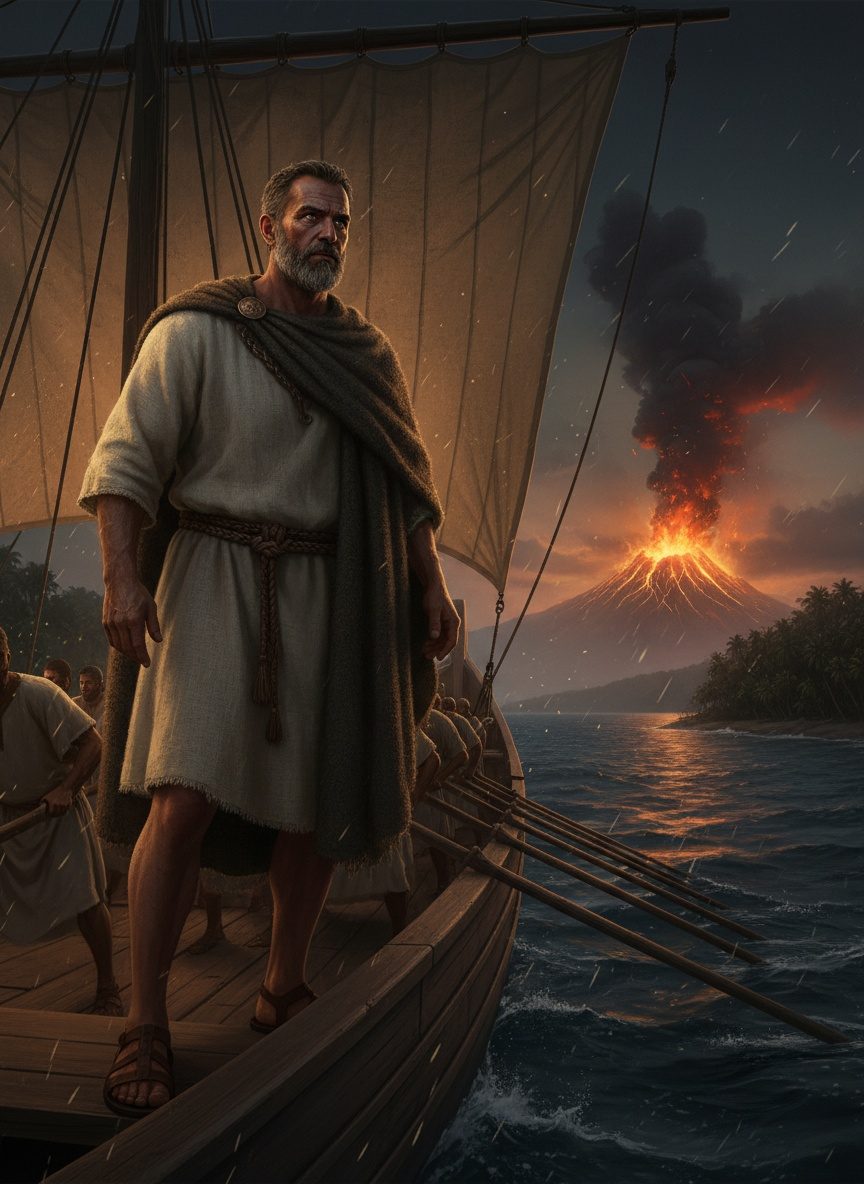
The western horizon glowed with a molten crimson as the sun slipped beneath the waves, casting its final rays upon a fleet of ships poised at the edge of the known world. The bustling harbor of Carthage lay far behind them, now just a memory in the minds of those whose eyes were set on the unknown. The air was thick with anticipation and salt, as the wooden vessels creaked under the weight of their cargo, ready to set sail for lands beyond their ancestors' maps. Those aboard carried with them dreams of discovery, whispered tales of treasure, and the resolve of a people driven by trade and exploration. The Pillars of Hercules marked the gateway to the Atlantic, a boundary no one dared to cross—until now.
Beyond the Pillars: Hanno's Uncharted Adventure
In around 500 BCE, the Carthaginian admiral known as Hanno the Navigator embarked on a daring voyage that would challenge the limits of the ancient world. With sixty ships, each laden with settlers and supplies, he set sail southward along the uncharted coast of Africa. This was not a simple trade expedition. It was a journey into the heart of mystery, undertaken with the knowledge that no Greek, Phoenician, or Egyptian had chronicled what lay beyond those mythic waters. Hanno's mission was to find new lands to settle, regions rich with resources that could fuel the expanding economy of Carthage.
The expedition ventured past the fortified islands of the Mediterranean, navigating the treacherous waters beyond the Strait of Gibraltar. The sailors, skilled yet weary, faced the unpredictable might of the Atlantic Ocean, its vast expanse both challenging and strangely alluring. The stars overhead were their only guides, twinkling serenely as they charted their course along a coastline teeming with primeval wonder. Thick forests flanked the shores, echoing with the cries of creatures as strange as they were unseen, flora and fauna that confounded even the most seasoned explorers amongst them.
Hanno steered his fleet through unknown currents, encountering landscapes untouched by civilization and unmapped by Western knowledge. The sheer audacity of Hanno's journey made it one of the most significant explorations of its age. Each night, embers danced on the horizon from volcanic peaks, the fiery displays awe-inspiring yet foreboding, illuminating the darkness that engulfed their floating city of sails.
Land of Fire and Beasts
As the Carthaginian ships cut through the waters, pushing ever southwards, they encountered vistas that would inspire tales of wonder back home. Dense groves of trees, unlike any seen before, bordered the ocean, with gentle hills rolling to the horizon. From these shores, columns of smoke curled into the sky, the scent of sulfur hinting at the violent geology hidden beneath lush surfaces.
Initially, the locals proved elusive, specters in the shadows, reluctant to disclose whether they viewed these outsiders as friend or foe. Yet, the Carthaginians' quest continued, the thrill of discovery outweighing their fear of the unknown. In time, they established camp on shorelines, their fires flickering echoes of the volcanoes that peppered the land. Reports awaited Hanno's discerning eye back in Carthage, descriptions detailed by keen-eyed navigators, and impressions carved meticulously in stone for posterity.
During their travels, the Carthaginians claimed to encounter wild people, some adorned in skins and speaking in tongues unfamiliar. Perhaps most intriguing were the stories of strange, large creatures inhabiting the forests—animals they struggled to name but which seemed untamed and ferocious. Could these have been descriptions of the mighty gorillas which, according to some interpretations, Hanno's expedition famously described as reminiscent of wild men?
Volcanic activity marked their passage. By day, plumes of smoke heralded landscape contours, and by night, the fiery mouths of craters turned the skies a blood-red hue, reflections shimmering unsettling patterns on the sea. The divine seemed palpably present, tempestuous and unpredictable, living in the fire-tinged nightscape. For the Carthaginians, these were not just lands of strategic interest but realms where the divine aura was tangibly fused with nature.
The Stone Tablet's Silent Witness
When Hanno returned to Carthage, his expedition's impacts rippled through the ancient world like the disturbed waters of the ocean he had mastered. The admiral left behind a legacy in the form of a periplus—a maritime log of sorts etched into stone—documenting the journey in remarkable, if enigmatic, detail. This account, known as the "Periplus of Hanno," remains one of the few surviving testaments to the Carthaginian spirit of exploration and their understanding of the world. It provided a tantalizing peek into territories that the Greeks and Romans would only fully appreciate centuries later.
The carvings spoke of volcanic landscapes and curious encounters, challenging the perceptions of what was geographically possible. These inscriptions survived as silent witnesses to Hanno's odyssey, offering a window onto a world as ancient as it was ever-changing. What was then considered a voyage 'beyond the world' became a part of Carthage's rich tapestry—a story of ambition and the human yearning to explore beyond the horizon.
Hanno's journey proved that the thirst for exploration and the courage to face the unknown were not limited to the modern ages of Columbus or Magellan. It reminds us that ancient civilizations were already reaching out, extending feelers into the world, seeking not just new lands but new opportunities and knowledge. The courage of Hanno the Navigator, encapsulated in those enduring stone symbols, challenges our contemporary understanding of frontiers as merely physical boundaries, urging us instead to redefine them as possibilities of human achievement. In his wake, generations would dream further and venture deeper, guided by the stars and driven by the undying call of the uncharted.