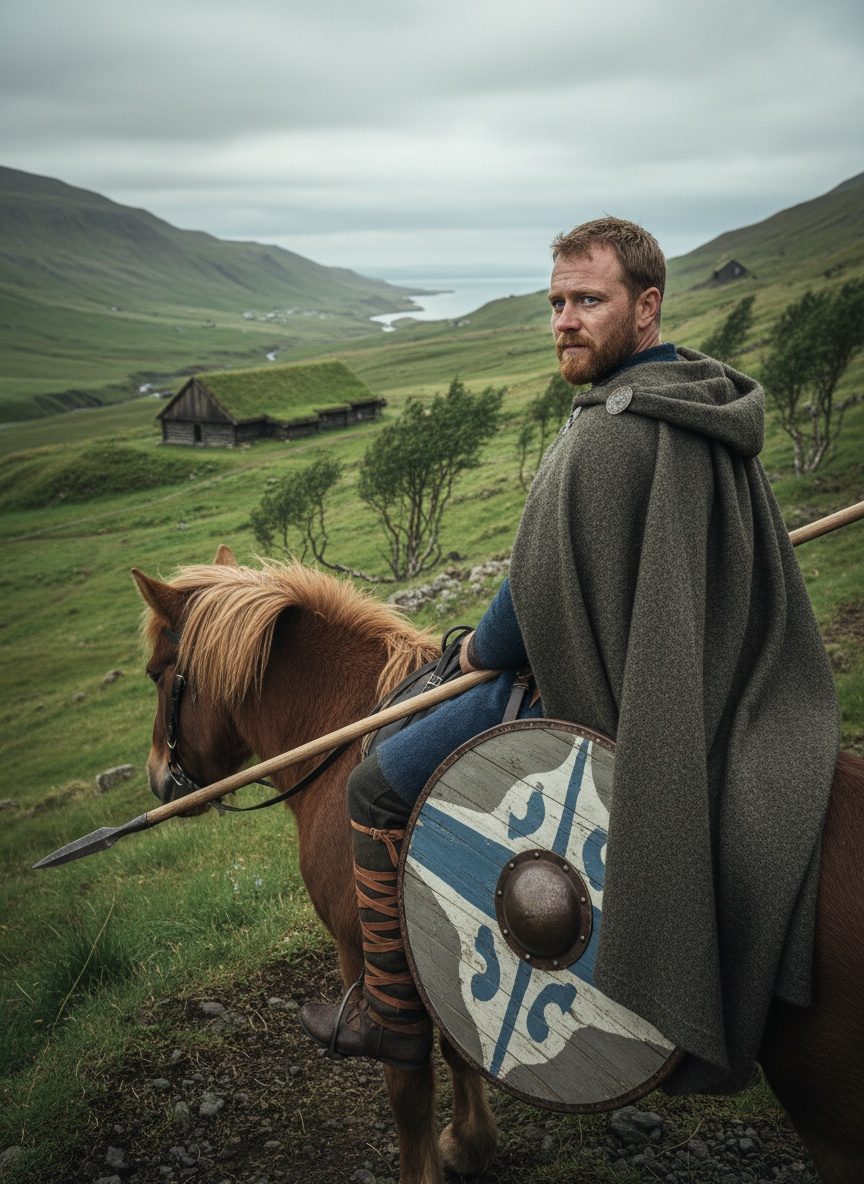
Gunnar of Hlíðarendi was a man with a choice. He chose wrong.
The Proud Farmer of Hlíðarendi
Picture the sweeping landscapes of Iceland in the Viking Age. The hills are a patchwork of green and gray, dotted with sheep and the occasional farmstead. Down in the valley sits a farm known as Hlíðarendi, the home of one of Iceland's most charismatic and gifted chieftains, Gunnar. He was known far and wide not just for his prowess in battle and mastery of weaponry but also for his remarkable skill in horse-riding and his almost uncanny ability to leap as high as his own height in full battle armor. A man of such talents was often a target, admired by some and feared by others.
Gunnar, however, was not merely a man of war. He was equally revered for his fairness, wisdom, and poetry — qualities that endeared him to his friends and made him tolerable even to his enemies. Yet, as the harsh winds of fate would have it, Gunnar's strengths could not protect him from the complexities of Viking-age politics or the perils of vengeance, that insidious element woven into the very fabric of Norse society.
The Sentence of Exile
In the year 990 AD, the hills around Hlíðarendi rustled with the murmurs of looming tragedy. Gunnar had found himself deeply entangled in a blood feud, a common occurrence in a time where family honor and retribution were bound by ancient societal codes. Despite being a figure of strength and justice, Gunnar was sentenced to exile by the Althing, the national parliament of Iceland and one of the oldest in the world. The charge: breaking the peace and fanning the flames of vengeance.
Exile in the Viking Age was akin to a slow death. It meant leaving behind everything — home, family, identity — to wander foreign lands where honor held no currency. For Icelanders, who shared a deep spiritual connection to their land, exile was a punishment more feared than death itself. Gunnar, understanding the gravity of his predicament, presented himself at the docks. His belongings were secured, his noble horse saddled, and the ship poised to sail on the mercurial seas. But it was at this critical juncture that the weight of his attachment became too overwhelming to bear.
The Irreversible Decision
It was a moment that would etch itself into the annals of saga literature as a tale of poignant defiance. As Gunnar rode towards the waiting vessel, he turned to take a final look at his beloved farm nestled upon the slopes of the valley. The sight of his land reminded him of all he held dear; every blade of grass, every vista of the rolling hills was imbued with memories of times when life felt unclouded by strife.
Seeing his home one last time was more than he could bear, and the decision unraveled him in an instant. As his ship bobbed in the harbor, he spun his horse around and headed back. His decision was not born of arrogance but a profound, aching love for his homeland and heritage. This act of turning back was not, however, a hallowed legend to be celebrated. It was an ill-fated violation of his sentence, a high-stakes gamble against the immutable rule of law.
The Price of Defiance
Gunnar’s return to Hlíðarendi was not greeted with applause. Instead, it sealed his doom. His enemies, aware of his defiant return, marshaled their forces. The ensuing conflict mirrored the legendary sagas of Norse myth but carried the weight of reality and consequence. Those who sought vengeance eventually descended upon him, their hearts set on fulfilling the grim duty of enforcing the Althing's verdict.
The final battle unfolded with ferocity matching the unleashed elements, and when the dust settled, Gunnar lay slain — a tragic figure subjugated not by sword or spear, but by his inability to sever the bonds of love for his home. Gunnar's decision to return was an act many of his contemporaries viewed as foolhardy, yet it was also a profoundly human moment that resonates across the ages. His story underscores the inextricable link between identity and place, reminding us of the extraordinary impact of home on the heart.
The saga of Gunnar of Hlíðarendi reveals a narrative far more profound than a mere historical anecdote. In refusing to abandon his home, Gunnar's decision becomes a timeless reflection of the human spirit's longing for belonging and the dire costs of defying societal edicts. His tale enfolds the whispers of Iceland's green hills and the murmurs of every exile faced with an impossible choice. The landscape continues to echo with his story, reminding us of the perilous intersection between personal desire and communal duty, where even the most valiant might find themselves overwhelmed by the tender call of home.