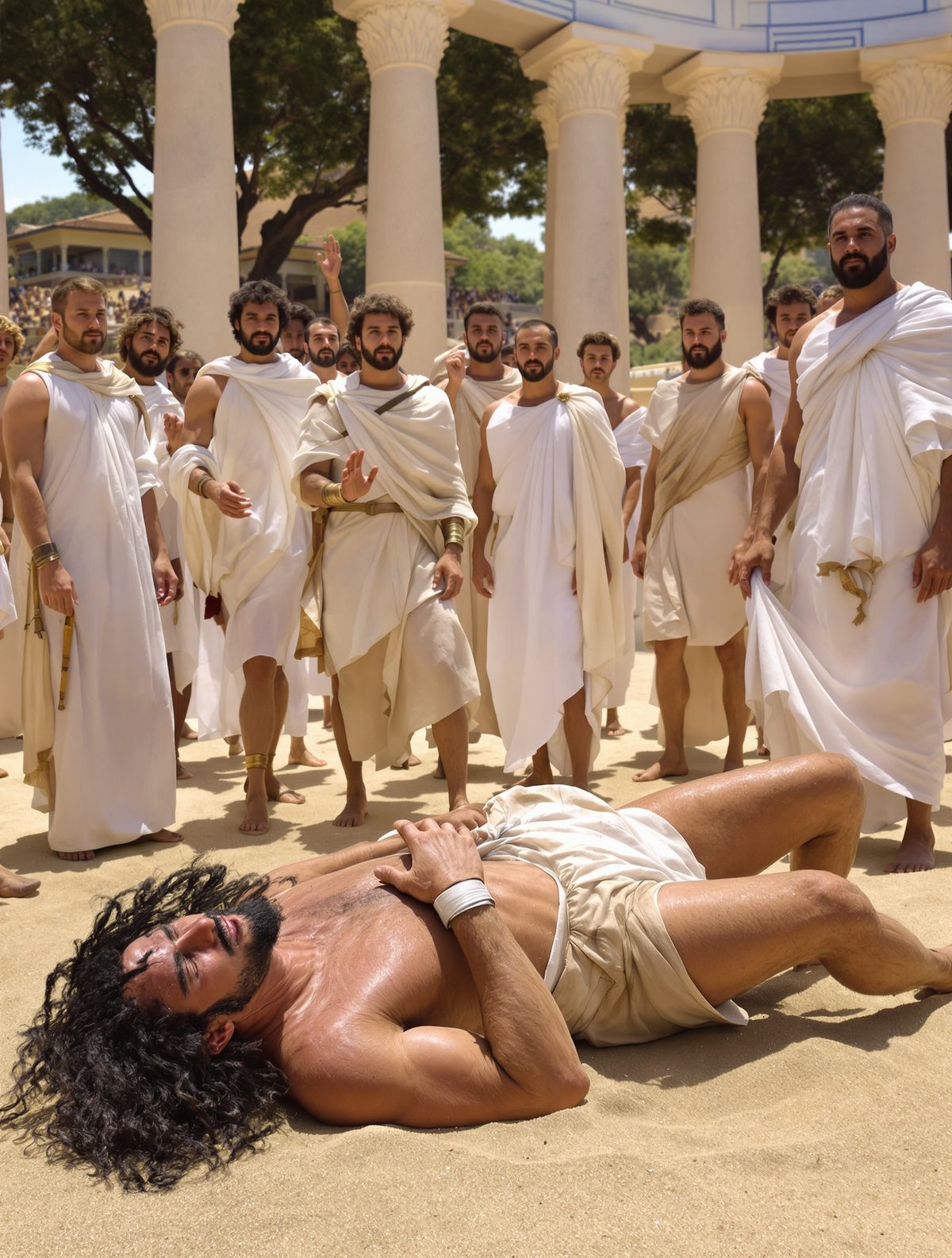
Picture this: You're a wealthy Sicilian merchant in 71 BC, leading Roman officials through your family's private shrine. Your grandfather's collection of Greek bronzes gleams in the Mediterranean sunlight—statues passed down for generations, each worth a small fortune. The governor nods appreciatively, asking detailed questions about provenance and craftsmanship. You're honored by his interest. Three days later, Roman soldiers arrive at your door with wagons. The governor has decided your collection would look better in his villa. Resist, and you'll find yourself facing trumped-up charges in his court. Welcome to Sicily under Gaius Verres, where being governor meant having the world's most powerful shopping list.
The Art Thief Who Ruled an Island
When Gaius Verres arrived in Sicily as governor in 73 BC, he stepped into what was essentially a three-year, all-expenses-paid art heist with legal immunity. Sicily wasn't just any Roman province—it was a glittering jewel of Greek culture, stuffed with centuries of artistic treasures from the greatest sculptors and painters of the ancient world. Temples housed masterpieces by Praxiteles and Polykleitos. Private villas displayed collections that would make modern museum curators weep with envy.
Verres saw all of this and decided it should be his.
Unlike typical corrupt governors who focused on skimming taxes or selling offices, Verres had refined tastes and bottomless greed. He possessed what Cicero would later describe as "an insatiable passion for art" combined with "the morals of a pirate." This wasn't random pillaging—this was systematic, informed theft conducted by someone who could distinguish a genuine Myron from a talented copy at fifty paces.
The governor's methods were elegantly simple. He would tour Sicily under the pretense of official business, identifying the finest pieces in temples and private collections. Then came the demands, always framed as "requests" that no one dared refuse. When subtle pressure failed, Verres escalated to legal threats, manufactured charges, and outright confiscation. In three years, he transformed his personal villa into what was arguably the finest art gallery in the Roman world—using other people's treasures.
Sacred Spaces, Stolen Masterpieces
Verres's most audacious thefts targeted Sicily's temples, where some of the ancient world's greatest masterpieces had been safeguarded for centuries. In Messana, he coveted a magnificent ivory and gold statue of Cupid by the legendary Praxiteles—the same Cupid that had once graced the famous shrine at Thespiae. The statue was so renowned that tourists traveled from across the Mediterranean just to see it.
When the citizens of Messana initially refused to surrender their treasure, Verres simply changed tactics. He threatened to quarter Roman soldiers in their homes indefinitely unless they "voluntarily" gifted him the statue. Faced with financial ruin, the city capitulated. The Praxiteles Cupid was carefully crated and shipped to Verres's villa, leaving behind an empty pedestal and a furious population.
But the governor was just getting started. In Syracuse, he set his sights on an even bigger prize: a collection of paintings by Zeuxis that decorated the Temple of Minerva. These weren't just any paintings—Zeuxis was considered one of the greatest artists who ever lived, famous for works so realistic that birds would try to eat painted grapes. Rather than steal the paintings outright, Verres ordered his men to carefully remove the temple's wooden panels and replace them with cheap imitations. The sacred space remained "decorated," but the originals sailed off to adorn Verres's dining rooms.
Perhaps most shocking was his treatment of the shrine at Assorus, where he stole a bronze statue of Hercules so ancient and revered that locals believed touching it brought good fortune. When the priest tried to hide the statue, Verres had him beaten and thrown into prison. The bronze Hercules, worn smooth by centuries of worshipful hands, ended up decorating Verres's garden.
The Villa That Became Rome's Greatest Gallery
By 71 BC, Verres's villa had become the talk of Rome—and not just among art lovers. Dinner invitations to his estate were coveted by the city's elite, who came as much to gawk at his incredible collection as to enjoy his famously lavish banquets. Guests would wander through rooms lined with masterpieces, each piece representing not just artistic genius but also Verres's unchecked power over an entire province.
The villa's layout read like a catalog of ancient art history. The atrium featured a collection of bronze athletes by various Greek masters, their muscled forms catching the light from specially positioned lamps. Verres had actually hired architects to redesign rooms specifically to showcase stolen pieces—essentially creating custom galleries for his ill-gotten gains. The dining room walls displayed those precious Zeuxis paintings from Syracuse, while the garden paths wound between marble gods and heroes plucked from Sicily's temples.
What made Verres's collection particularly impressive wasn't just its quality, but its coherence. This wasn't the random accumulation of a magpie collector, but the curated selection of someone with deep knowledge of art history. He targeted specific artists, hunted down famous pieces mentioned in travel guides, and even commissioned detailed copies of works he couldn't steal outright. Roman society had never seen anything like it—a private citizen commanding artistic treasures that rivaled the collections of kings.
The psychological effect was intentional. Every dinner guest, every important visitor to Rome who toured the villa, received the same message: Verres could take whatever he wanted, from whomever he wanted, wherever he wanted. His art collection wasn't just about beauty—it was a monument to absolute power.
When Sicily Finally Fought Back
For three years, Verres seemed untouchable. His political connections in Rome, combined with his distance from direct oversight, gave him what appeared to be carte blanche for his cultural pillaging. But the Sicilians were keeping track of every stolen statue, every plundered painting, every violated temple. They were building a case.
When Verres's governorship finally ended in 70 BC, a delegation of prominent Sicilians traveled to Rome with an unusual request. Rather than seeking financial compensation for the standard gubernatorial corruption, they wanted their art back. They approached Marcus Tullius Cicero, already famous as Rome's greatest orator, and asked him to prosecute Verres for what would become the ancient world's most spectacular art theft trial.
Cicero was initially skeptical—corruption trials were common, but this case seemed almost absurdly focused on luxury items rather than serious crimes. Then he saw the evidence. The Sicilians had documented everything: detailed inventories of stolen pieces, witness testimonies from priests and collectors, even architectural drawings showing how temple decorations had been removed. The compiled evidence filled seven scrolls and read like a catalog of the ancient world's greatest missing masterpieces.
What transformed this from a simple corruption case into a sensation was Cicero's decision to treat it as a crime against civilization itself. In his famous Verrine Orations, he argued that Verres hadn't just stolen property—he had violated the sacred trust between Rome and its provinces, desecrated religious spaces, and turned the power of governance into a tool for personal enrichment on an unprecedented scale.
The Trial That Rocked Rome
The trial of Gaius Verres became the entertainment event of 70 BC. Cicero's prosecution strategy was brilliant in its simplicity: he let the stolen art tell its own story. Rather than focusing on legal technicalities, he paraded witness after witness before the court, each describing a specific theft in vivid detail. A priest from Messana testified about soldiers dragging the Praxiteles Cupid from its sacred pedestal. Citizens from Syracuse described watching helplessly as workers dismantled their temple's decorations.
But Cicero's masterstroke was demanding that Verres produce the stolen items as evidence. The great orator essentially forced Rome's elite to confront the physical reality of the crimes by viewing the plundered treasures themselves. Imagine the scene: senators and judges examining the bronze Hercules from Assorus while its former priest testified about its theft, or studying the Zeuxis paintings while Syracusan officials described their removal from the temple walls.
Verres's defense team found themselves in an impossible position. They couldn't deny that their client possessed the artworks—everyone in Rome had seen his villa. They couldn't claim the pieces were legally acquired—the documentation was too thorough. Instead, they fell back on arguing that such thefts were normal perquisites of provincial governance, essentially admitting guilt while claiming it didn't matter.
The strategy backfired spectacularly. Faced with overwhelming evidence and Cicero's devastating oratory, Verres didn't even wait for a verdict. Midway through the trial, he abandoned his defense and fled Rome for exile in Massilia (modern Marseilles), leaving behind his incredible art collection and his reputation in ruins.
The Collector's Ironic End
The story of Gaius Verres contains one final, darkly ironic twist that brings his tale full circle. After decades in comfortable exile, enjoying the artistic treasures he had managed to take with him, Verres met his end in 43 BC during the political purges that followed Julius Caesar's assassination. But he wasn't killed for his political activities or past corruption.
Mark Antony had Verres executed because the exiled governor still possessed art that Antony wanted for himself. The man who had built his fortune and reputation on stealing other people's cultural treasures was ultimately murdered by someone who employed the exact same logic—that superior power justified taking beautiful things, regardless of their rightful ownership.
The parallel was so perfect that even ancient historians commented on it. Verres had spent his career arguing that might made right when it came to artistic property. In the end, someone mightier than himself applied that same principle, and the collector became the collected.
Meanwhile, back in Sicily, many of the stolen treasures were eventually returned to their original homes. The Praxiteles Cupid went back to Messana, the Zeuxis paintings were restored to Syracuse's Temple of Minerva, and the bronze Hercules resumed its place in the shrine at Assorus. But the precedent had been set, and throughout the Roman Empire's history, powerful governors would remember Verres's example—not as a cautionary tale about the limits of power, but as inspiration for what determined theft could accomplish.
Today, when we read about looted antiquities in private collections or cultural treasures "acquired" during colonial periods, we're seeing echoes of Gaius Verres's logic. The governor's three-year spree in Sicily established a template that powerful people have followed for over two millennia: identify beautiful things, take them using whatever authority you possess, and then enjoy them while hoping the world eventually forgets how you got them. The names change, the locations shift, but the fundamental crime remains remarkably consistent—the theft of cultural heritage disguised as the privilege of power.