Picture this: It's a blazing hot day in 240 BC, and while most people in Alexandria are seeking shade, one man is obsessed with shadows. Eratosthenes, the head librarian of the world's greatest library, stands transfixed by a simple wooden stick he's planted in the ground. To passersby, he might look like he's lost his mind. But this Greek scholar is about to accomplish something extraordinary—he's going to measure the entire Earth using nothing more than that stick, some basic math, and one of the most elegant experiments in human history.
What Eratosthenes achieved that day would make modern scientists weep with admiration. While most of the ancient world was still arguing about whether the Earth was flat, round, or sitting on the back of a giant turtle, this brilliant librarian calculated our planet's circumference to within 2% accuracy. No satellites, no GPS, no advanced instruments—just shadows, geometry, and pure human ingenuity.
The Librarian Who Knew Everything
Eratosthenes wasn't your typical bookworm. Born around 276 BC in Cyrene (modern-day Libya), he was what the Greeks called a pentathlos—someone who excelled at multiple disciplines. His colleagues nicknamed him "Beta" because he was supposedly the second-best scholar in every field he touched. Mathematics, astronomy, poetry, geography, music theory—you name it, Eratosthenes had mastered it.
When he became chief librarian of the Great Library of Alexandria around 245 BC, he held what was arguably the most prestigious intellectual position in the ancient world. The library housed over 400,000 scrolls and attracted the greatest minds of the Mediterranean. Think of it as Google headquarters, Harvard, and the Library of Congress all rolled into one magnificent institution.
But Eratosthenes had a restless mind that couldn't be contained by even the world's greatest collection of knowledge. He was particularly fascinated by a curious piece of information that had reached him from the southern Egyptian city of Syene (modern-day Aswan), about 500 miles south of Alexandria.
The Mystery of the Missing Shadows
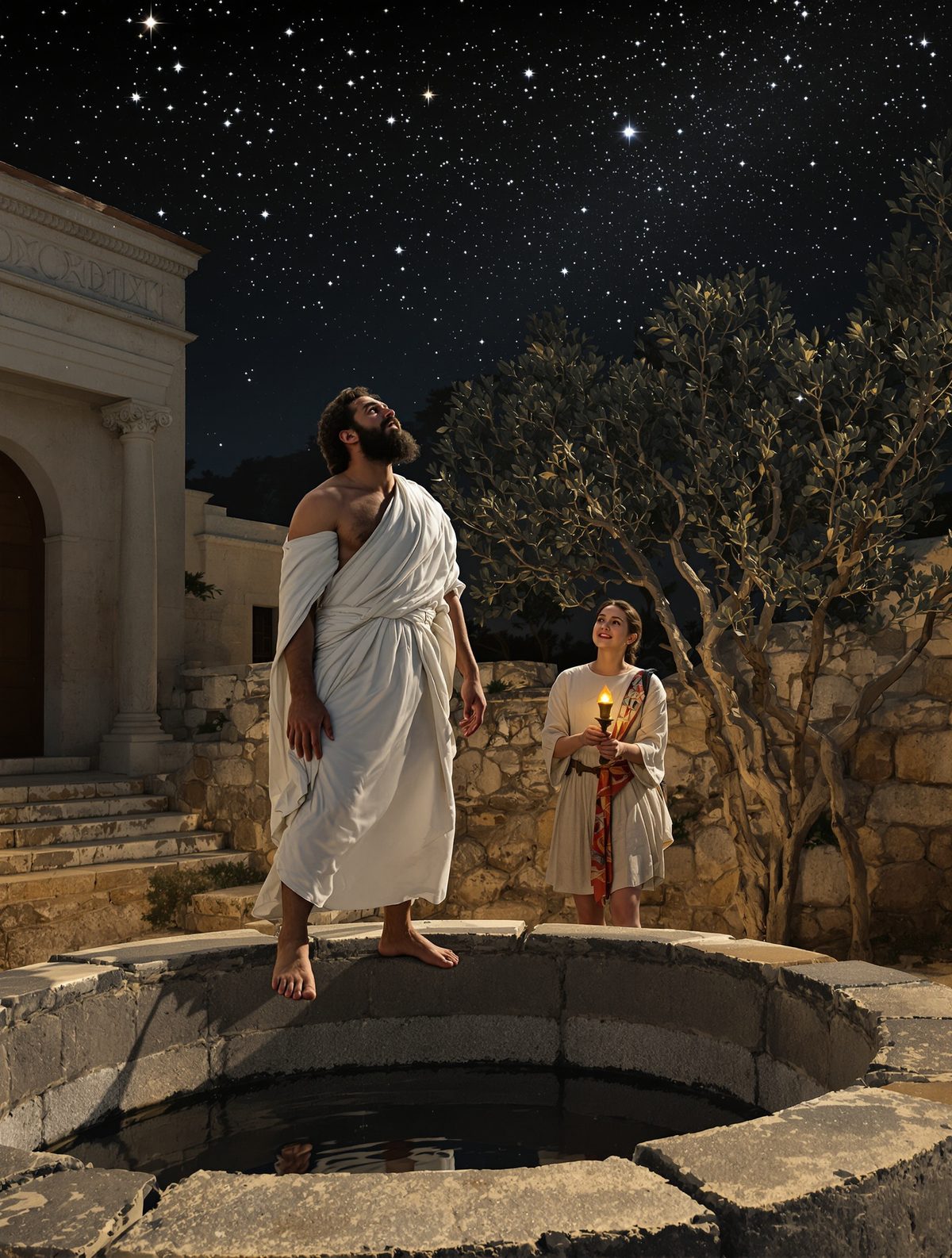
The story goes that Eratosthenes had heard about something remarkable that happened in Syene every year on the summer solstice, around June 21st. At precisely noon on this day, the sun shone directly down deep wells without casting any shadows on the sides. Vertical objects cast no shadows at all. The sun was positioned perfectly overhead, like a cosmic spotlight beaming straight down.
This wasn't just local folklore—it was a well-documented phenomenon. Syene was famous for sitting almost exactly on the Tropic of Cancer, the northernmost point where the sun appears directly overhead at least once per year. Ancient Egyptians had known about this for centuries, but they'd never thought to use it for anything more than impressive party tricks and religious ceremonies.
Eratosthenes, however, saw something different. His mathematical mind immediately grasped the implications. If the sun cast no shadows in Syene at noon on the summer solstice, but did cast shadows in Alexandria at the exact same moment, then the Earth's surface had to be curved. And if it was curved, he could calculate just how curved it was.
The Experiment That Changed Everything
On the summer solstice of 240 BC, Eratosthenes conducted what might be history's most elegant scientific experiment. He planted a vertical stick (called a gnomon) in the ground in Alexandria and waited for noon. As the sun reached its highest point, he carefully measured the angle of the shadow cast by his stick.
What he found was that the shadow formed an angle of approximately 7.2 degrees—or about one-fiftieth of a complete 360-degree circle. This was his eureka moment. If the sun's rays were parallel (which they effectively are, given that the sun is 93 million miles away), and the stick in Syene cast no shadow while his stick in Alexandria cast a shadow of 7.2 degrees, then Alexandria had to be positioned at a 7.2-degree curve away from Syene on the Earth's surface.
The math that followed was breathtakingly simple. If 7.2 degrees represented the distance between Alexandria and Syene, and this was one-fiftieth of a complete circle, then the total circumference of the Earth had to be 50 times the distance between the two cities.
Now he just needed to know exactly how far apart the cities were. This is where the story gets even more impressive. Eratosthenes didn't have modern surveying equipment or satellite imagery. Instead, he relied on the most accurate method available: professional pacers. These were people whose job it was to walk long distances while carefully counting their steps, providing reasonably accurate measurements for ancient trade and military purposes.
The Calculation That Stunned the World
According to the pacers, Alexandria and Syene were approximately 5,000 stadia apart. A stadium was an ancient Greek unit of measurement, and while scholars still debate its exact length, most estimates put it at about 157 meters. This meant the distance between the cities was roughly 785 kilometers (487 miles).
Eratosthenes did the multiplication: 5,000 stadia × 50 = 250,000 stadia for the Earth's complete circumference. Converting this to modern measurements gives us approximately 39,250 kilometers (24,390 miles).
The actual circumference of Earth? 40,075 kilometers (24,901 miles). Eratosthenes was off by less than 2%.
Let that sink in for a moment. Using a stick, some shadows, and basic geometry, a librarian in ancient Egypt calculated the size of our entire planet with an accuracy that wouldn't be significantly improved upon for over 1,500 years. When European explorers finally circumnavigated the globe in the 16th century, their measurements confirmed what Eratosthenes had figured out with his elegant experiment.
The Man Who Mapped the World
This wasn't Eratosthenes' only groundbreaking achievement. Riding high on his success, he went on to create the first systematic world map with lines of latitude and longitude. He calculated the tilt of Earth's axis with remarkable precision. He even estimated the distance to the sun and moon, coming surprisingly close despite having no telescopes or modern instruments.
Perhaps most importantly, he coined the term "geography" (literally "earth-writing" in Greek) and essentially founded the discipline as we know it today. His three-volume work Geographica became the standard reference for centuries, influencing everyone from Roman generals planning conquests to medieval scholars preserving ancient wisdom.
But Eratosthenes paid a price for his brilliance. In his later years, he developed a painful eye condition that gradually led to blindness. Unable to read the scrolls that had been his lifelong passion, the great scholar reportedly starved himself to death around 194 BC at the age of 82. Even his final act was one of intellectual choice and mathematical precision.
Why This Ancient Experiment Still Matters
In an age when some people still believe the Earth is flat despite overwhelming evidence to the contrary, Eratosthenes' experiment feels almost prophetic. His story reminds us that scientific truth doesn't require expensive equipment or advanced degrees—just careful observation, logical thinking, and the courage to question conventional wisdom.
The librarian's stick experiment also demonstrates something profound about human knowledge. While we often think of scientific progress as a steady march forward, the truth is more complex. Eratosthenes proved the Earth was round and calculated its size in 240 BC, yet a thousand years later, many people had forgotten or rejected this knowledge. Scientific truth, it turns out, requires not just discovery but also preservation and transmission—something this head librarian understood better than most.
Today, as we grapple with climate change, space exploration, and artificial intelligence, we could learn something from Eratosthenes' approach. He didn't just collect information; he connected dots across disciplines, asked bold questions, and wasn't afraid to challenge the conventional wisdom of his time. In our increasingly specialized world, we need more pentathlos thinkers—people who can see the big picture and make unexpected connections.
The next time you see your shadow on a sunny day, remember Eratosthenes. That simple interplay of light and darkness once helped a curious librarian unlock one of the universe's fundamental secrets. Sometimes the most profound discoveries are hiding in the most ordinary moments, waiting for someone with the right combination of knowledge, creativity, and wonder to notice them.