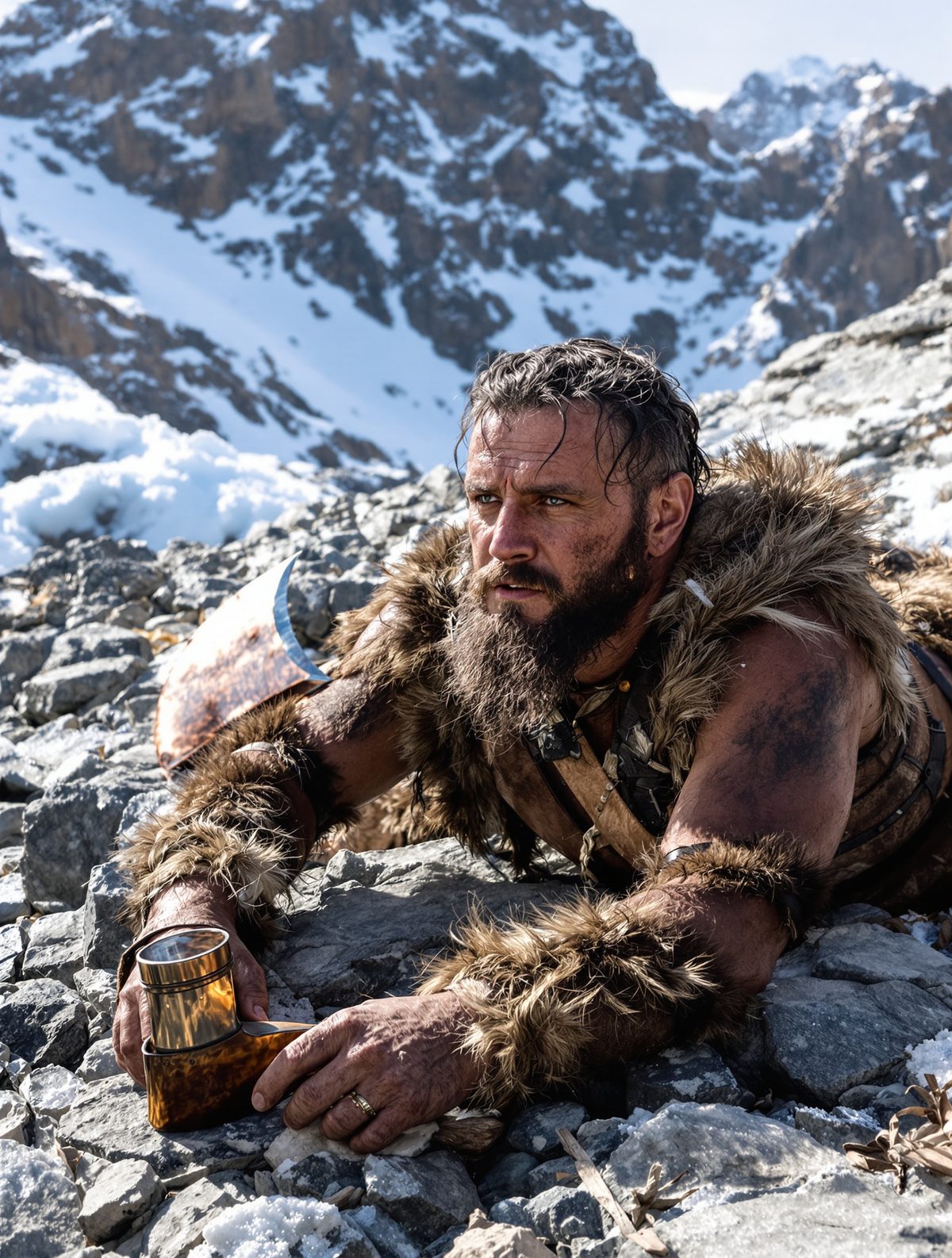
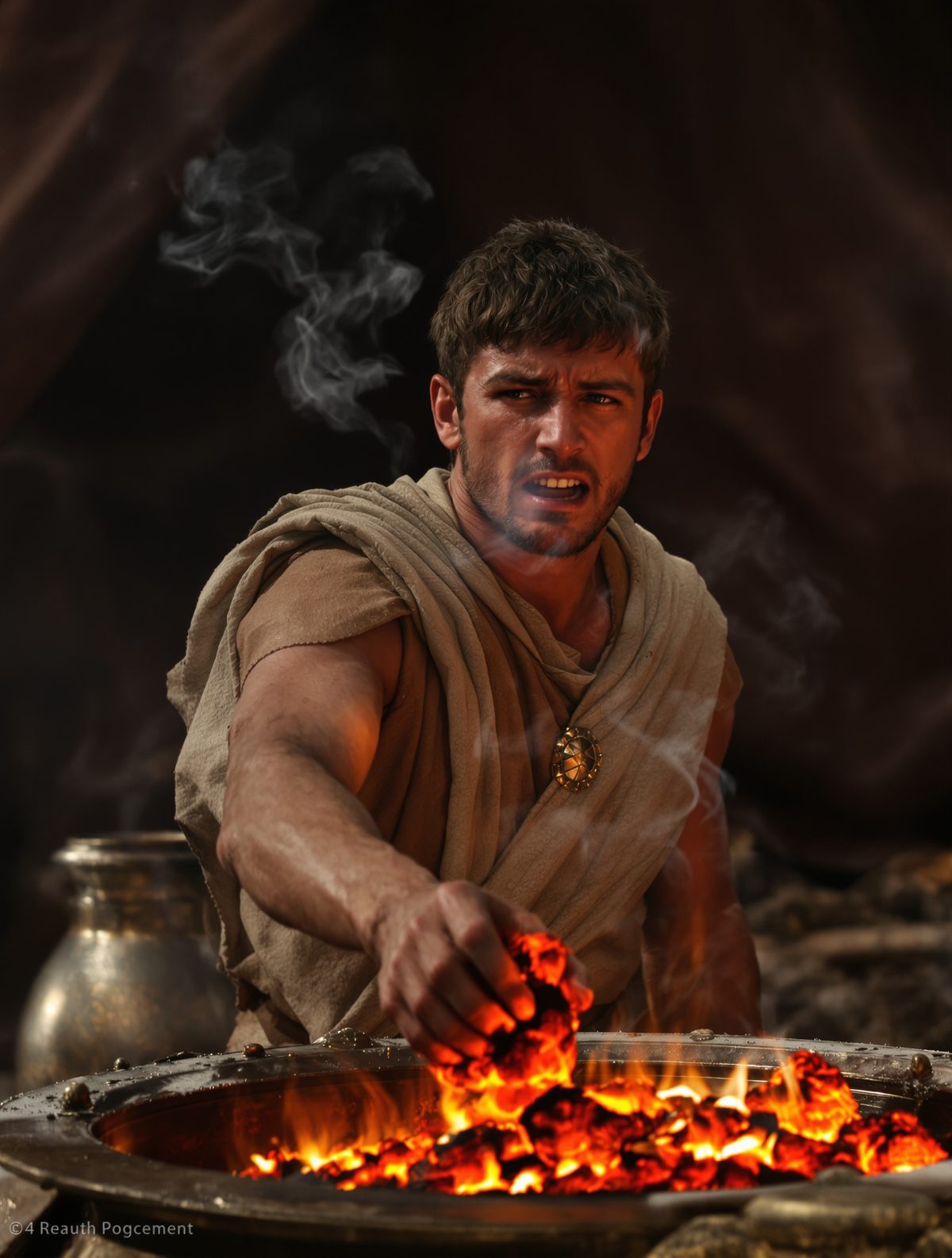
Picture this: It's a scorching summer day in 240 BC, and you're standing at the bottom of a well in the ancient Egyptian city of Syene. You look up, and something miraculous happens—you can see the sun's reflection perfectly in the water below. No shadows. No darkness. Just pure, unobstructed sunlight streaming straight down the shaft. Now imagine traveling 500 miles north to Alexandria, and at that exact same moment, every column, every statue, every stick in the ground is casting a shadow. Two cities, one sun, completely different realities.
Most people would shrug this off as a curious coincidence. But Eratosthenes of Cyrene wasn't most people. This brilliant Greek mathematician was about to use this simple observation to pull off one of history's most elegant scientific achievements—measuring the entire Earth using nothing more than shadows, basic geometry, and a man willing to pace the desert for 500 miles.
The Librarian Who Saw Beyond Books
Eratosthenes wasn't just any scholar lounging around ancient Alexandria. He was the chief librarian of the Great Library, arguably the most prestigious intellectual position in the ancient world. Imagine being the head curator of humanity's entire collection of knowledge—every scroll, every map, every mathematical treatise that mattered passed through his hands.
But here's what makes Eratosthenes fascinating: his colleagues called him "Beta"—literally meaning "second best"—because he was excellent at everything but the absolute master of nothing. He was a mathematician, geographer, poet, astronomer, and music theorist. In today's world, we'd call him a Renaissance man, except he predated the Renaissance by nearly 2,000 years.
The shadow observation that would change everything came from reports filtering into Alexandria about the famous wells of Syene (modern-day Aswan). Local residents had long celebrated the summer solstice because it was the one day each year when the sun shone directly down their wells, illuminating the water at the bottom without casting any shadows along the walls. They even had a festival for it.
When Shadows Whispered Earth's Secrets
On June 21st, 240 BC, while the wells of Syene basked in shadowless noon, Eratosthenes stood in Alexandria measuring shadows with the precision of a master craftsman. He chose a perfectly vertical stick—what we might call a gnomon today—and carefully measured both its height and the length of its shadow at the exact moment when the sun reached its highest point.
Here's where his genius shines: most people saw two unrelated local phenomena. Eratosthenes saw the curvature of the Earth itself. If the Earth were flat, he reasoned, the sun would create identical shadows everywhere at the same time. But if the Earth were round—and by 240 BC, educated Greeks already knew it was—then the sun's rays would strike different locations at slightly different angles.
Using basic geometry that would make any high school student proud, Eratosthenes calculated the angle of his shadow in Alexandria. The measurement was beautifully simple: the shadow's length compared to the stick's height revealed that Alexandria sat exactly 7.2 degrees along Earth's curve from Syene. Since a complete circle contains 360 degrees, this meant the distance between the two cities represented exactly one-fiftieth of Earth's total circumference.
The World's First Long-Distance Surveyor
Now came the challenge that would make or break the entire experiment: accurately measuring the distance between Alexandria and Syene. This wasn't like checking Google Maps—Eratosthenes needed precision across 500 miles of ancient Egyptian desert and Nile River valley.
Enter one of history's most unsung heroes: a professional bematist. These remarkable individuals were trained from childhood to walk with perfectly consistent steps, essentially becoming human measuring devices. Eratosthenes hired one of these walking calculators to pace the entire distance between the two cities, counting every single step.
The bematist's report came back: approximately 5,000 stadia. Now here's where things get historically murky in the most fascinating way—we're not entirely certain which version of the "stadium" measurement Eratosthenes used. Ancient civilizations had multiple standards, kind of like how we have both miles and kilometers today, except far more confusing.
But regardless of which stadium he used, Eratosthenes' math was flawless. If 5,000 stadia represented one-fiftieth of Earth's circumference, then the full circumference had to be 250,000 stadia. Converting this to modern measurements, depending on which stadium standard he employed, gives us a result between 24,662 and 27,967 miles.
The Calculation That Stunned the Ancient World
Earth's actual circumference at the equator is 24,901 miles. Let that sink in for a moment. Using shadows, footsteps, and geometry that hadn't changed since Euclid, Eratosthenes came within 2% of the correct answer. In 240 BC. Without telescopes, satellites, or any technology more advanced than a stick and some string.
To put this achievement in perspective, Christopher Columbus—1,732 years later—based his voyage calculations on wildly inaccurate Earth measurements that estimated our planet as roughly 25% smaller than it actually is. If Columbus had used Eratosthenes' calculations instead of the flawed estimates popular in his era, he might have reconsidered the feasibility of sailing west to reach Asia.
But here's perhaps the most mind-blowing aspect: Eratosthenes didn't just measure Earth's circumference. His method also allowed him to calculate the planet's diameter (approximately 7,850 miles—he nailed this one too) and even estimate the distances to the sun and moon using similar geometric principles.
The Man Who Mapped the World
Fresh off his Earth-measuring triumph, Eratosthenes didn't rest on his laurels. He revolutionized geography by creating the first systematic world map using a grid system—essentially inventing latitude and longitude lines 2,000 years before GPS made them household concepts.
His geographical work was so advanced that he calculated the tilt of Earth's axis (23.5 degrees—correct again) and created a star catalog containing 675 stars. He even invented the leap year concept to keep calendars aligned with Earth's actual orbital period.
Perhaps most remarkably, Eratosthenes used his Earth measurements to speculate about other continents. He theorized that if you sailed west from Spain, you'd eventually reach land—but he correctly calculated that the journey would be far too long for ancient ships to survive. Columbus should have listened.
Why Ancient Footsteps Still Matter Today
In our age of satellite imagery and GPS precision, it's easy to dismiss Eratosthenes' achievement as a historical curiosity. But his legacy runs far deeper than one brilliant calculation. He demonstrated something profound about human curiosity and scientific method: the willingness to see connections where others see coincidences, to ask "why" when others accept "what," and to trust logical reasoning even when it leads to conclusions that seem impossible.
Every time a scientist uses indirect measurement to study something too large, too distant, or too dangerous to examine directly—from calculating the size of atoms to measuring the expansion of the universe—they're following the methodological blueprint Eratosthenes established with his shadows and footsteps.
More than that, his story reminds us that breakthrough discoveries don't always require breakthrough technology. Sometimes the most elegant solutions come from combining careful observation, creative thinking, and the courage to believe that simple tools can unlock profound truths. In an era when we often assume progress requires ever-more sophisticated equipment, Eratosthenes proves that human ingenuity remains our most powerful instrument.
The next time you notice your shadow at noon, remember: you're seeing the same evidence of Earth's curvature that inspired one of humanity's greatest intellectual achievements. The difference between casual observation and scientific breakthrough isn't always what you see—it's what you choose to do with what you're seeing.