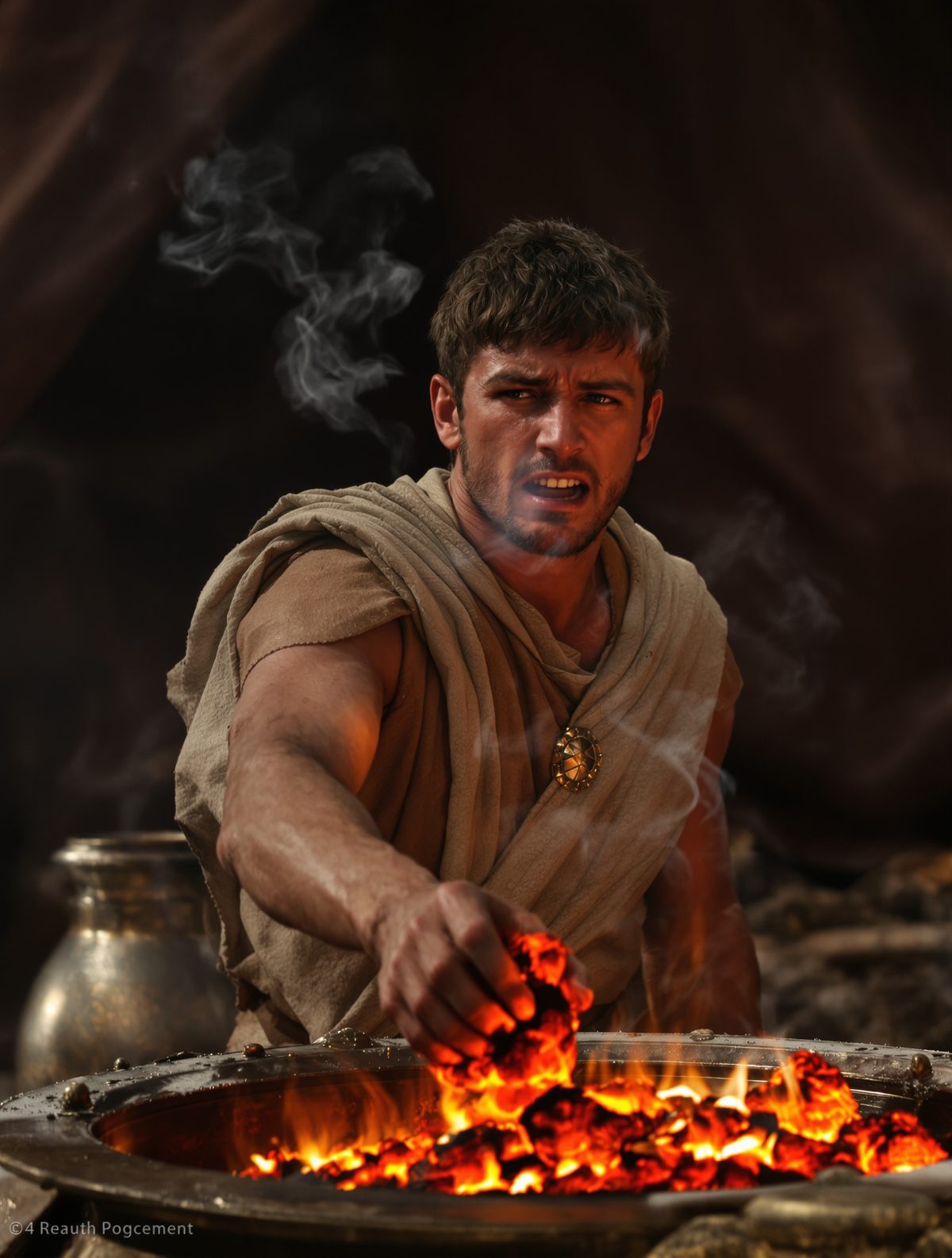
Picture this: a man stumbles through knee-deep snow, his left shoulder burning with agony as blood seeps through his leather tunic. An arrow shaft protrudes from his back—a killing shot fired by someone he trusted enough to let approach from behind. He collapses in a rocky gully high in the Alps, pulls the arrow from his wound, and slowly bleeds to death as snow begins to cover his body. Within hours, he's frozen solid. Within days, he's buried under ice that won't melt for over five millennia.
On September 19, 1991, two German hikers named Helmut and Erika Simon were trekking through the Ötztal Alps when they spotted something brown protruding from the ice. At first, they assumed it was just another unfortunate modern climber—the mountains claimed several victims each year. But as they looked closer at the leathery remains, something felt different. The body looked ancient.
They had no idea they were staring at the world's oldest solved murder case.
The Iceman Emerges from His Frozen Tomb
What the Simons discovered at 10,530 feet above sea level was nothing short of miraculous. The body, later nicknamed Ötzi after the Ötztal region where he was found, had been naturally mummified by the unique conditions of his alpine tomb. Unlike Egyptian mummies preserved through artificial means, Ötzi had been freeze-dried by nature itself, creating an unprecedented window into Copper Age life.
The initial recovery was chaotic and almost disastrous. Austrian authorities, assuming they were dealing with a recent death, used jackhammers and ice picks to extract the body—accidentally damaging Ötzi's hip and destroying artifacts in the process. It wasn't until archaeologist Konrad Spindler examined the remains that anyone realized the true magnitude of the discovery.
Ötzi was 5,300 years old—older than Stonehenge, older than the pyramids of Giza. He had died around 3300 BC, when humans were just beginning to work copper and the wheel hadn't even been invented yet. Most remarkably, he was completely intact, right down to his eyeballs and the contents of his stomach.
CSI: Copper Age
For decades, scientists believed Ötzi had died from exposure—a Copper Age climber who got caught in bad weather and froze to death. That theory held until 2001, when radiologist Paul Gostner was reviewing CT scans and noticed something that had been missed for ten years: a small, dark shadow near Ötzi's left shoulder blade.
It was an arrowhead.
The flint projectile had torn through Ötzi's shoulder, severing a major artery and causing massive internal bleeding. But here's where the plot thickens: the arrow shaft had been carefully removed from the body, likely by his killer. This wasn't some hunting accident or random attack—someone had deliberately retrieved their arrow, probably to avoid leaving evidence behind.
Further forensic investigation revealed even more disturbing details. Ötzi had defensive wounds on his right hand and wrist, cuts that were only 1-2 days old when he died. He'd been in a fight recently, possibly with multiple attackers. DNA analysis found blood from four different people on his clothes and weapons—none of it his own. Two blood sources were on the same arrowhead, suggesting Ötzi had shot two people with a single arrow during the conflict.
The evidence painted a picture of a man fleeing for his life, wounded and exhausted, who thought he'd found safety in the high mountains only to be hunted down and executed.
The Last Meal of a Dead Man Walking
One of the most haunting aspects of Ötzi's story lies in the mundane details of his final hours. His last meal, still preserved in his stomach after 53 centuries, consisted of ibex meat (a type of wild goat), red deer, einkorn wheat, and various plants. He'd eaten just 30 minutes to 2 hours before his death—meaning his killer struck while Ötzi was resting and refueling.
The meal itself tells a story of a man who wasn't panicking or running blindly through the mountains. The ibex meat was high-quality protein, carefully prepared and consumed. This suggests Ötzi felt secure enough to stop, make camp, and cook a proper meal. He probably thought he'd escaped whatever conflict had wounded his hand and left blood from four different people on his belongings.
Analysis of his intestinal contents revealed something even more intriguing: pollen from the hop hornbeam tree, which only flowers in late spring or early summer. Combined with other botanical evidence, scientists determined Ötzi died sometime between March and June—but more importantly, the pollen's condition showed he'd traveled from the valley floor to the mountains in less than 33 hours. This wasn't a casual hunting trip gone wrong—this was a man running for his life.
A 5,300-Year-Old Technology Marvel
While Ötzi's death was brutal, his possessions reveal him to be a sophisticated individual living at the cutting edge of Copper Age technology. His gear reads like an ancient outdoorsman's wish list: a copper axe (so rare for the time period that it likely marked him as wealthy or high-status), a longbow made of yew wood, a quiver with 14 arrows, a flint dagger, and a peculiar disk that might have been a badge of office.
His clothing was equally impressive—a waterproof cloak made from woven grass, leather leggings, a bear-skin hat, and shoes stuffed with grass for insulation. The level of craftsmanship was extraordinary, representing dozens of different animal species and sophisticated textile techniques that wouldn't look out of place in a modern outdoor gear catalog.
Perhaps most intriguingly, Ötzi carried a primitive first aid kit. Birch fungus attached to his belongings has antibiotic properties, while other plant materials could serve as tinder or medicine. He was also covered in tattoos—61 of them—placed precisely over areas where he suffered from arthritis and other ailments. These weren't decorative tattoos but rather an ancient form of acupuncture, making Ötzi one of our earliest examples of therapeutic medicine.
Theories of a Prehistoric Murder
Who killed Ötzi, and why? After more than two decades of investigation, scientists have developed several theories, each more intriguing than the last.
The Revenge Theory: Ötzi had clearly been in a recent fight, injuring or killing multiple people (remember that blood from four different individuals). His death might have been payback—a family or tribal vendetta that followed him into the mountains.
The Theft Theory: His copper axe was incredibly valuable, equivalent to owning a luxury car today. Someone might have killed him for his possessions, though this doesn't explain why they left such a valuable item behind.
The Leadership Theory: Some archaeologists believe Ötzi was a tribal leader or shaman (his tattoos and unusual disk suggest special status). His murder might have been political—a coup or power struggle that required eliminating a rival.
The most compelling evidence points to someone Ötzi knew and trusted. The arrow struck him from behind at close range, suggesting his killer approached without raising alarm. In the unforgiving world of 3300 BC, you didn't let strangers walk up behind you in hostile territory.
A Murder That Changed Everything
Ötzi's death was a tragedy, but his preservation was a miracle that revolutionized our understanding of prehistoric life. Before his discovery, our knowledge of Copper Age Europe came mainly from pottery shards and stone tools. Ötzi gave us something infinitely more precious: a complete human being, with his tools, clothes, food, medicine, and even his final thoughts frozen in time.
He shattered assumptions about "primitive" prehistoric peoples, revealing a world of sophisticated technology, complex medicine, and long-distance trade networks. His copper came from southern Tuscany, hundreds of miles away. His flint originated in the Lessini Mountains. This wasn't an isolated Stone Age hunter—this was a well-connected individual living in a complex, interconnected world.
Perhaps most powerfully, Ötzi reminds us that human nature hasn't changed in 5,300 years. He fled from violence, ate when he thought he was safe, and died at the hands of someone he trusted. His story could be ripped from today's headlines, proving that the fundamental experiences of betrayal, survival, and murder are timeless human constants.
In an age where we often feel disconnected from our past, Ötzi serves as a frozen bridge across 53 centuries. His murder remains unsolved, his killer's name lost to time. But his life—and death—continue to speak to us, whispering secrets about our shared humanity from his icy tomb in the Alps.