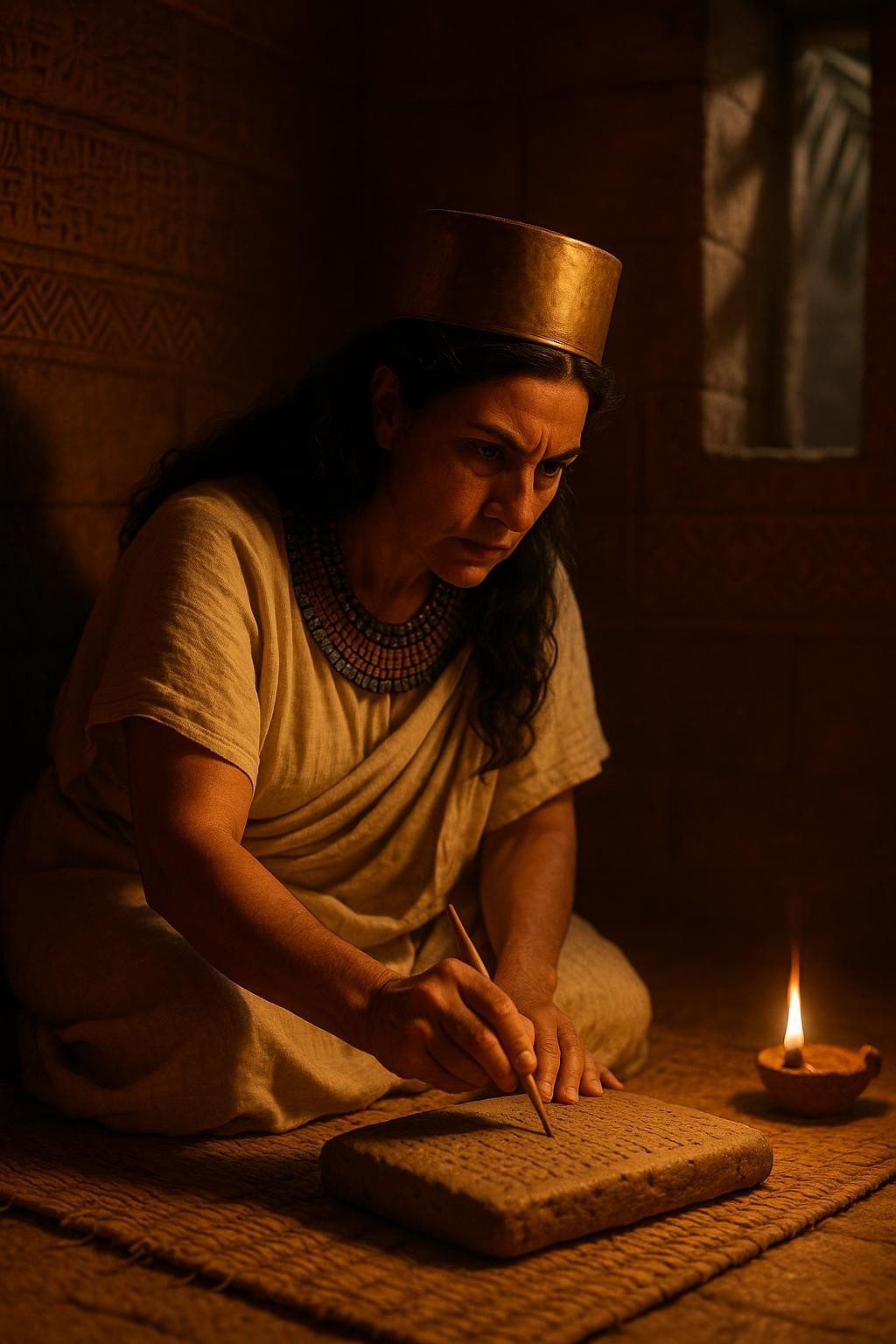
The sun blazed over the arid landscape of Sumer, casting long shadows across the baked earth. The wind carried whispers of a world both vibrant and ancient, a cradle of civilization where human ambition first took root. Yet beneath this seemingly serene sky, turbulence brewed. It was here, four millennia ago, that a drama unfolded which would forever change the course of history. Enheduanna of Ur, high priestess and daughter of the mighty Sargon of Akkad, found herself in the eye of this storm.
Whispers of a Divine Favor
In the grand city of Ur, life pulsed through the stone streets like a living organism. Merchants bartered under colorful canopies, and the scents of incense and fresh-baked bread filled the air, mingling with the distant sound of temple bells. Towering above all was the ziggurat, a stairway to the heavens where Enheduanna held her sacred post as high priestess of Nanna, the moon god. Her role was not merely ceremonial; she was a vital conduit between the divine and mortal realms, a duty both revered and fraught with peril.
However, Enheduanna’s dual identity as both divine intermediary and imperial princess was a delicate balance. As the daughter of Sargon, the founder of a vast empire, she embodied power and unity in an era marked by alliances and rivalries. Her writings celebrated the gods and explored the human condition, threads woven together with a wisdom and insight unmatched by her contemporaries. Her status, though grand, was not impervious to the tumultuous politics of the time.
Exile and Desolation
Then came the day when shadows crept beyond the ziggurat’s walls. The political machinations of usurpers sought to unseat the ruling order, and Enheduanna's world crumbled. Cast out from her temple by Lugalanne, a rising power who sought to claim the city and its divine favor, she was plunged into isolation. Stripped of her role and status, her exile unfolded under a cloak of despair.
The loss was deep, not only of her position but of her city and the sacred bond she shared with Nanna. Enheduanna’s grief was a cavernous void, as the familiar sounds of temple hymns faded into silence, replaced by the unyielding wail of wind through empty corridors. It was in this desolation, however, that she began a journey not of retreat, but of defiance.
Inanna’s Descent and Defiance
Isolated, yet undeterred, Enheduanna crafted a resonant masterpiece: the Exaltation of Inanna. This hymn to Inanna, goddess of love and war, was an impassioned supplication and a declaration of faith. In her writings, she poured her anguish, strength, and unbroken spirit. Her words rebelled against silence and defined her legacy, becoming an act of literary insurrection against her oppressors.
As a high priestess, Enheduanna was already a figure of profound importance, but by putting her name to her clay tablet inscriptions, she transcended her time. She stood amidst the ruins of her shattered life, wielding her stylus like a blade of truth and artistry. The hymn was more than a prayer; it was an assertion of her unyielding soul, immortalized in Sumerian script.
Echoes Through Time
Enheduanna’s writings emerged as a pivotal moment in human history, marking her as the world’s first named author. Her bold claiming of authorship opens a window into the ancient world, where the voice of a woman defied both time and subjugation. Her hymns sing across four millennia, a literary beacon illuminating the early power of personal narrative.
This ancient testament to resilience still echoes today, reminding us of the indomitable human spirit. In an era dominated by patriarchal structures, Enheduanna’s leadership and artistry defied the confines of her exile, underscoring her intellect and emotional depth. Her voice has endured through clay tablets and spoken word, a testament to the lasting power of the written word.
In our modern world, where the act of writing often signifies freedom and self-expression, the legacy of Enheduanna is felt with every penned line, every inscribed thought. From her, we inherit our understanding of the written word as a tool for change, a mirror to the soul, and a bridge across time—echoes of one woman’s uncompromising declarations etched into eternity.