The bronze sandal tumbled through the sulfurous air, glinting in the hellish glow of molten lava before clattering against the rocky crater wall. Mount Etna had just delivered its verdict on one of history's most audacious claims to divinity—and it wasn't impressed. Somewhere in the fiery depths below lay the body of Empedocles, the brilliant philosopher who had convinced half of ancient Sicily that he was a god. His plan had been flawless: leap into the volcano, vanish without a trace, and let his followers assume he had ascended to the heavens. There was just one problem—volcanoes, it turns out, sometimes have a sense of irony.
The Making of a Self-Proclaimed God
In the bustling Greek colony of Akragas (modern-day Agrigento) around 490 BC, a child was born who would grow up to embody the very essence of ancient Greek intellectual ambition. Empedocles came from aristocratic stock—his grandfather had won the horse race at the Olympic Games of 496 BC, a victory that marked the family as people of considerable wealth and influence. But young Empedocles had his sights set on prizes far greater than athletic glory.
By his thirties, Empedocles had established himself as one of the most formidable minds of his generation. He wasn't content to excel in just one field—that would have been pedestrian. Instead, he mastered philosophy, medicine, poetry, politics, and what we might today call early scientific research. He was the first person to propose that all matter consisted of four fundamental elements: earth, air, fire, and water—a theory that would dominate Western thought for over two thousand years.
But perhaps his most remarkable achievement was in medicine. Empedocles understood that the heart was the center of the blood system and came remarkably close to grasping the concept of circulation. He saved the city of Selinus from a plague by draining nearby swamps, and he allegedly restored a woman named Pantea to life after she had been unconscious and breathless for thirty days. Whether miracle or sophisticated medical intervention, such feats built his reputation as someone who commanded powers beyond ordinary mortals.
The Philosopher in Purple Robes
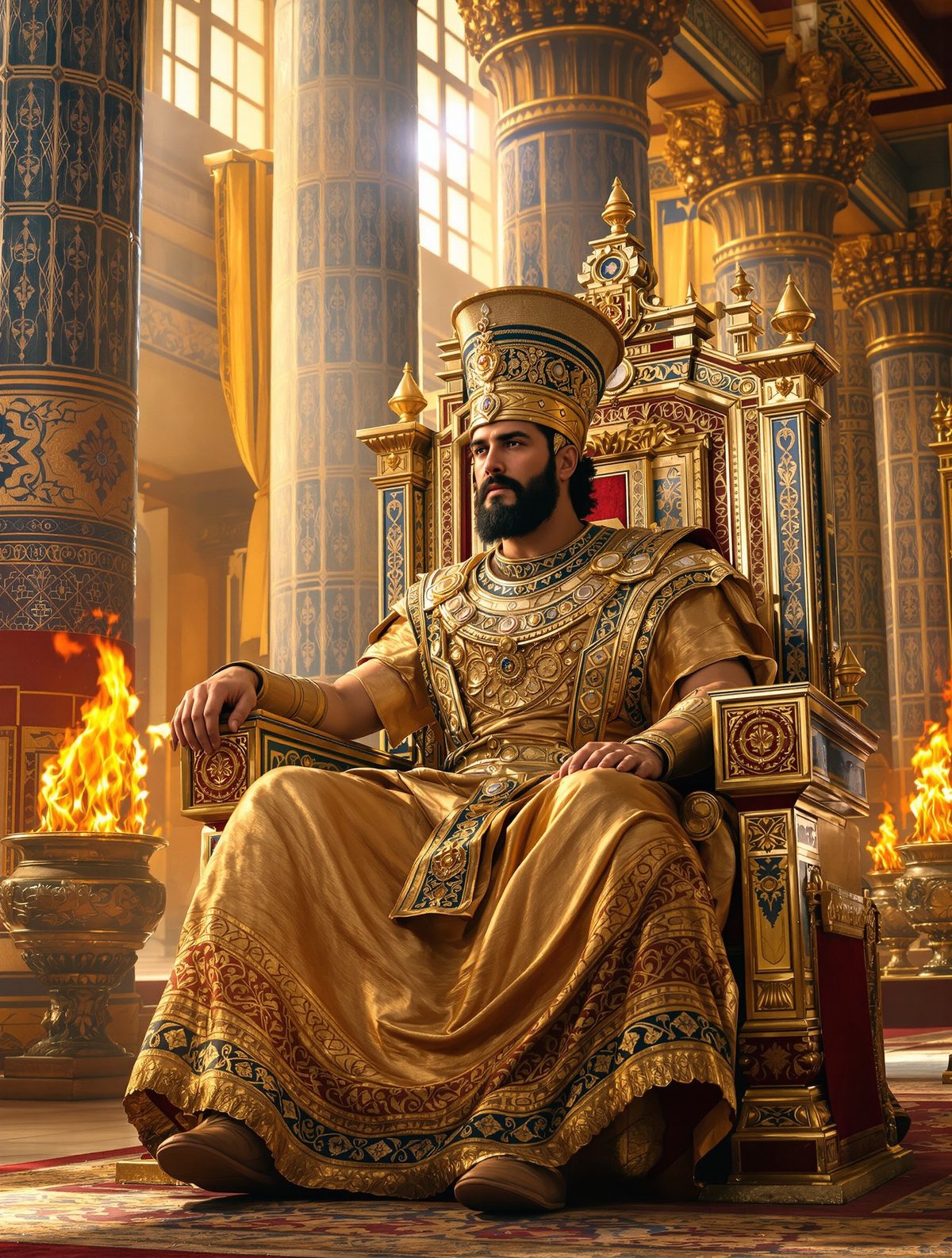
Success, however, went to Empedocles' head in spectacular fashion. Gone were the simple robes of a typical philosopher. Instead, he draped himself in purple garments—the color of royalty—and adorned his feet with bronze sandals that caught the Mediterranean sun as he walked. A golden crown sat upon his head, and his long hair flowed dramatically behind him as he moved through the cities of Magna Graecia like a living deity.
His entourage was equally theatrical. Everywhere Empedocles went, he was accompanied by servants and disciples who hung on his every word. He spoke in riddles and proclaimed divine revelations, claiming to remember his previous incarnations. He told followers he had once been "a boy, a girl, a plant, a bird, and a scaled fish in the sea." This wasn't metaphor—Empedocles insisted he literally recalled these past lives with perfect clarity.
The people of Sicily were remarkably receptive to his claims. In an age when the line between philosophy and religion remained blurry, and when exceptional individuals were sometimes elevated to divine status, Empedocles' combination of genuine intellectual brilliance and shameless self-promotion proved irresistible. He performed what appeared to be miracles, spoke with the authority of someone who had unlocked the secrets of the universe, and carried himself with the bearing of an immortal being temporarily walking among mortals.
The Ultimate Test of Divinity
But there's a peculiar burden that comes with claiming to be a god: eventually, people expect proof. And what proof could be more convincing than demonstrating one's immortality? By around 432 BC, when Empedocles was approaching his sixtieth year, he decided the time had come for the ultimate validation of his divine nature.
Mount Etna provided the perfect stage for his grand finale. The massive volcano, visible from much of eastern Sicily, had been active for millennia—a primordial force that seemed to connect the earthly realm with the world of the gods. Ancient Greeks believed that beneath Etna lay the forge of Hephaestus, the god of fire and metalworking, where the Cyclopes hammered out thunderbolts for Zeus. If anywhere could serve as a gateway between the mortal and divine realms, surely it was here.
Empedocles' logic was elegant in its simplicity. Gods, being immortal, cannot truly die. Therefore, if he leaped into the crater and his body was completely consumed by the volcanic fires, leaving no trace behind, his followers would naturally conclude that he had shed his mortal form and ascended to take his place among the immortals. It was the perfect plan—provided absolutely nothing went wrong.
When Volcanoes Have the Last Laugh
The exact details of that fateful day remain shrouded in the mists of ancient accounts, but the broad strokes are clear enough. Empedocles made his way up the slopes of Mount Etna, perhaps alone, perhaps accompanied by a small group of his most devoted followers. The ascent would have been arduous—Etna rises over 10,000 feet above sea level, and its upper reaches are a landscape of hardened lava flows, volcanic ash, and sulfurous gases that burn the lungs and sting the eyes.
At the crater's edge, with the inferno of molten rock bubbling below, Empedocles presumably delivered some final words befitting his divine status. Then, in an act of either supreme confidence or supreme delusion, he leaped into the volcanic maw. For a moment, it seemed his plan might actually work. The philosopher vanished into the fires, consumed completely by forces that had shaped the Earth since its birth.
But Mount Etna, it appears, had a sense of humor. Some time later—perhaps hours, perhaps days—the volcano belched forth a single, unmistakable artifact: one bronze sandal, instantly recognizable as belonging to the self-proclaimed god. The mountain had literally spat out the evidence of Empedocles' mortality, reducing his grand divine revelation to an almost comical debunking.
The Sandal That Shattered a Legend
News of the sandal's discovery spread rapidly across the Greek world, and the reaction was swift and merciless. The very item that had once symbolized Empedocles' divine pretensions now became the proof of his all-too-human folly. Ancient writers like Diogenes Laërtius preserved the story as a cautionary tale about the dangers of hubris—that distinctly Greek concept of excessive pride that inevitably provokes divine punishment.
Yet even in death, Empedocles managed to generate controversy. Some of his devoted followers refused to accept the sandal as genuine evidence, claiming it had been planted by his enemies. Others argued that a true god might deliberately leave behind such a token to test the faith of believers. A few even suggested that Empedocles had anticipated this very outcome and orchestrated it as part of some deeper philosophical teaching about the nature of mortality and divine pretension.
The Roman poet Horace later immortalized the incident in verse, writing that Empedocles "burned in his eagerness to be thought a god, and plunged into the flames of Etna." The story became a standard reference point in discussions of philosophical arrogance, cited by everyone from medieval scholars to Renaissance humanists as an example of what happens when intellectual pride overreaches its proper bounds.
The Enduring Legacy of a Bronze Sandal
More than two millennia after that bronze sandal tumbled from Mount Etna's crater, the story of Empedocles continues to fascinate us—and perhaps for good reason. In an age where social media transforms ordinary individuals into personal brands, where influencers craft carefully curated versions of reality, and where the line between genius and self-promotion grows ever thinner, the tale of the philosopher who jumped into a volcano feels remarkably contemporary.
Empedocles was, in many ways, history's first celebrity intellectual—brilliant, charismatic, and ultimately undone by his inability to distinguish between justified confidence and fatal delusion. His genuine contributions to human knowledge were considerable: his four-element theory, his medical insights, his political reforms in Akragas. But these achievements weren't enough. He needed to be more than human, more than mortal, more than merely exceptional.
Today, we live in an era of unprecedented individual platform and reach, where expertise in one field can be leveraged into authority across multiple domains, and where the temptation to craft an almost mythical personal narrative has never been greater. The story of Empedocles serves as both inspiration and warning: pursue excellence by all means, but remember that even bronze sandals are subject to gravity, and volcanoes, like reality itself, have an annoying habit of refusing to cooperate with our grandest self-conceptions.
In the end, perhaps the most profound lesson of Empedocles' leap isn't about the dangers of claiming divinity, but about the very human desire to transcend our limitations—and the equally human tendency to forget that true greatness lies not in escaping our mortality, but in what we accomplish while embracing it.