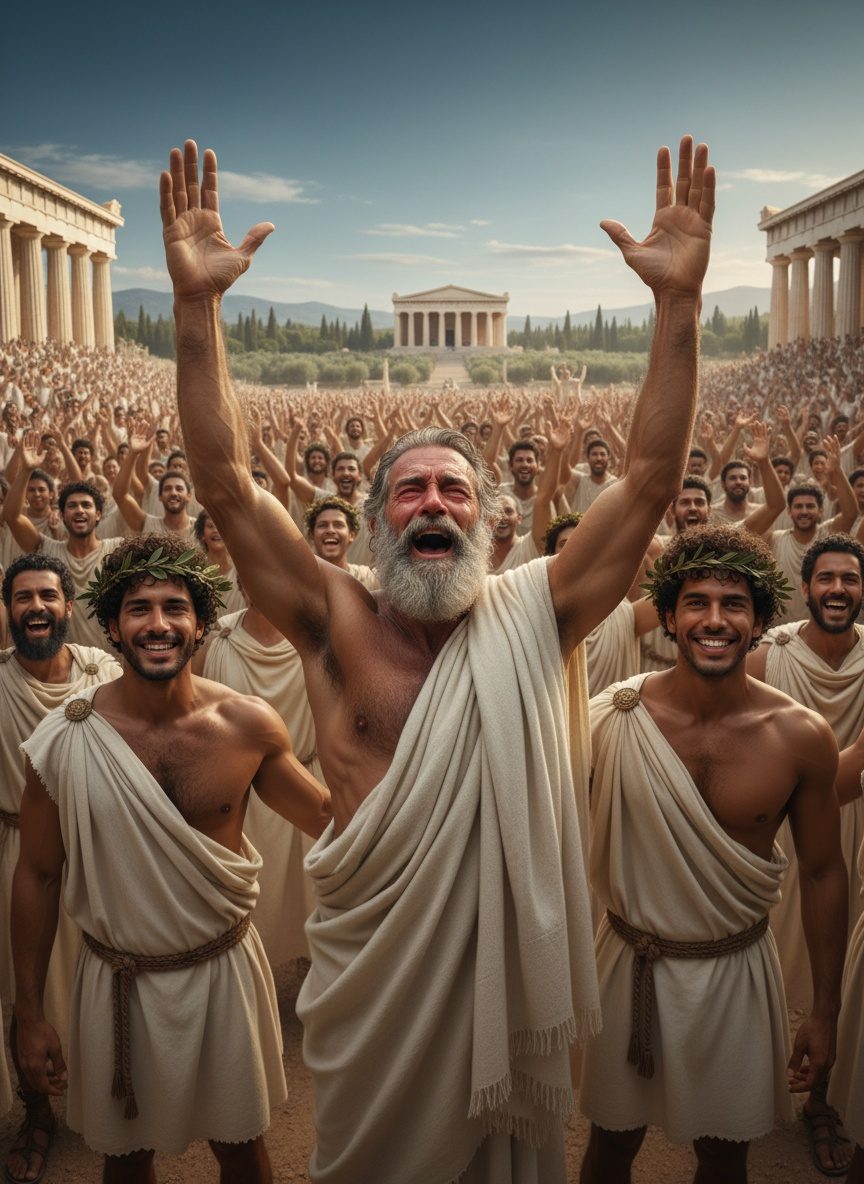
The roar of the crowd eclipsed the sunlit day at Olympia as Diagoras of Rhodes found himself lifted high upon the shoulders of jubilant spectators, his heart pounding louder than their chants. Dust from the stadium floor swirled around him like the echoes of battles fought and won, as a sense of awe mixed with disbelief settled over the crowd. It wasn’t just his victory—today, the laurel wreaths crowned both his sons, making legends of a family whose roots lay in the island city-state of Rhodes.
Diagoras, once a formidable boxer himself, had trained his sons with the rigour only true champions understood. In those days, Olympia was not merely an arena for physical triumph but also a cauldron where the spirit of a city-state could boil over into triumph. For Diagoras and his family, that boiling point had reached its zenith. From high on the shoulders of the cheering throng, the old man wept. Tears of pride? Perhaps. Tears of legacy? Certainly.
As the rhythmic stamping of feet softened and the cheers turned to murmurs of admiration, the victory procession continued under the clear skies that had watched over Greek gods and men alike. The grainy smell of stirred earth filled the air, mingling with the sweat of competitors who bore witness to a historic ideal—glory without the divine. Tradition dictated that Olympians owed their successes to divine will or intervention, but Diagoras, known for his noted skepticism, had grown legendary as much for his disbelief as for his accomplishments inside the ring.
The events of that day marked more than personal victories for Diagoras and his sons. They encapsulated a unique defiance towards the pantheon that governed so much of Greek life. In the heart of a crowd passionate for their gods and their games, Diagoras stood as a man who looked beyond Mount Olympus for his strength. In a particularly charged moment, a Spartan—known for their stoic resolve—pierced the air with a shout that encapsulated the collective sentiment. His words immobilized the crowd and rippled through the ages: “Die, Diagoras; you will not ascend to Olympus.” Such a declaration acknowledged not only a supreme moment of human achievement but also an uneasy acknowledgment that perhaps, gods revered might not always be required for greatness.
This musing hovered over the stadium, where dust and thoughts settled in the wake of athletic triumphs. Olympia, a site synonymous with expectations of divine favor, looked on as a mortal became myth. Diagoras didn’t pause to acknowledge the shout but gazed towards his sons, steely-eyed, embodying an emotional confluence of joy, satisfaction, and relief—a lifetime of dedication had culminated in this unimaginable moment.
To truly comprehend this scene, one must delve into what made the Games so magnetic in the first place, both for athletes and spectators. Founded in 776 BC, the Olympic Games were a social and religious duty, a gathering where men not only sought to enhance family status but to affirm divine designation through athletic prowess. Victories were paraded, festooned with religious devotion, and credited as much to the whims of deities as to human endeavor.
Yet here was Diagoras, elevated above mere mortals by the sheer weight of a familial triumph, suggesting a shift where human endeavor solely was as exalted as divine intervention. His life and those of his sons, Damagetos and Akousilaos, were rich with the kind of courage and tenacity that perhaps didn’t just reject religion but suggested an alternative—belief in oneself. They shattered the conventional narrative, and the crowd, fed by a burgeoning sense of secular pride, cheered in affirmation.
Consider, too, the broader implications of such a legendary event. Olympia, with its acres devoted to temples and treasuries under the vigilant eyes of Zeus, bore witness to a narrative not commonly spoken—a mortal's will prevailing without reliance on feigned divine favor. Diagoras’ story communicated directly with the core of what it meant to be Greek: the endless quest for arete, or excellence, the striving, unceasing human condition reaching beyond its frailties.
As shadows lengthened and the day wore to its close, the entities of gods seemed no heavier than the amber shadow of a laurel. Where history recorded the actions of men and muscle, the lofty records of divine machinations seemed to reveal cracks. In that moment, Diagoras’ sons epitomized what comes of pure will, true ambition—a defiance of what people are often taught to revere without questions. The gods had remained in their celestial seats that day, silent and foreboding, yet the laurels rested on human brows.
The legend of Diagoras of Rhodes transcends the athletic fields of Olympia, speaking to a larger liberation of human potential and the sometimes temperamental equilibrium between faith and self-determination. As the narrative lived on through retellings, it became clear that the grandeur lay not just in being lifted upon cheering shoulders, but in lifting oneself up from the myths that bind humanity to its pasts.
In the afterglow of triumph, Diagoras and his progeny serve as a poignant reminder of individual capability, ushering in thoughts that perhaps, humanity needs its Pantheon not poised high above with guiding hands, but merely as fellow walkers along the twisting marathon of life. What happened that day in Olympia resonated far beyond games and gods, pointing towards a wisdom that transcends eras—the human spirit, when allowed to rise, knows itself to be its own immortal solace.