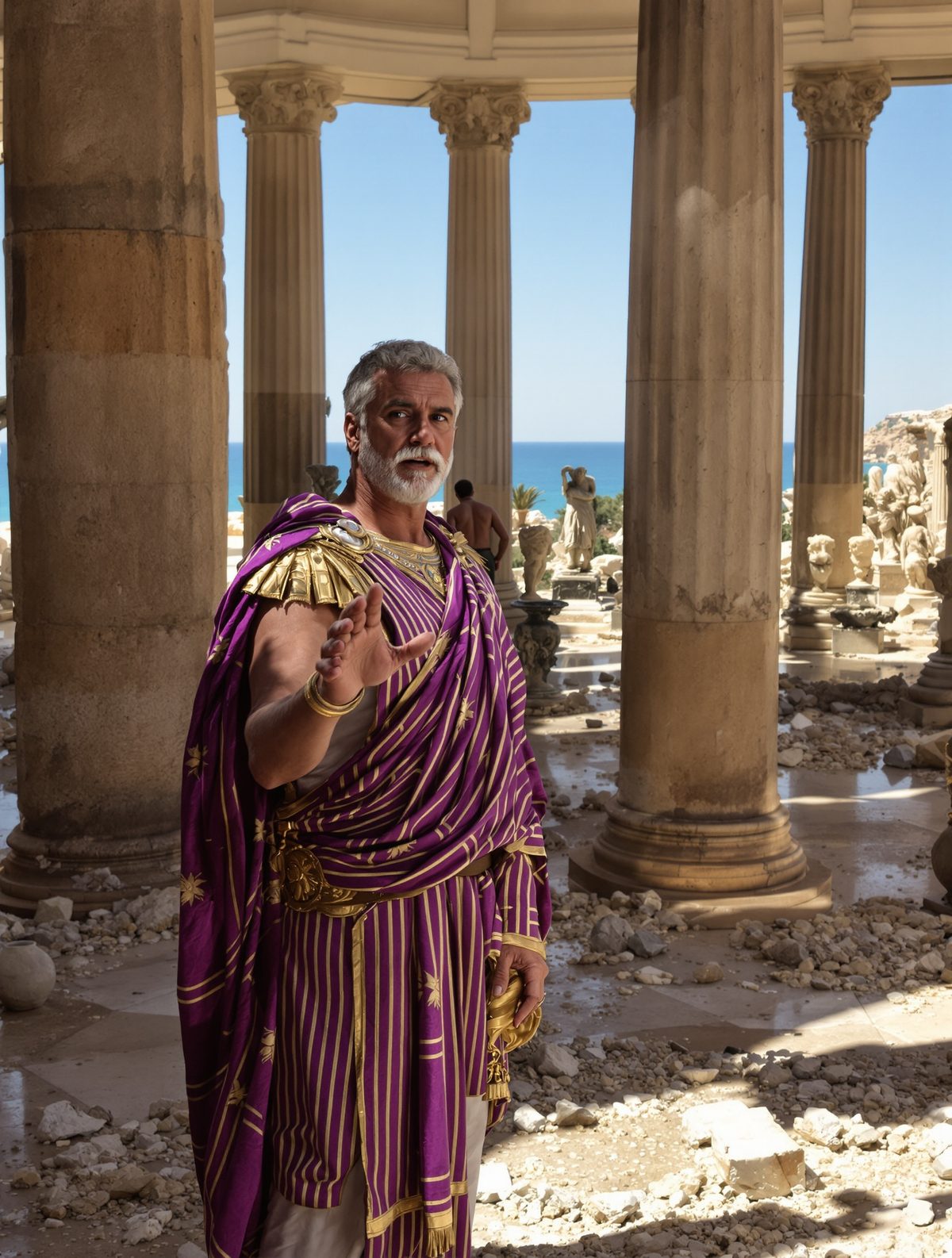
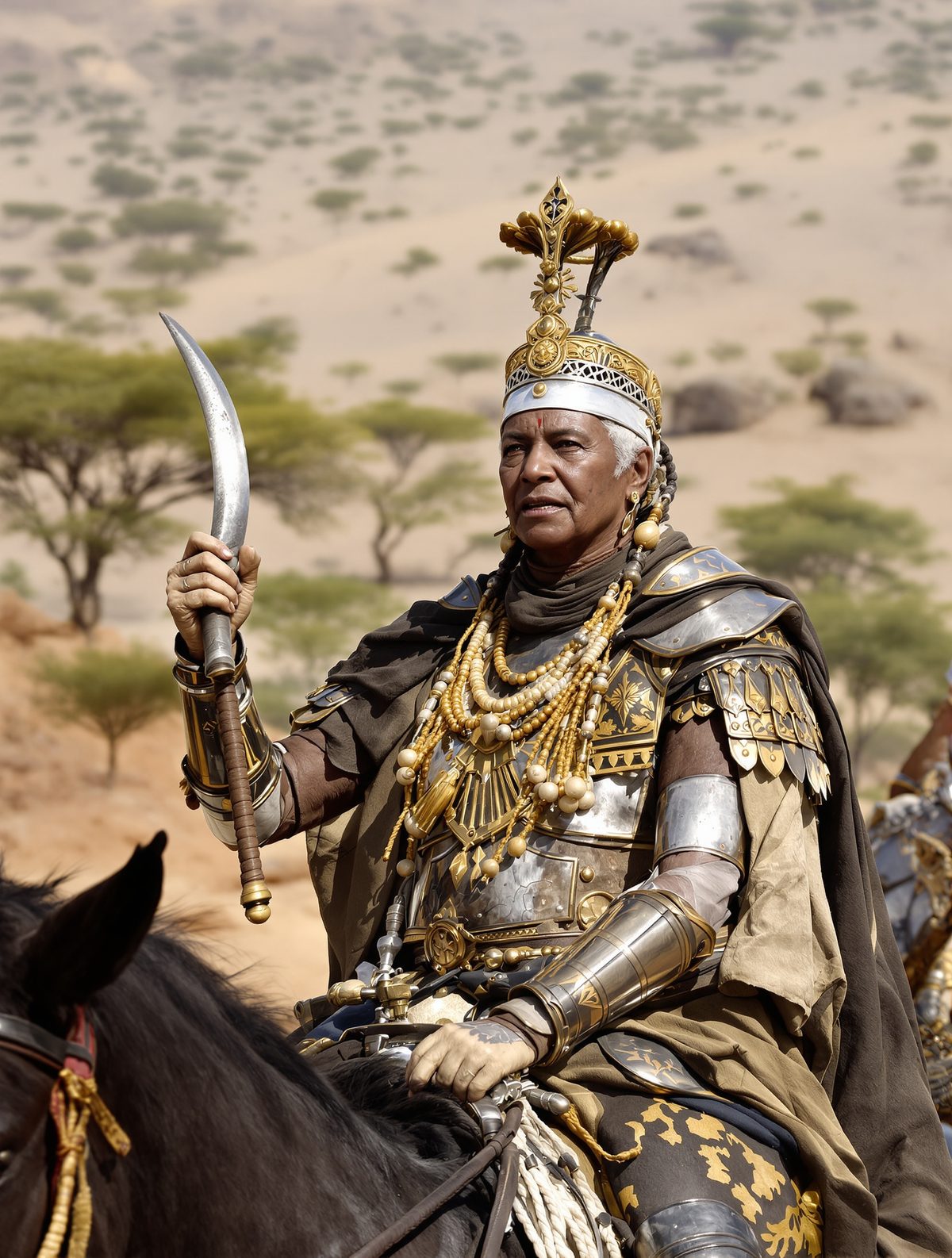
The flames rose from every corner of the Aurès Mountains, painting the North African sky a hellish orange. Fields of grain that had fed thousands for generations crackled and turned to ash. Wells that had sustained life in the desert for centuries were filled with stones and poisoned with salt. Cities that had stood since Roman times were systematically demolished, their stones scattered like broken teeth across the landscape.
This wasn't the work of invading armies—it was the desperate strategy of a queen determined to deny her enemies the spoils of conquest. In 698 AD, as Arab forces pressed deeper into North Africa, Dahia al-Kahina made a choice that would echo through history: if she couldn't keep her kingdom, she would make sure no one else could have it either.
The Warrior Queen of the Aurès
Dahia al-Kahina wasn't born to rule—she seized power through sheer force of will and military genius. A member of the Jarawa tribe, one of the many Berber peoples who had called North Africa home for millennia, she rose to prominence during one of the most turbulent periods in the region's history. The Arabs called her "al-Kahina," meaning "the soothsayer" or "the priestess," a testament to her reputation for supernatural wisdom and prophetic abilities.
Standing nearly six feet tall with flowing dark hair that she wore unbound as a symbol of her defiance, al-Kahina commanded respect through more than just her imposing presence. She was a master tactician who understood the harsh geography of the Maghreb better than any foreign invader ever could. The Aurès Mountains, with their hidden valleys and treacherous passes, became her fortress—and her final battleground.
What made al-Kahina truly remarkable wasn't just her military prowess, but her ability to unite the fractious Berber tribes under a single banner. For centuries, these proud peoples had resisted Roman legions, Byzantine administrators, and Vandal raiders. Now, faced with a new threat from the east, they found their champion in this fierce queen who promised to fight the Arabs to her last breath.
The Islamic Tide Sweeps West
By the late 7th century, the Arab conquest of North Africa seemed unstoppable. Under the brilliant general Hassan ibn al-Nu'man, Muslim armies had swept across Egypt, Libya, and Tunisia with devastating efficiency. Cities that had stood for a thousand years fell in weeks. The great port of Carthage, heir to ancient Punic glory, surrendered without a fight in 695 AD.
But the Arabs soon discovered that conquering cities was one thing—subduing the fierce Berber tribes of the interior was quite another. These weren't urban populations willing to negotiate terms of surrender. These were desert warriors who knew every water source, every mountain pass, every cave that could hide an army. And at their head stood al-Kahina, whose very name struck fear into Arab hearts.
The first major confrontation came at the Battle of Meskiana in 698 AD. Al-Kahina's forces, numbering perhaps 50,000 warriors, met Hassan's army in the valley below the Aurès Mountains. Contemporary Arab chroniclers, usually quick to praise their own victories, wrote with grudging admiration about the Berber queen's tactical brilliance. Using the mountainous terrain to her advantage, she lured the Arab cavalry into narrow defiles where their superior numbers meant nothing, then unleashed devastating attacks from the heights above.
Hassan's army was not just defeated—it was routed. The great general himself barely escaped with his life, fleeing eastward with the remnants of his force. For three years, he would not dare return to challenge the Berber queen again.
The Strategy of Ashes
Victory, however, brought al-Kahina little joy. She possessed something that few leaders in history have ever claimed: the gift of seeing clearly into the future. What she saw terrified her. The Arab armies would return, and when they did, they would come with overwhelming force. No amount of tactical genius could hold back the tide forever.
It was then that al-Kahina made her most controversial and desperate decision. If the Arabs wanted her land, she would ensure they inherited nothing but ashes and dust. In what became known as the "Policy of Destruction," she ordered her people to begin systematically destroying their own civilization.
The scale of the destruction was breathtaking. Ancient olive groves that had produced oil for export across the Mediterranean were cut down and burned. Granaries filled with wheat and barley were emptied and torched. Irrigation systems that had turned marginal land into fertile fields were demolished. Even fruit trees—symbols of long-term investment and hope for the future—were uprooted and destroyed.
Most shocking of all, al-Kahina ordered the destruction of cities and towns. Archaeological evidence suggests that major urban centers in the Aurès region were systematically demolished during this period, their populations relocated to temporary camps in the mountains. The queen's reasoning was coldly logical: without cities to capture and populations to tax, the Arabs would have no reason to remain in her territory.
The Human Cost of Defiance
The scorched earth policy exacted a terrible toll on al-Kahina's own people. Families that had farmed the same land for generations watched their ancestral homes burn. Merchants saw their trade goods destroyed. Children went hungry as food stores were deliberately emptied and burned rather than left for potential conquerors.
Many of al-Kahina's followers began to question her strategy. Some tribal leaders openly opposed the destruction, arguing that they were doing the Arabs' work for them. A few tribes even began secret negotiations with Hassan ibn al-Nu'man, offering to switch sides in exchange for guarantees of safety and property.
The queen pressed on regardless, driven by an iron determination that bordered on obsession. Contemporary sources describe her during this period as a woman possessed, traveling constantly throughout her territory to personally oversee the destruction. She slept little, ate less, and seemed to age years in the span of months. Those closest to her reported that she spoke frequently of visions and prophecies, claiming she could see the future spread out before her like a map written in fire.
Perhaps most tragically, even al-Kahina's own family began to turn against her. Two of her sons, adopted from different tribes as part of political alliances, eventually fled to join the Arab forces. They would later serve as guides when Hassan returned for his final assault.
The Final Reckoning
Hassan ibn al-Nu'man returned to the Maghreb in 701 AD with the largest army yet assembled for the conquest of North Africa. Reinforced with fresh troops from Damascus and supported by Berber allies who had grown weary of al-Kahina's destructive policies, the Arab forces numbered close to 80,000 men.
What Hassan found shocked him. The once-prosperous region had been transformed into a wasteland. Where thriving cities had once stood, only ruins remained. The fertile valleys were barren, their irrigation systems destroyed. Even the roads had been deliberately damaged, making movement difficult for his supply trains.
But al-Kahina's strategy had backfired in a crucial way. Her own forces, weakened by three years of self-imposed hardship and demoralized by the constant destruction, could no longer mount effective resistance. Many of her warriors had deserted, either fleeing to distant lands or switching sides to join the Arabs. Those who remained were hungry, poorly equipped, and increasingly doubtful of their queen's sanity.
The final battle took place near a place called Tabarka, close to the modern Tunisia-Algeria border. Al-Kahina, now in her sixties and showing the strain of years of constant warfare, led her remaining warriors in one last desperate charge against the Arab lines. Contemporary accounts describe her fighting with the fury of a woman who had nothing left to lose, her sword flashing in the desert sun as she carved through enemy ranks.
It was not enough. Surrounded and overwhelmed, al-Kahina fell with most of her remaining followers. Hassan ibn al-Nu'man, showing unusual respect for a fallen enemy, ordered that she be buried with honor. The conquest of North Africa was complete.
Legacy of a Scorched Earth Queen
Dahia al-Kahina's story raises uncomfortable questions about resistance, sacrifice, and the price of freedom. Was she a visionary leader who understood that some things are worth destroying rather than surrendering? Or was she a fanatic who inflicted unnecessary suffering on her own people in service of a hopeless cause?
The truth, as always, is complicated. Al-Kahina's scorched earth strategy failed to prevent Arab conquest, but it may have saved Berber culture in ways she never intended. The economic devastation she created made North Africa a less attractive prize for the Arabs, leading them to treat the region more as a frontier zone than a core province. This, in turn, allowed Berber traditions, languages, and social structures to survive in ways that might not have been possible under more intensive Arab settlement.
Today, as we watch modern conflicts unfold across the globe, al-Kahina's story resonates with uncomfortable relevance. Her willingness to destroy her own kingdom rather than see it fall into enemy hands echoes in the rubble of Syria, the burned fields of Ukraine, and countless other conflicts where people have chosen destruction over surrender. Her story reminds us that the human capacity for resistance—even self-destructive resistance—knows no bounds when people feel their very identity is at stake.
In the end, Dahia al-Kahina achieved a kind of immortality that no military victory could have granted her. She became a symbol of defiance that transcends the particular circumstances of 7th-century North Africa. Her story continues to inspire those who refuse to bow to overwhelming odds, even when—especially when—the cost of resistance seems unbearable.