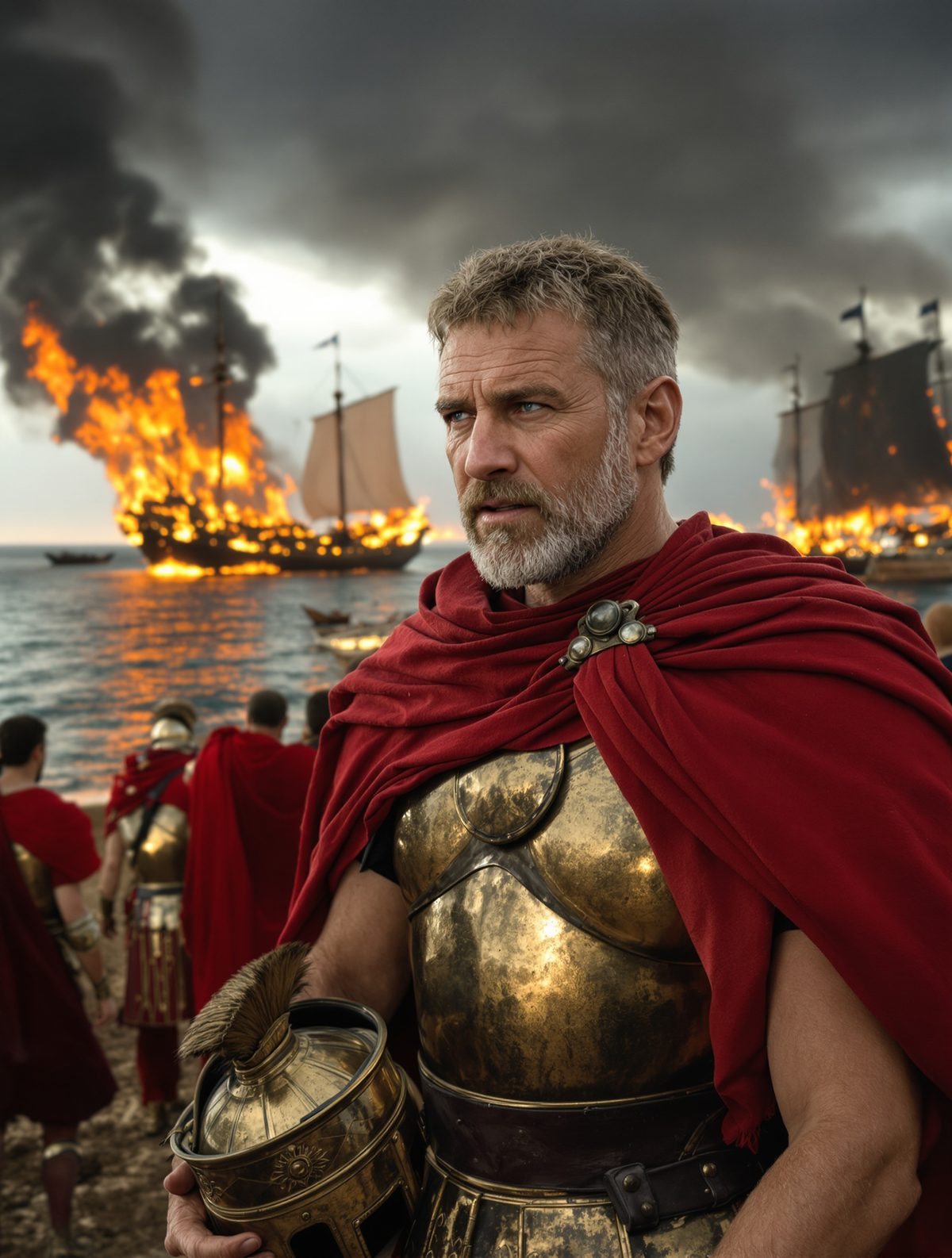
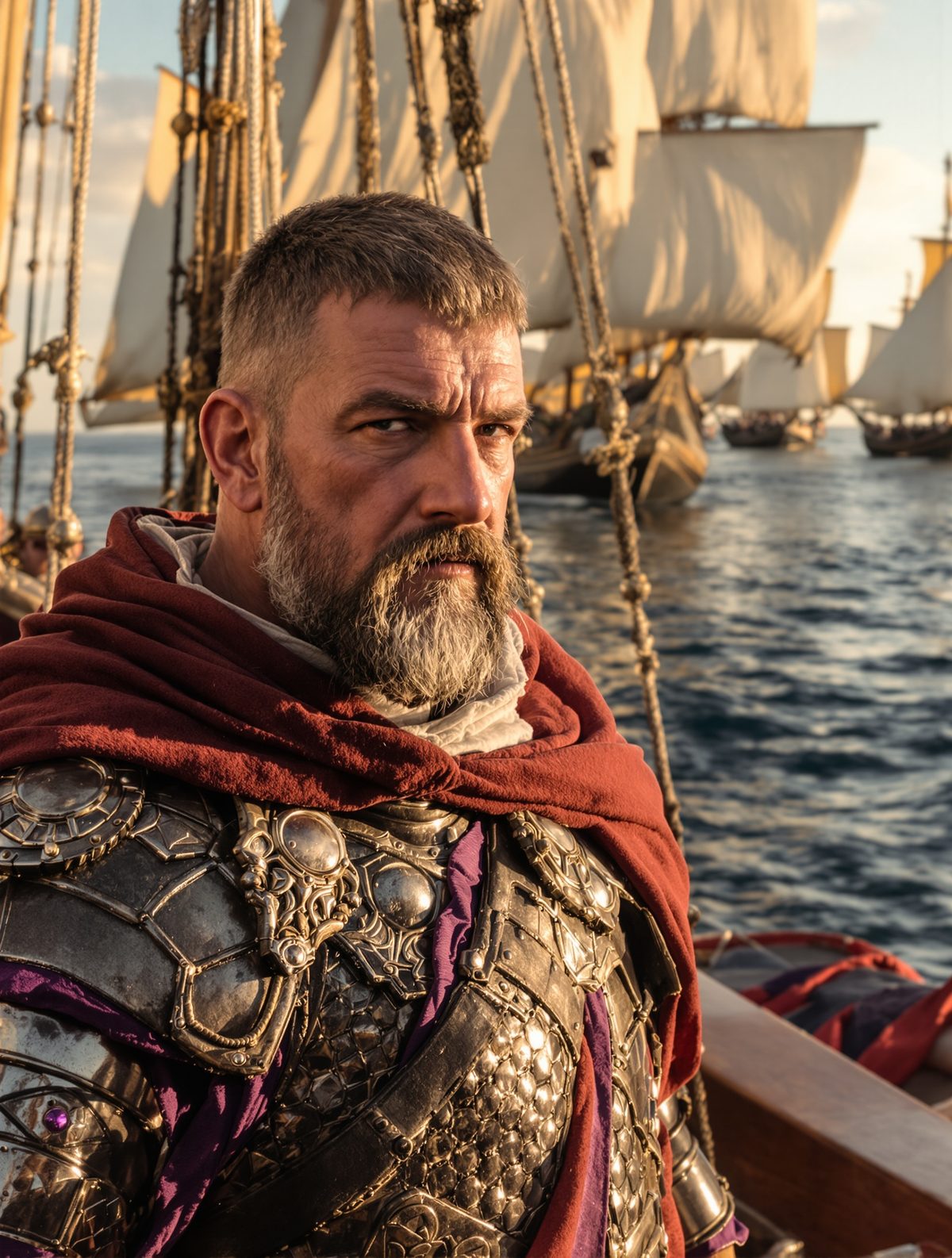
The molten gold scalded his lips as the Parthian soldiers forced the precious metal down his throat. Marcus Licinius Crassus—once the wealthiest man in Rome, conqueror of Spartacus, kingmaker of Julius Caesar—was about to die in the most fitting way imaginable. The man who had spent his life accumulating riches beyond measure would literally choke on gold. But this wasn't just poetic justice. It was a calculated message from an enemy who understood exactly what drove the Roman general to invade their lands in the first place.
In 53 BC, deep in the Mesopotamian desert, Crassus's severed head would soon be carried into a Parthian royal court where actors were performing a Greek tragedy. The timing was perfect—because Crassus's own life had become the ultimate cautionary tale about the price of unchecked ambition.
The Man Who Bought Rome
To understand how Rome's richest citizen ended up dying such a gruesome death, you have to understand just how obscenely wealthy Marcus Crassus had become. Modern estimates suggest his fortune peaked at around 200 million sestertii—roughly equivalent to $2 billion in today's money. But raw numbers don't capture the true scope of his influence in a city where money literally was power.
Crassus had perfected what might be history's most cynical business model. He maintained Rome's only private fire brigade, but here's the twist: when buildings caught fire, Crassus would arrive at the scene and offer to buy the burning property at a fraction of its value. Refuse his offer? His firefighters would stand by and watch your building burn to the ground. Accept his lowball price? Suddenly his men would spring into action, often saving the structure and adding another profitable property to his portfolio.
By 60 BC, Crassus owned most of central Rome and had his fingers in everything from silver mines in Spain to the slave markets of Asia Minor. He could afford to maintain a private army of 500 men and once famously declared that no man could call himself wealthy unless he could afford to pay for his own legion—roughly 5,000 soldiers.
But for all his wealth, Crassus lacked the one thing money couldn't buy in Republican Rome: military glory. While his rivals Julius Caesar was conquering Gaul and Pompey the Great was earning triumphs across the Mediterranean, Crassus was stuck managing his business empire. His one major military victory—crushing Spartacus's slave rebellion in 71 BC—was impressive but hardly the stuff of legend. He needed something bigger. Something that would cement his legacy as more than just Rome's richest man.
The Parthian Gamble
In 55 BC, at the age of 60, Crassus finally got his chance. As consul, he secured the governorship of Syria, which came with something irresistible: a border with the wealthy Parthian Empire. Here was an enemy worth conquering, a prize that could eclipse even Caesar's victories in Gaul.
The Parthian Empire stretched from the Euphrates River to the Indus Valley, controlling the lucrative trade routes between East and West. Their capital at Ctesiphon glittered with silk from China and spices from India. Roman senators spoke in hushed tones about Parthian treasuries overflowing with gold. For a man like Crassus, it must have seemed like destiny.
But Crassus fundamentally misunderstood his enemy. The Parthians weren't another collection of disorganized tribes waiting to be conquered by Roman discipline and superior tactics. They had perfected a completely different style of warfare that had already humbled other invaders. Their armies were built around speed and mobility—heavy armored cavalry called cataphracts working in concert with mounted archers who could rain arrows while retreating at full gallop.
The omens were terrible from the start. When Crassus's army crossed the Euphrates in 53 BC, a sudden storm nearly capsized the boats. The river ran red with mud that soldiers whispered looked like blood. Even Crassus's own son Publius, leading a cavalry contingent, reportedly expressed doubts about the campaign. But the general pressed on with seven legions—roughly 35,000 men—plus auxiliaries and cavalry. It was a massive force, and Crassus believed it was unstoppable.
Carrhae: Where Eagles Fell
The Battle of Carrhae, fought on a scorching day in June 53 BC, became one of Rome's most devastating defeats. Crassus had marched his legions deep into Mesopotamia, following dubious intelligence from local guides who may have been working for the Parthians all along. When the two armies finally met near the town of Carrhae, the Romans found themselves facing an enemy unlike anything they had encountered.
The Parthian general Surena had orchestrated a masterpiece of tactical deception. What appeared to be a modest force of cavalry suddenly revealed itself as a sophisticated war machine. The famous Parthian horse archers began their deadly work, circling the Roman formations and unleashing clouds of arrows. Every time the Romans tried to charge, the enemy simply rode away, still shooting.
Roman soldiers raised their shields in the testudo (tortoise) formation, but the arrows kept coming. Worse, Surena had positioned a camel train loaded with fresh arrows behind his lines, ensuring his archers would never run out of ammunition. Under the blazing sun, weighed down by heavy armor, the Romans began to wilt.
In desperation, Crassus ordered his son Publius to lead a cavalry charge that might break the Parthian lines. It was exactly what Surena had been waiting for. The young man and his 1,000 Gallic horsemen were lured away from the main force and systematically destroyed. When Parthian cavalry returned carrying Publius's head on a spear, something broke inside the Roman army.
By sunset, 20,000 Romans lay dead in the desert sand. Another 10,000 had been captured. Crassus himself had survived, but barely. The eagles of five legions—the sacred standards that represented Rome's honor—had been captured. It was a catastrophe that would echo through Roman politics for generations.
The Golden Death
What happened next depends on which ancient source you trust, but the most dramatic account comes from the historian Cassius Dio. According to his version, Crassus initially escaped the battlefield but was convinced to attend a parley with Surena, ostensibly to negotiate terms. It was a trap.
During the meeting, violence broke out—possibly planned, possibly spontaneous—and Crassus was killed in the melee. But Surena wasn't finished with Rome's richest general. In a gesture heavy with symbolism, the Parthian commander ordered molten gold to be poured into Crassus's mouth and down his throat.
"Here, satisfy yourself with the gold for which you thirsted," Surena allegedly declared over the corpse. It was the perfect epitaph for a man who had spent his entire life accumulating wealth, only to die in a war motivated by greed.
The story gets even more surreal. Crassus's head and hands were cut off and carried to the Parthian court at Seleucia, where King Orodes was watching a performance of Euripides's The Bacchae. At the climactic moment when the character Agave displays the severed head of her son Pentheus, an actor named Jason produced Crassus's actual head as a prop. The audience erupted in applause, thinking it was merely a remarkably realistic stage effect.
Art imitating life imitating art—it was a finale worthy of a Greek tragedy, which is exactly what the Parthians intended.
The Price of Ambition
Crassus's death sent shockwaves through Rome that extended far beyond the military disaster. His demise eliminated the third member of the informal alliance between himself, Caesar, and Pompey that had been keeping the peace in Roman politics. Within a decade, Caesar and Pompey would be at each other's throats in a civil war that would destroy the Roman Republic forever.
But perhaps the most lasting lesson of Crassus's story lies in its brutal irony. Here was a man who understood better than anyone how to accumulate power through wealth, yet he died because he fundamentally misunderstood what wealth was for. He had enough money to live like a king, enough influence to shape the destiny of nations, enough luxury to satisfy any reasonable human desire. Instead, he threw it all away chasing after more.
The molten gold forced down his throat wasn't just Parthian cruelty—it was a perfect metaphor for the insatiable appetite that had driven him across the Euphrates in the first place. In our own era of extreme wealth concentration and endless growth imperatives, Crassus's fate serves as a reminder that there are some hungers that can never be satisfied, some ambitions that devour everything they touch.
The richest man in Rome died choking on the very thing he thought would make him immortal. Two thousand years later, we're still trying to learn the same lesson.