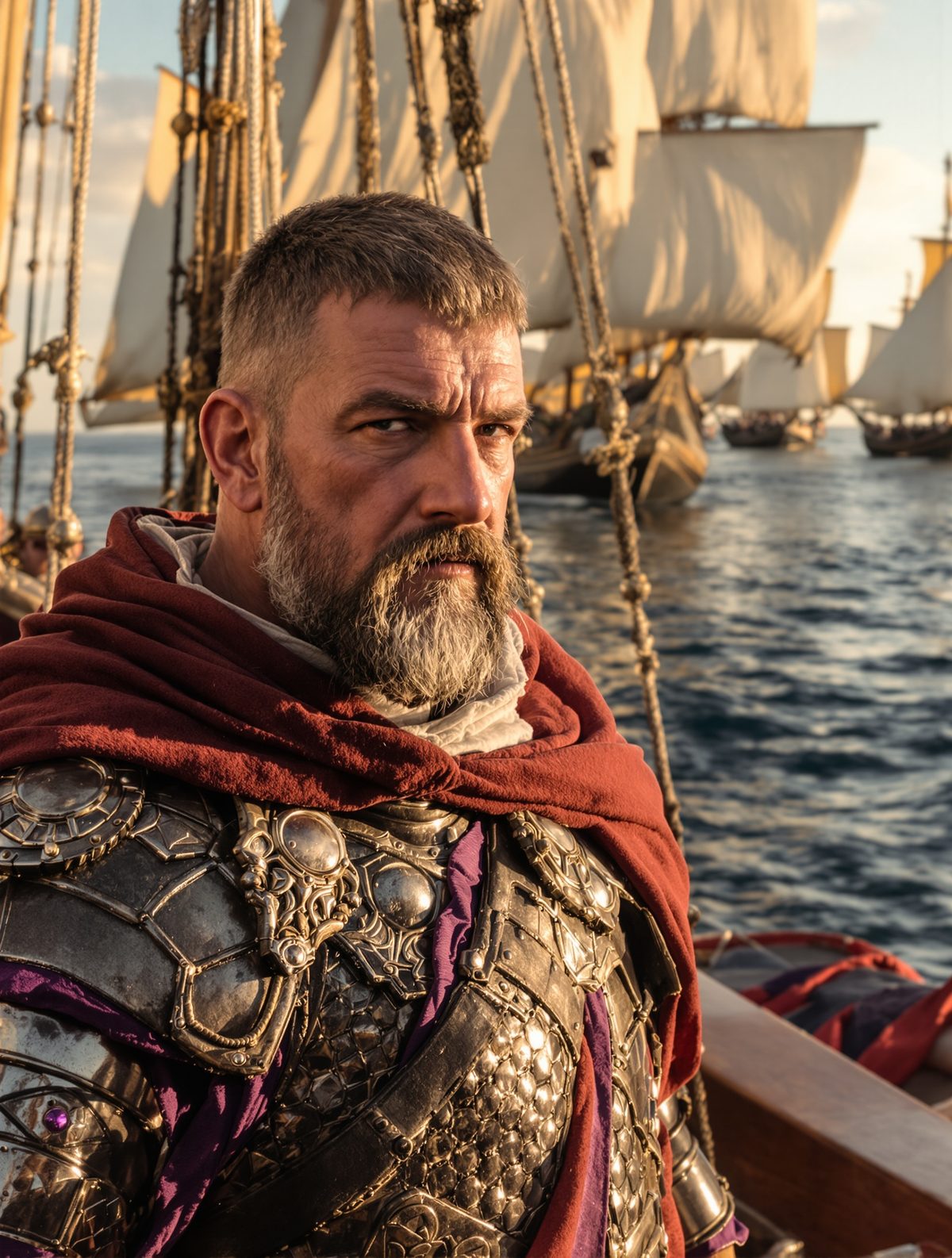
The Mediterranean sun blazed mercilessly as thick black smoke rose from the harbor of Cape Bon in 310 BC. Thirteen thousand Greek soldiers watched in stunned silence as their last hope of escape crackled and burned before their eyes. Ship after ship—sixty vessels in total—disappeared into flames and ash, taking with them any chance of retreat to Sicily. The man responsible for this act of apparent madness stood calmly observing his handiwork: Agathocles, the former potter who had clawed his way to absolute power in Syracuse, had just trapped his entire army on the coast of North Africa with Carthaginian forces closing in from all sides.
What happened next would become one of history's most audacious gambles—a desperate strategic masterstroke that would either doom his men to certain death or force them to achieve the impossible. This is the story they never taught you about one of antiquity's most ruthless and brilliant leaders, and the moment when burning bridges became literal military doctrine.
The Potter's Rise to Power
Agathocles wasn't born to rule. In a world where power typically flowed through aristocratic bloodlines, he emerged from the humblest beginnings imaginable. Born around 360 BC to a potter in the countryside near Syracuse, young Agathocles should have lived and died in obscurity, his hands stained with clay rather than blood. But ancient sources tell us he possessed something far more dangerous than noble birth: an insatiable hunger for power and the cunning to seize it.
By his twenties, Agathocles had abandoned the potter's wheel for the sword, using his striking appearance and charismatic personality to rise through Syracuse's military ranks. The Greek historian Diodorus Siculus described him as exceptionally handsome and physically powerful, qualities that served him well in both politics and warfare. But it was his complete lack of moral restraint that truly set him apart from his contemporaries.
In 317 BC, after years of political maneuvering and brutal suppression of rivals, Agathocles seized control of Syracuse through a carefully orchestrated coup. His first act as tyrant revealed the ruthlessness that would define his reign: he ordered the execution of over 4,000 aristocrats and wealthy citizens, confiscating their property to fund his ambitions. Unlike other Greek tyrants who at least paid lip service to justice, Agathocles openly embraced his role as an absolute despot.
When Carthage Came Calling
Agathocles' brutal consolidation of power didn't go unnoticed by Syracuse's neighbors, particularly the Carthaginians who controlled much of Sicily's western coast. For decades, Carthage and the Greek cities of Sicily had maintained an uneasy balance of power, but the emergence of an aggressive new tyrant in Syracuse threatened to upset that delicate equilibrium.
The breaking point came when Agathocles began expanding his territory, attacking Carthaginian allies and threatening their Sicilian strongholds. In 311 BC, Carthage responded with overwhelming force, dispatching a massive army under the command of Hamilcar. Ancient sources suggest the Carthaginian force numbered around 45,000 men—a staggering military investment that demonstrated just how seriously they took the Syracusan threat.
What followed was a series of crushing defeats for Agathocles. His forces were systematically outmaneuvered and overpowered by the superior Carthaginian army. By 311 BC, Syracuse itself was under siege, its walls surrounded by enemy forces while Carthaginian ships blockaded the harbor. The former potter's empire seemed destined to crumble as quickly as it had risen.
But Agathocles had learned something during his brutal climb to power: sometimes the most desperate situations call for the most audacious solutions.
The Impossible Gambit
In the summer of 310 BC, with Syracuse's walls being pounded by Carthaginian siege engines and his people facing starvation, Agathocles made a decision that seemed to border on madness. Rather than continue the hopeless defense of his city, he would take the fight directly to Carthage's doorstep—launching an invasion of North Africa itself.
The plan was audacious to the point of seeming suicidal. While the bulk of Carthage's military was occupied in Sicily, their homeland would be relatively defenseless. But reaching North Africa meant running a naval blockade with a hastily assembled fleet, then establishing a foothold on hostile territory with no reliable supply lines or prospect of reinforcement.
Agathocles managed to slip past the Carthaginian blockade under cover of darkness with sixty ships carrying approximately 13,000 soldiers and 1,500 cavalry. The crossing itself was a minor miracle—somehow, this desperate flotilla managed to evade detection and make landfall near Cape Bon, just forty miles from Carthage itself.
But upon reaching the African coast, Agathocles faced an immediate crisis. His soldiers, suddenly grasping the magnitude of their isolation, began demanding an immediate return to Sicily. They had signed up to defend Syracuse, not to die on a foreign shore thousands of miles from home. Morale plummeted as the reality of their situation set in.
The Flames of No Return
It was at this moment of crisis that Agathocles revealed the calculating brilliance that had carried him from pottery shop to palace. Rather than attempt to rally his troops with speeches or promises, he opted for a far more dramatic solution. On a clear morning in 310 BC, he ordered his entire fleet to be set ablaze.
The decision was announced as an economic necessity—maintaining and guarding the ships would require men and resources they couldn't spare. But the true purpose was psychological warfare directed at his own army. With their ships burning behind them, his soldiers faced a stark choice: conquer or die.
Ancient sources describe the scene in vivid detail. The soldiers watched in stunned silence as sixty vessels—their only link to home—were consumed by flames. The smoke could be seen for miles, a black column rising into the African sky like a funeral pyre for their old lives. Some men wept openly, while others raged against their commander's apparent madness.
But Agathocles had calculated correctly. Faced with the absolute impossibility of retreat, his army's despair gradually transformed into grim determination. They were no longer an invasion force with an escape route—they had become a tribe of exiles with nothing to lose and everything to gain.
Victory from the Ashes
The psychological transformation was immediate and dramatic. Within days of the ships' destruction, Agathocles' forces began achieving victories that had seemed impossible just weeks earlier. They defeated a hastily assembled Carthaginian relief force, captured several fortified cities, and began attracting support from Carthage's African subjects who had long chafed under their rule.
The Libyan and Numidian tribes, seeing an opportunity to throw off Carthaginian domination, flocked to Agathocles' banner. His small army of desperate Greeks suddenly found itself at the head of a growing rebellion that threatened Carthage's entire African empire. The potter's son was now commanding a coalition that controlled much of modern-day Tunisia.
For three years, Agathocles maintained his African campaign, winning battle after battle and coming tantalizingly close to capturing Carthage itself. Only political complications back in Syracuse eventually forced him to negotiate a peace treaty that recognized him as the undisputed ruler of much of Sicily—a far better outcome than anyone could have predicted when he first set those ships ablaze.
The Legacy of Burning Bridges
Agathocles' decision to burn his fleet at Cape Bon became legendary throughout the ancient world, inspiring both admiration and horror. The phrase "burning your ships" entered military vocabulary as shorthand for total commitment to a course of action, eliminating the possibility of retreat to ensure victory becomes the only option.
But perhaps the most fascinating aspect of this story is what it reveals about leadership in desperate times. Agathocles understood something that modern psychology has confirmed: humans often perform extraordinary feats when ordinary options are removed. By eliminating his army's ability to retreat, he forced them to discover reserves of courage and determination they never knew they possessed.
This ancient tale resonates today because it challenges our assumptions about rational decision-making. In our modern world of careful risk assessment and contingency planning, there's something both terrifying and inspiring about a leader willing to bet everything on a single throw of the dice. Agathocles reminds us that sometimes the most irrational decisions produce the most extraordinary results—and that the line between genius and madness is often drawn only in retrospect, by the victors who survived to tell the tale.