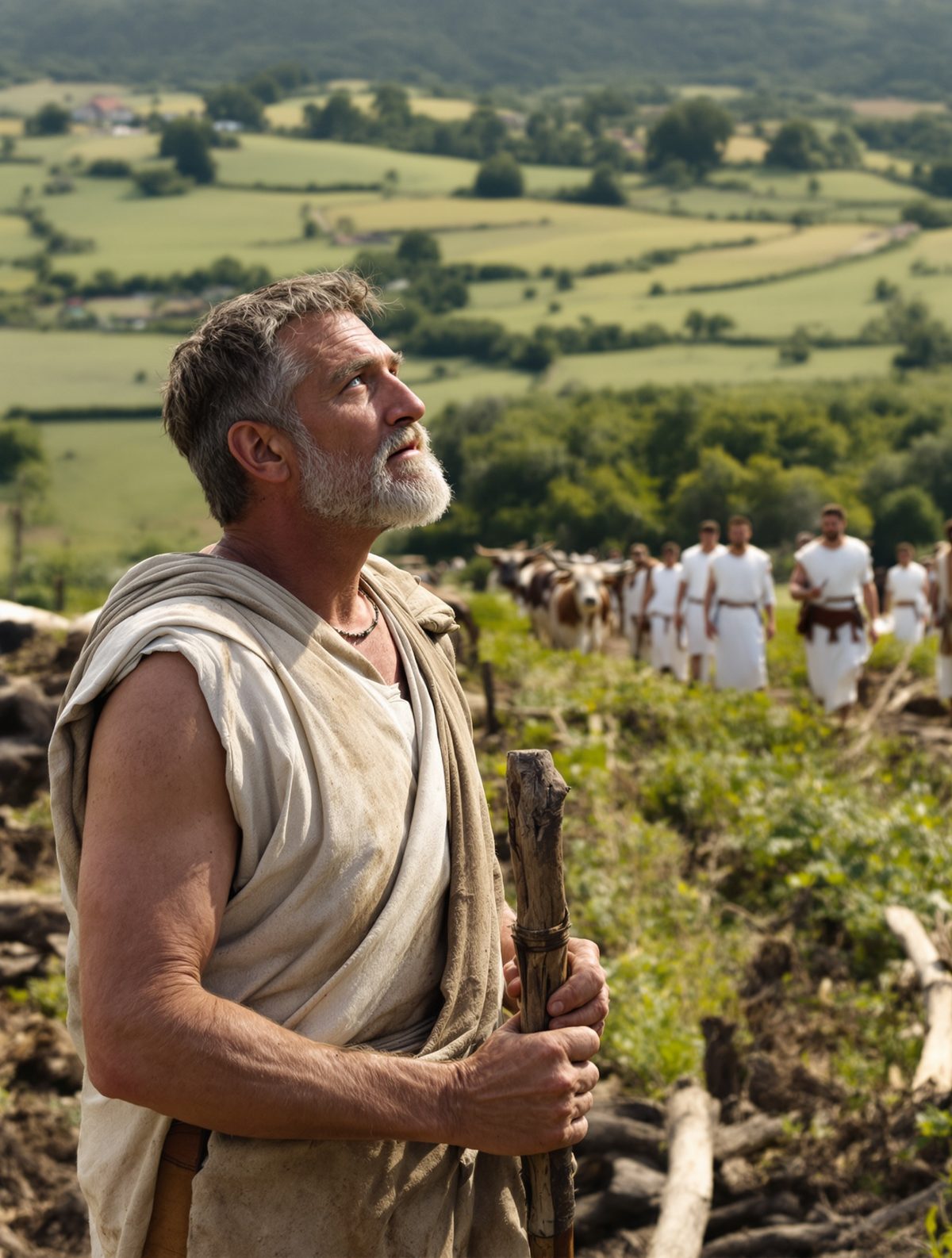
Picture this: you're one of the most brilliant minds in ancient Athens, author of over 700 philosophical works, respected throughout the Mediterranean world for your razor-sharp intellect. You've spent decades contemplating the deepest questions of existence, teaching students the art of logical reasoning, and building a philosophical system that will influence human thought for millennia. Then one sunny afternoon in 206 BC, you watch a drunken donkey stumble around your garden after eating fermented figs, and you laugh yourself to death.
This is exactly what happened to Chrysippus of Soli, the third head of the Stoic school and arguably one of history's greatest philosophers. In an irony that would have made the gods themselves chuckle, the man who taught that wisdom lay in emotional control died from an uncontrollable fit of laughter triggered by his own joke about a tipsy donkey.
The Mind That Shaped Ancient Philosophy
Chrysippus wasn't just any philosopher—he was the philosopher who essentially saved Stoicism from intellectual extinction. Born around 279 BC in Soli, a Greek city in what's now Turkey, he arrived in Athens as a young man with a brilliant mind and an unfortunate stutter that initially made him an unlikely candidate for public speaking. Yet by the time of his death at age 73, he had become so central to Stoic philosophy that later scholars would say, "If there had been no Chrysippus, there would have been no Stoa."
What made Chrysippus extraordinary wasn't just his prolific output—those 700+ works included treatises on logic, ethics, physics, and theology—but his ability to systematize and defend Stoic doctrine against critics. Ancient sources tell us he was so thorough in his arguments that he would quote entire opposing texts just to refute them line by line. His contemporary, the mathematician Apollodorus, complained that Chrysippus filled his books with so many quotations that "if you removed what he quoted from others, his papyrus would be left empty."
But perhaps most remarkably for a Stoic philosopher who preached emotional equilibrium, Chrysippus possessed a surprisingly robust sense of humor. Ancient biographers noted his fondness for wordplay, logical paradoxes that bordered on comedy, and an appreciation for life's absurdities that would ultimately prove fatal.
The Day Everything Went Sideways
The fatal day began like any other in Chrysippus's well-ordered life. According to Diogenes Laërtius, our primary source for this story, the elderly philosopher was spending a quiet afternoon at home, possibly in his garden or courtyard, when he noticed something amiss. A donkey—whether it belonged to him or had wandered in from the street remains unclear—had discovered his carefully cultivated fig tree and was enthusiastically devouring the ripe fruit.
Now, for most people, this would have been merely annoying. Figs were valuable in ancient Athens, prized both for their sweetness and their nutritional value. They were often dried and stored for winter consumption, making fresh figs a seasonal delicacy worth protecting from four-legged thieves. But Chrysippus, ever the philosopher, saw something different in this scene of petty theft.
As he watched the donkey gorging itself on fig after fig, swaying slightly from the fermented fruit's alcohol content, an idea struck him. The absurdity of the situation—this dignified beast reduced to a stumbling, fig-drunk creature—sparked what would become his final philosophical observation.
The Joke That Killed
What happened next reveals something profound about Chrysippus's character. Rather than chase away the intoxicated donkey, he called to his slave with a request that was equal parts logical and ludicrous: "Give the donkey some wine to wash down those figs!"
The brilliance of the joke lay in its perfect philosophical absurdity. Here was a donkey, already intoxicated from fermented figs, and Chrysippus was suggesting they complete the comedy by offering it a proper drink. It was the kind of deadpan humor that revealed the ridiculous nature of treating an animal as if it were a dinner guest, while simultaneously commenting on the arbitrary nature of social conventions.
But the joke hit Chrysippus harder than he expected. As he watched his bewildered slave approach the swaying donkey with a cup of wine, the sheer absurdity of the scene overwhelmed him. He began to laugh—not the polite chuckle of intellectual appreciation, but deep, uncontrollable laughter that seemed to spring from years of philosophical tension finally finding release.
According to ancient accounts, the laughter continued far beyond normal bounds. Chrysippus laughed until he could no longer breathe, until his face turned red, until his body could no longer sustain the physical demands of his mirth. In those final moments, the great Stoic philosopher who had spent decades teaching others about the importance of emotional moderation died from an excess of joy at his own wit.
The Stoic Paradox
The irony of Chrysippus's death wasn't lost on his contemporaries or later scholars. Here was a man who had written extensively about the Stoic ideal of apatheia—not apathy in the modern sense, but freedom from destructive passions and emotional extremes. He taught that true wisdom came from understanding what was within our control and accepting what wasn't, maintaining equilibrium in the face of life's ups and downs.
Yet Chrysippus died from the most uncontrolled emotional response imaginable. Some ancient critics of Stoicism pointed to his death as evidence that the philosophy was fundamentally flawed—if its greatest proponent couldn't maintain emotional control, what hope did ordinary people have?
But perhaps they missed the deeper truth. Chrysippus didn't die from anger, fear, or despair—the destructive emotions Stoics warned against. He died from joy, from a moment of pure appreciation for life's absurdity. In a way, his death embodied a different kind of Stoic principle: the ability to find humor and meaning in unexpected places, even in the mundane sight of a donkey eating figs.
Moreover, ancient sources suggest that Chrysippus had been in declining health, possibly suffering from what we might now recognize as heart disease. The laughter may have simply triggered a cardiac event that was already waiting to happen—making his death less about philosophical failure and more about unfortunate timing.
Legacy of Laughter
Chrysippus's death became one of ancient history's most frequently cited examples of unusual mortality, alongside Aeschylus being killed by a tortoise dropped by an eagle and Democritus allegedly dying from inhaling honey fumes. But unlike these other strange deaths, Chrysippus's carried a kind of poetic justice that resonated across centuries.
His philosophical works, tragically, haven't survived intact. We know about his ideas primarily through fragments quoted by later authors and references in the works of critics and admirers. What we've lost represents one of the greatest intellectual tragedies of the ancient world—imagine if we had access to even a fraction of those 700 works today.
Yet in an odd way, the story of his death has preserved something essential about Chrysippus that pure philosophical treatises might not have captured: his humanity. The man who could laugh himself to death at a donkey eating figs was clearly someone who found deep joy in life's unexpected moments, who could appreciate absurdity even in his final hours.
The Wisdom of Dying Well
In our modern world, obsessed with control and productivity, there's something both cautionary and inspiring about Chrysippus's end. He reminds us that no amount of wisdom or preparation can fully prepare us for life's ultimate surprises—and perhaps that's exactly as it should be.
The great Stoic philosopher died as he lived: thinking, observing, and finding unexpected connections in ordinary moments. His final joke about the wine-drinking donkey wasn't just a moment of levity—it was a last act of philosophical insight, recognizing the beautiful absurdity that underlies so much of human existence.
Today, when we're constantly reminded to take life seriously, to optimize and maximize every moment, Chrysippus offers a different lesson. Sometimes the most profound wisdom lies in recognizing when something is simply, hilariously ridiculous. And sometimes, dying of laughter isn't the worst way to go—it's a reminder that joy, even uncontrolled joy, might be the most human response to the cosmic comedy we're all living through.
After all, if you're going to die from one of the emotions, laughter seems like a pretty good choice.