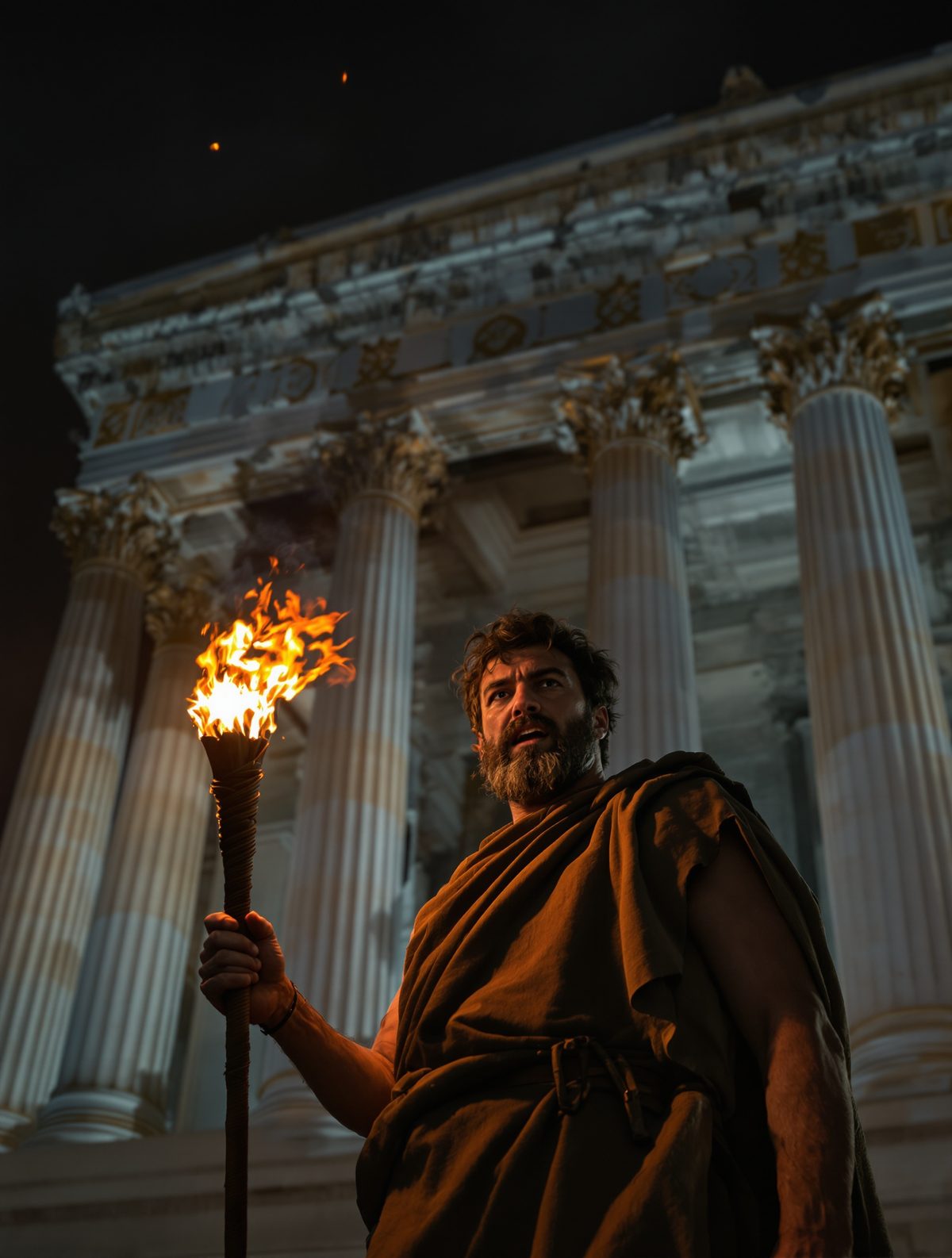
Picture this: Roman senators in togas, racing through the dusty countryside on horseback, sweat streaming down their faces as they desperately search for a man who holds the key to their civilization's survival. When they finally spot him, he's not lounging in a marble villa or commanding troops from a war tent. He's behind a wooden plow, dirt caked under his fingernails, working a modest four-acre farm like any common peasant.
The year was 458 BC, and Rome was about to die. Enemy tribes had surrounded the eternal city's armies, and disaster loomed on every horizon. In this moment of absolute crisis, the most powerful republic in the ancient world had come begging to a farmer named Lucius Quinctius Cincinnatus. What happened next would become one of history's most extraordinary examples of power, duty, and the rarest of human virtues: the willingness to let go.
When Rome's Worst Nightmare Came True
The crisis began when the Aequi, a fierce mountain tribe, declared war on Rome and did something no enemy had managed before—they didn't just attack Roman territory, they trapped an entire Roman army. Consul Lucius Minucius Esquilinus had marched out with Rome's finest legions to crush these "barbarians," but the Aequi commander Gracchus Cloelius had other plans.
In a masterpiece of military strategy, Cloelius lured the Roman forces into a valley near Mount Algidus, then sealed off both exits with fortified camps. Suddenly, Rome's "invincible" legions found themselves in a deadly trap—surrounded, cut off from supplies, and facing slow starvation or quick annihilation.
Back in Rome, panic spread like wildfire through the marble halls of power. Messengers brought increasingly desperate reports from the trapped consul: food was running out, morale was collapsing, and the proud eagles of Rome's legions might soon be trophies hanging in barbarian huts. For the first time in memory, the senate faced a terrifying possibility—the complete destruction of Rome's military might.
Here's what makes this crisis even more remarkable: the Roman Republic was still young, barely 50 years old, and surrounded by enemies who remembered when Rome was just another Italian hill town. One major military disaster could unravel everything they had built.
The Ultimate Emergency Protocol
The Roman constitution included a nuclear option for moments exactly like this: the dictatorship. But this wasn't dictatorship as we know it today. Roman dictators received imperium maius—absolute authority over every citizen, every soldier, every decision. They could execute anyone without trial, confiscate property at will, and override any law. It was unlimited power with one crucial catch: it expired after six months, no exceptions.
The senate faced an agonizing choice. Grant someone godlike authority over Roman civilization, or watch that civilization crumble. After heated debate, they reached unanimous agreement on their candidate: Cincinnatus, a 60-year-old former consul who had voluntarily retreated from politics after his son's disgrace and death.
But there was one small problem—nobody knew exactly where to find him.
What the senators did know was shocking by Roman standards. This former consul, this man who had once commanded legions and shaped policy in the forum, was working his own land with his own hands. In a society where aristocrats considered manual labor beneath their dignity, Cincinnatus had chosen the plow over politics, dirt over power.
The Most Important Plow in History
When the senatorial delegation finally located Cincinnatus on his small farm across the Tiber River, they found a scene that must have seemed almost surreal. Here was Rome's last hope, stripped to the waist, pushing a wooden plow behind a pair of oxen under the blazing Italian sun. His hands were calloused, his back was bent from honest labor, and he was covered in the kind of honest sweat that Roman aristocrats usually left to their slaves.
According to the historian Livy, the senators called out for Cincinnatus to put on his toga—they had urgent business from Rome. The formality was crucial: they couldn't deliver their earth-shattering news to a half-naked farmer. They needed to address a Roman citizen in proper attire.
Cincinnatus washed the dirt from his hands and arms, called for his wife Racilia to bring his toga from their modest farmhouse, and dressed with the dignity befitting his former rank. Only then did the senators deliver their message: Rome was dying, the legions were trapped, and the senate had voted to make him dictator with absolute power over the known world.
His response was immediate: "I accept."
Here's a detail that will blow your mind: Cincinnatus owned just four acres. Four acres! That's about three football fields. Today's average American house sits on about a quarter-acre lot. The man Rome turned to for salvation was working a plot of land smaller than most modern shopping centers.
Sixteen Days That Saved Western Civilization
What happened next reads like something out of a military thriller. Cincinnatus didn't waste time with speeches or ceremonies. He immediately dispatched orders throughout Roman territory: every man of military age was to report for duty immediately, bringing food for five days and twelve wooden stakes for fortification work.
By sunset, he was marching toward Mount Algidus with a hastily assembled but determined army. His strategy was audacious in its simplicity: he would surround the Aequi who had surrounded the Romans, creating a deadly sandwich of Roman steel.
The execution was flawless. Under cover of darkness, Cincinnatus positioned his forces around the Aequi camps. When dawn broke on the fourth day of his dictatorship, the enemy found themselves trapped between two Roman armies—the original force they had surrounded, and Cincinnatus's rescue army hemming them in from behind.
The Aequi commander Gracchus Cloelius, who had been so confident just days before, now faced an impossible choice: fight a two-front battle against desperate Romans, or surrender unconditionally. He chose surrender, but Cincinnatus imposed terms that would make even hardened Roman veterans smile. Every Aequi soldier had to pass "under the yoke"—crawling beneath crossed spears in the ultimate gesture of humiliation—before being allowed to retreat to their mountains.
Total time from crisis to victory: 16 days. Not 16 weeks or 16 months—16 days.
The Resignation That Shocked the Ancient World
Here's where the story becomes truly extraordinary. Cincinnatus had just achieved what every ambitious Roman dreamed of: total victory over Rome's enemies and unlimited power over the republic. He could have ruled for the full six months. He could have used his authority to make himself incredibly wealthy. He could have found excuses to extend his power indefinitely.
Instead, he did something that left his contemporaries speechless and inspired admiration for the next 2,000 years. On the 16th day of his dictatorship, Cincinnatus formally resigned his unlimited authority and asked for just one thing: permission to return to his farm.
The resignation ceremony in Rome was unlike anything the city had ever witnessed. Citizens lined the streets not just to celebrate victory, but to catch a glimpse of the man who had voluntarily given up absolute power. According to historical accounts, they threw flowers at his feet and followed him all the way to the city gates, cheering and calling out blessings.
But perhaps the most remarkable detail of all: Cincinnatus refused the gold and land that Rome offered as rewards. He had served his republic, fulfilled his duty, and wanted nothing more than to return to his four acres and his plow.
Why a Roman Farmer Still Matters in the Digital Age
In our modern world of career politicians and billionaire power brokers, Cincinnatus seems almost mythical. Can you imagine a contemporary leader voluntarily giving up power after achieving total victory? Can you picture a former president or prime minister choosing to return to manual labor on a small farm?
Yet Cincinnatus's story resonates precisely because such examples are so rare. His tale inspired America's founding fathers—George Washington explicitly modeled his resignation as commander-in-chief after Cincinnatus, earning him comparison to the Roman farmer-dictator. The city of Cincinnati bears his name specifically because its founders hoped to embody his virtues.
But there's something even more profound at work here. Cincinnatus understood something that modern leadership culture often forgets: true power lies not in acquiring authority, but in knowing when to relinquish it. He recognized that his strength came not from his titles or his temporary dictatorship, but from his character, his competence, and his willingness to serve something larger than himself.
In an age when we're constantly bombarded with examples of corruption, power-grabbing, and leaders who seem to view public service as personal enrichment, Cincinnatus stands as a reminder that another way is possible. He shows us that the greatest leaders might not be the ones desperately seeking power, but those who accept it reluctantly, use it effectively, and surrender it willingly.
Perhaps most importantly, he proves that there's profound dignity in honest work, whether you're commanding legions or following a plow. In our celebrity-obsessed culture that often conflates fame with worth, Cincinnatus reminds us that true greatness might be found not in the spotlight, but in the quiet satisfaction of duty fulfilled and promises kept.