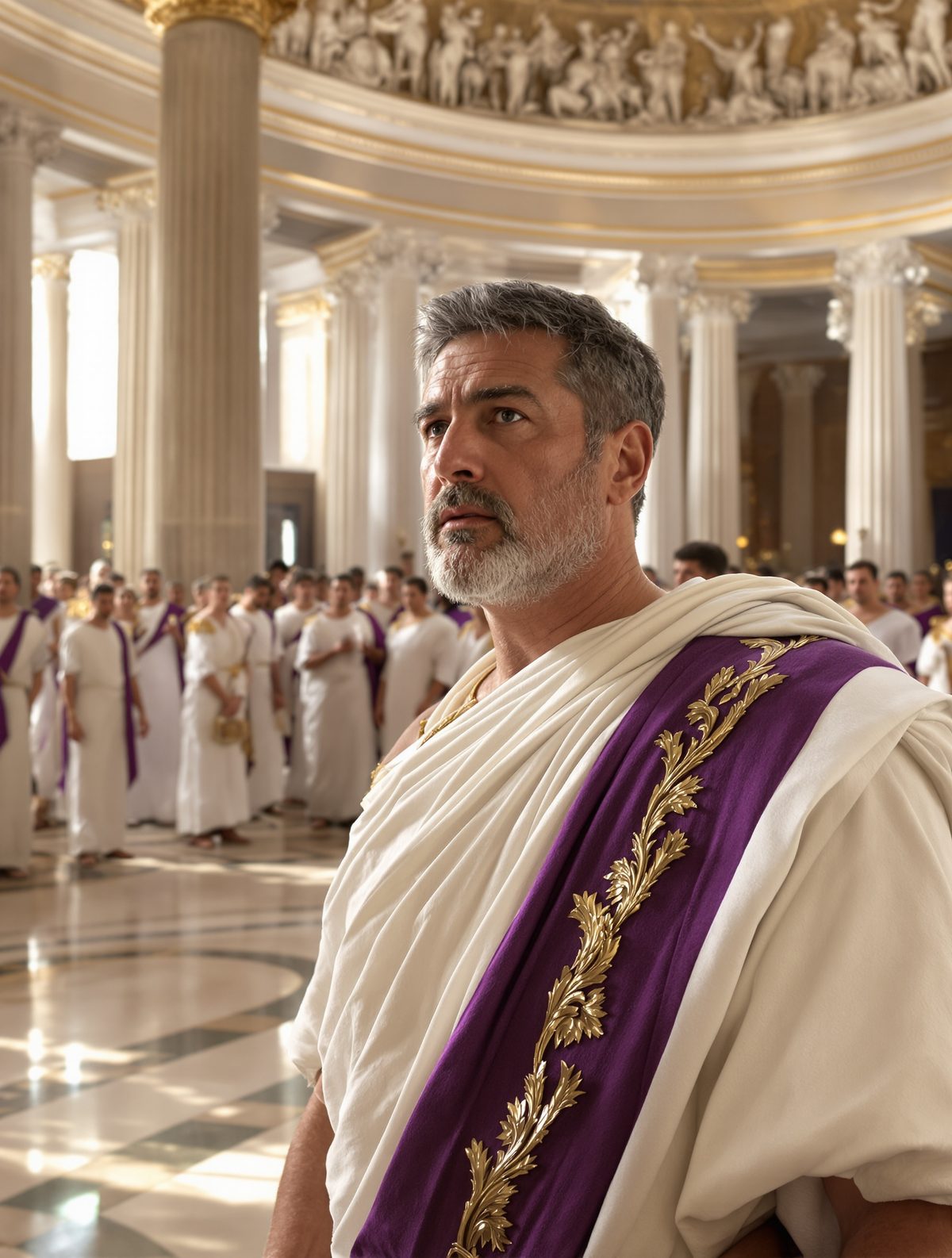
As dawn broke over the North African city of Utica on April 12, 46 BC, a Roman senator carefully cleaned blood from his hands and calmly asked for breakfast. Hours earlier, Marcus Porcius Cato—known to history as Cato the Younger—had spent the night reading Plato's Phaedo, a philosophical dialogue about death and the immortality of the soul. He had debated the nature of virtue with his friends until the small hours. Then, as his companions slept, he had driven his own sword deep into his chest rather than live under the rule of Julius Caesar.
But Cato's iron will proved stronger than his mortal flesh. The wound hadn't killed him. His servants, hearing the commotion, had rushed in to find him collapsed but breathing, his intestines spilling from the gash. A doctor quickly stitched him up, bandaged the wound, and left him to recover. It was then—weak from blood loss but resolute in purpose—that Cato tore open his own stitches with his bare hands, pulled out his entrails, and finally achieved the death he deemed necessary for honor.
This wasn't madness. This was the final act of a man who had spent his entire life preparing for this moment—the ultimate political statement against tyranny.
The Last Free City in a Conquered World
By 46 BC, the Roman Republic was dead in all but name. Julius Caesar's legions had swept across Gaul, crossed the Rubicon, and crushed Pompey's forces at the decisive Battle of Pharsalus three years earlier. One by one, the great champions of the old Republic had fallen, fled, or submitted. Egypt had welcomed Caesar as a god. Spain had bent the knee. The Mediterranean had become, quite literally, a Roman lake under the command of one man.
But in the dusty streets of Utica, a port city on the North African coast in what is now Tunisia, the ghost of the Republic still breathed. Here, Cato the Younger had gathered the last remnants of the old guard—senators, generals, and citizens who refused to accept that nine centuries of Republican government could simply end at the whim of one ambitious general, no matter how brilliant.
Cato wasn't just any senator. At 48 years old, he had spent decades as the moral conscience of Rome, famous for his incorruptible virtue and unwavering devotion to Republican principles. While other politicians took bribes, Cato walked barefoot through the streets in winter. While others wore expensive togas, Cato dressed in simple black wool. He was known to deliver speeches in the Senate while drunk—not from wine, but from moral indignation.
Now, as Caesar's veteran legions approached Utica's walls, Cato faced an impossible choice: surrender and live under a dictatorship, or make the ultimate sacrifice for his principles.
A Stoic's Preparation for Death
What most people don't realize about Cato's suicide is that it wasn't a moment of despair or defeat—it was a carefully orchestrated philosophical statement decades in the making. Cato was a devoted follower of Stoicism, the ancient Greek philosophy that emphasized virtue, duty, and rational acceptance of fate. To a Stoic, death wasn't something to fear but simply another natural event, like the changing of seasons.
More importantly, Stoics believed that maintaining one's virtue and freedom of choice mattered more than preserving life itself. As the philosopher Seneca would later write, "Every new beginning comes from some other beginning's end." For Cato, submitting to Caesar would mean the end of everything he valued most—personal honor, political freedom, and the sacred traditions of the Republic.
The senator had been preparing for this moment in ways both practical and spiritual. Earlier that evening, he had quietly arranged for the evacuation of as many Republican supporters as possible, providing ships and safe passage to those who chose exile over submission. He settled his affairs, embraced his adult son, and made sure his household was in order. This wasn't the desperate act of a cornered animal—it was the deliberate choice of a man who had thought deeply about the meaning of life and death.
Then came the reading. Cato chose Plato's Phaedo not randomly, but because it contained Socrates' own final philosophical discussions before drinking hemlock in an Athens prison. In the dialogue, Socrates argues that death is either a dreamless sleep (which would be peaceful) or a journey to another realm where the soul could continue learning (which would be wonderful). Either way, death held no terror for the virtuous man.
The Philosophy of the Final Night
Picture the scene: In a modest room overlooking the Mediterranean, lit by oil lamps that cast dancing shadows on painted walls, Cato sat surrounded by his closest friends and fellow philosophers. Outside, Caesar's scouts were already probing Utica's defenses. Inside, the conversation turned to the deepest questions humans have ever asked: What happens when we die? What makes life worth living? When does honor matter more than survival?
According to the historian Plutarch, who interviewed people who were present that night, Cato read passages aloud from Plato and engaged his companions in spirited debate. The irony wasn't lost on anyone in the room—here was a man discussing the immortality of the soul while planning his own death, examining the nature of virtue while preparing to demonstrate it in the most extreme way possible.
What's remarkable is how calm Cato remained throughout these discussions. His friends later reported that he seemed more at peace than he had in months. The terrible decision had been made; now there was only the execution of that decision to complete. He spoke of his life, his regrets, and his hopes for Rome's future. As one companion later wrote, "He seemed to have found a joy in dying that he had rarely found in living."
As the night wore on, his friends gradually retired to their quarters, emotionally exhausted by the weight of the evening's conversations. None of them suspected what Cato was planning. To them, the reading and discussion seemed like the senator's way of finding peace with an uncertain future, not preparing for a certain death.
The Moment of Choice
Alone at last, Cato made his final preparations. He wrote letters to be delivered after his death—messages of encouragement to other Republican holdouts, instructions for his family, and a final statement of his political beliefs. Then he lay down on his bed, pulled his sword close to his chest, and drove it home with the same methodical precision he had brought to every other aspect of his life.
But here's where the story takes its most dramatic turn. The human body, it turns out, is remarkably resilient, and Cato's wound, while severe, wasn't immediately fatal. The crash of his fall brought servants running. They found him unconscious but breathing, blood pooling around a gaping chest wound. A doctor was summoned, the wound was cleaned and stitched, and bandages were applied. The general assumption was that this had been a moment of weakness, a temporary lapse that the senator would regret upon awakening.
They couldn't have been more wrong. When Cato regained consciousness and realized he was still alive, his first words weren't of gratitude but of frustration. He had made his choice, and he would not be denied. Despite his weakness from blood loss, despite the protests of his servants, despite the physical agony it must have caused, Cato tore open his carefully stitched wound with his own hands and completed what the sword had begun.
The doctor who had tried to save him later wrote that he had never seen such determination in a dying man. "It was as if," he observed, "death itself was afraid to take him against his will."
The Ripple Effects of a Roman's Last Stand
Cato's suicide sent shockwaves throughout the ancient world. When news reached Caesar, the dictator reportedly wept and declared, "Cato, I begrudge you your death, as you have begrudged me your life." Caesar understood that in death, his greatest political opponent had achieved something that no military victory could provide—moral authority that would outlast any earthly empire.
The senator's dramatic end immediately became legend. Roman writers composed epic poems about his final night. Stoic philosophers used his example to teach about virtue and courage. Even Caesar's supporters found themselves grudgingly impressed by the sheer force of will Cato had demonstrated. In choosing death over compromise, he had transformed himself from a political opponent into a timeless symbol.
More practically, Cato's suicide became a rallying cry for future resistance movements. When Caesar was assassinated just two years later, the conspirators explicitly invoked Cato's memory. When Augustus established the Roman Empire, opposition writers circulated stories of Cato's virtue as veiled criticism of imperial corruption. The man who had failed to save the Republic in life had become its eternal guardian in death.
Perhaps most remarkably, Cato's final act influenced how Romans thought about suicide itself. In a culture that already viewed honorable suicide as preferable to disgraceful surrender, Cato's methodical, philosophical approach became the gold standard. Future Roman suicides—from generals facing defeat to emperors facing deposition—would explicitly model their deaths on Cato's example.
The Modern Meaning of an Ancient Choice
Twenty-one centuries later, in an era of political compromise and pragmatic flexibility, Cato the Younger's uncompromising final stand might seem like ancient fanaticism. After all, couldn't he have done more good by staying alive? Couldn't he have worked within Caesar's system to preserve what Republican values he could?
But Cato's choice speaks to something deeper than political tactics—the question of what principles are worth dying for. In a world where institutions can be corrupted, where norms can be abandoned, and where the unthinkable can become routine, Cato reminds us that some things matter more than survival. He understood that there are moments when compromise becomes complicity, when flexibility becomes surrender, and when the greatest service to future generations is to demonstrate that some lines should never be crossed.
His final night of reading also offers a different model of how to face impossible choices. Instead of rage or despair, Cato chose contemplation. Instead of hasty action, he chose philosophical reflection. He literally spent his last hours on earth thinking about what makes life meaningful and death acceptable. In our age of instant reactions and social media outrage, there's something profoundly moving about a man who responded to his greatest crisis by reading a book and talking with friends about the deepest questions of human existence.
Cato the Younger died as he lived—on his own terms, according to his own principles, with his own hand. History would remember him not as the senator who failed to save the Roman Republic, but as the man who showed that even in humanity's darkest moments, individual conscience can still choose virtue over survival, principle over pragmatism, and eternal honor over temporary comfort. Sometimes, the most powerful political statement isn't what you're willing to live for—it's what you're willing to die for.