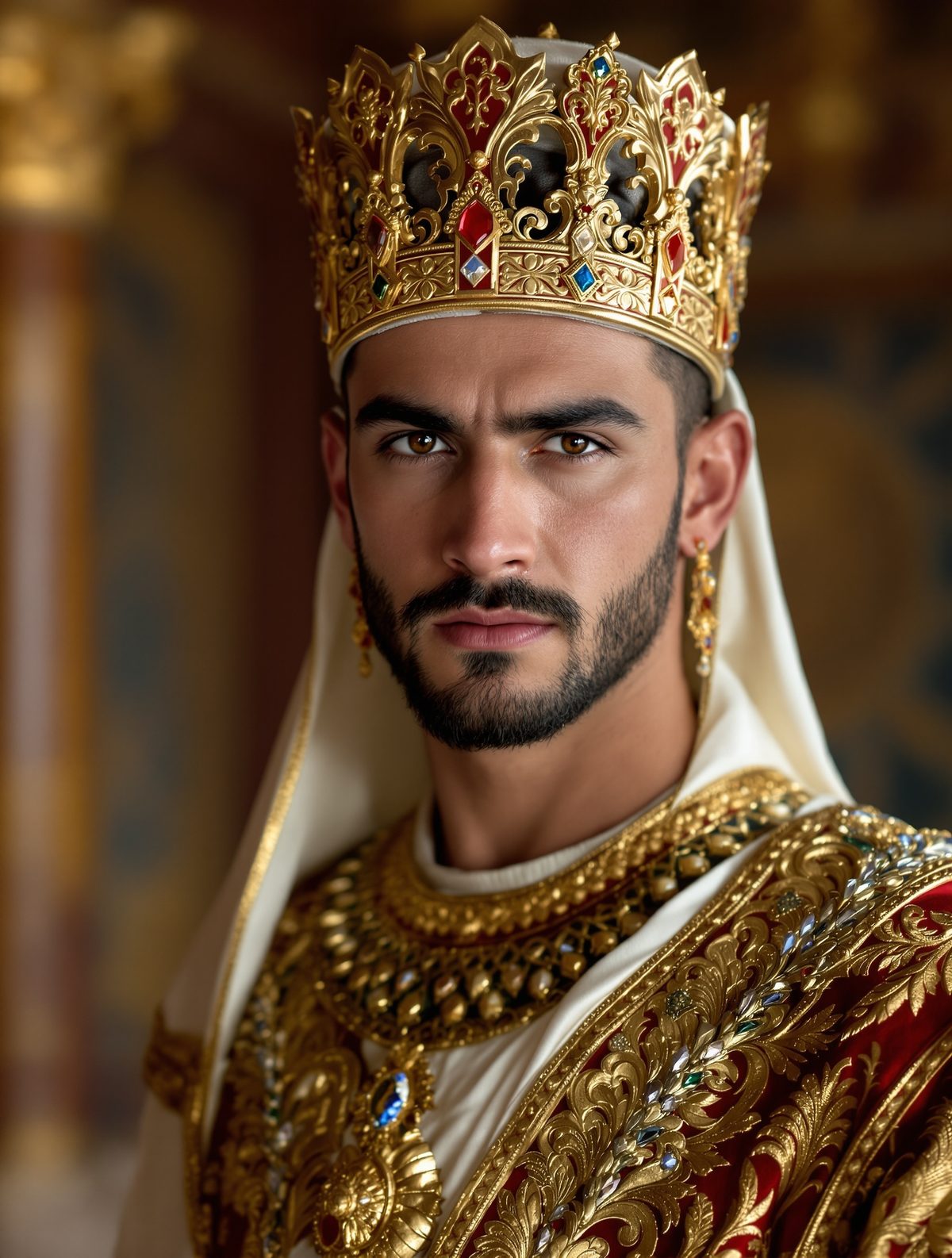
The massive bronze doors of the Serapeum temple creaked open in Memphis, Egypt, and a collective gasp echoed through the assembled crowd. Persian King Cambyses II, conqueror of the known world, sat rigidly on his throne as Egyptian priests emerged from the sacred chambers. Between them walked a magnificent black bull, its hide gleaming like polished obsidian, adorned with golden ornaments that caught the flickering torchlight. This was the Apis bull—living god of Egypt, divine incarnation of the creator deity Ptah, worshipped by millions for over two millennia.
What happened next would shock even the battle-hardened Persian soldiers present. Without warning, Cambyses rose from his throne, drew his ceremonial dagger, and plunged it deep into the sacred animal's thigh. As the bull's blood pooled on the temple floor and the creature collapsed in agony, the Egyptian priests fell to their knees in horror. Their god was dying before their eyes, and with it, perhaps their entire civilization.
This single act of brutal sacrilege in 525 BC would define one of history's most controversial rulers and set in motion a chain of events that would reshape the ancient world forever.
The Builder of the World's Greatest Empire Meets His Match
Cambyses II wasn't just any conqueror—he was the heir to Cyrus the Great's Persian Empire, the largest dominion the world had ever seen. By 525 BC, Persian territory stretched from the Indus River to the Aegean Sea, encompassing modern-day Iran, Iraq, Turkey, Afghanistan, and much of Central Asia. But one prize had always eluded Persian grasp: Egypt, the ancient kingdom that had stood for nearly three thousand years.
The Egypt that Cambyses invaded was no mere collection of desert tribes. This was a civilization that had built the Great Pyramids when most of Europe was still covered in primeval forests. Egyptian mathematics, medicine, and architecture were legendary throughout the Mediterranean. Their military prowess was equally formidable—they had repelled invasions by Assyrians, Nubians, and countless other would-be conquerors.
Yet Cambyses achieved in months what others had failed to accomplish in centuries. At the Battle of Pelusium in May 525 BC, his forces crushed the army of Pharaoh Psamtik III, utilizing a psychological warfare tactic that revealed just how well he understood Egyptian culture. Persian soldiers reportedly carried cats, ibises, and other animals sacred to the Egyptians as living shields, knowing their enemies would rather die than harm these creatures. The strategy worked devastatingly well.
But conquering Egypt militarily was only half the battle. To truly rule this ancient land, Cambyses needed to understand—or at least accommodate—the complex religious beliefs that had sustained Egyptian civilization for millennia. This is where the sacred Apis bull entered the story.
The Living God That Ruled Memphis
To understand the magnitude of Cambyses' sacrilege, one must first grasp just how central the Apis bull was to Egyptian religious life. This wasn't simply a temple decoration or symbolic artifact—Egyptians believed the Apis bull was literally a living god, the earthly manifestation of Ptah, the creator deity who had spoken the world into existence.
The selection process for each new Apis bull was extraordinarily specific. According to the ancient historian Herodotus, who visited Egypt just decades after Cambyses' conquest, the chosen bull had to display precise markings: a white triangular patch on its forehead, a white patch shaped like an eagle on its back, double hairs on its tail, and a scarab-shaped mark under its tongue. Only a bull displaying all these characteristics could be declared the new Apis.
Once identified, the sacred bull lived in luxury that would make modern billionaires jealous. The Apis resided in magnificent quarters within the temple complex at Memphis, tended by dozens of priests, fed the finest foods, and consulted by thousands of pilgrims seeking divine guidance. When an Apis bull died, the entire nation entered a period of mourning comparable to the death of a pharaoh. The deceased bull was mummified with the same elaborate rituals used for human royalty and entombed in a massive stone sarcophagus in the underground galleries of the Serapeum.
Archaeological excavations in the 19th century revealed the stunning scale of these burials. The Serapeum contained dozens of enormous granite sarcophagi, each weighing up to 70 tons and carved with exquisite precision. These weren't the graves of mere animals—they were the tombs of gods.
The Moment That Shattered Sacred Order
When Cambyses demanded to see this famous sacred bull, Egyptian priests likely hoped their new Persian ruler might show proper reverence, perhaps even adopting Egyptian customs as previous foreign rulers had done. The Ptolemaic Greeks who would later rule Egypt embraced local traditions wholeheartedly, with rulers like Cleopatra becoming more Egyptian than the Egyptians themselves.
But Cambyses was cut from different cloth. Ancient sources, including Herodotus, describe him as increasingly unstable, prone to violent outbursts and contemptuous of foreign customs. Some modern historians suggest he may have suffered from mental illness, pointing to his erratic behavior throughout his reign. Others argue his actions were calculated displays of dominance designed to break Egyptian resistance.
The scene in the Serapeum unfolded with shocking brutality. As recorded by multiple ancient historians, Cambyses not only stabbed the sacred bull but reportedly laughed at the priests' anguish. He mocked their beliefs, calling them fools for worshipping animals. The bull, wounded in the thigh, lingered for days before dying—a prolonged agony that the Egyptians interpreted as divine punishment for their entire nation.
The psychological impact cannot be overstated. Imagine if a foreign conqueror had publicly desecrated the most sacred relics of Christianity, Islam, and Judaism simultaneously—that's comparable to what Egyptians experienced. Their divine order, unchanged for millennia, had been shattered by a single act of violence.
The Curse of the Sacred Bull
Egyptian priests declared that Cambyses had doomed himself through this act of sacrilege, and remarkably, events seemed to bear out their prediction. Within months of killing the Apis bull, Cambyses' reign began unraveling with almost supernatural speed.
First came military disasters. His planned invasion of Nubia ended in catastrophic failure when his army, inadequately supplied, became lost in the desert and nearly starved. A separate expedition against the Oracle of Ammon—another Egyptian religious site—simply vanished entirely into the Sahara, never to be seen again. Some estimates suggest 50,000 Persian soldiers died in these failed campaigns.
Meanwhile, rebellion erupted back in Persia itself. A pretender claiming to be Cambyses' murdered brother Bardiya seized the throne, forcing the king to abandon his Egyptian conquests and race home. But Cambyses would never make it back to Persia alive.
In 522 BC, less than three years after killing the sacred bull, Cambyses died under mysterious circumstances in Syria. Ancient sources disagree on the details—some claim he died from an infected wound, others suggest suicide or assassination. But the timing struck Egyptians as unmistakably divine justice. Their god had been avenged.
Most chilling of all, according to later Egyptian records, the wounded Apis bull died on the exact same day that Cambyses himself perished, as if their fates had become supernaturally intertwined through that single act of violence.
When Empires Collide With Faith
The story of Cambyses and the sacred bull might seem like ancient history, but it illuminates timeless tensions that persist today. What happens when political power confronts religious devotion? How should conquerors treat the beliefs of the conquered?
Cambyses' successor, Darius I, learned from this catastrophic mistake. When he consolidated Persian rule over Egypt, Darius showed elaborate respect for local customs, even commissioning new temples and participating in religious ceremonies. This approach proved far more effective—Persian rule in Egypt lasted for nearly two centuries under Darius' more tolerant policies.
The broader lesson extends beyond ancient history. Throughout the centuries, empires that have attempted to crush local beliefs through force have typically faced fierce resistance and ultimate failure. From Roman persecution of early Christians to modern conflicts rooted in religious differences, the pattern remains remarkably consistent: attacking what people hold sacred rarely brings lasting peace.
Perhaps most fascinating is how this single moment of violence—one man's dagger thrust into an animal's leg—rippled across history. It weakened Persian rule in Egypt, contributed to Cambyses' downfall, and became a cautionary tale remembered for centuries. The ancient world was more interconnected than we often imagine, where news of sacrilege in Memphis could destabilize an empire stretching from India to Greece.
In our own globally connected age, where images and ideas spread instantly across continents, the story of Cambyses serves as a stark reminder: what we do to others' most sacred beliefs matters, not just morally, but practically. Empires built on respect endure; those built on contempt crumble. And sometimes, the fate of kings hangs on how they treat a single sacred bull in a temple they thought didn't matter.