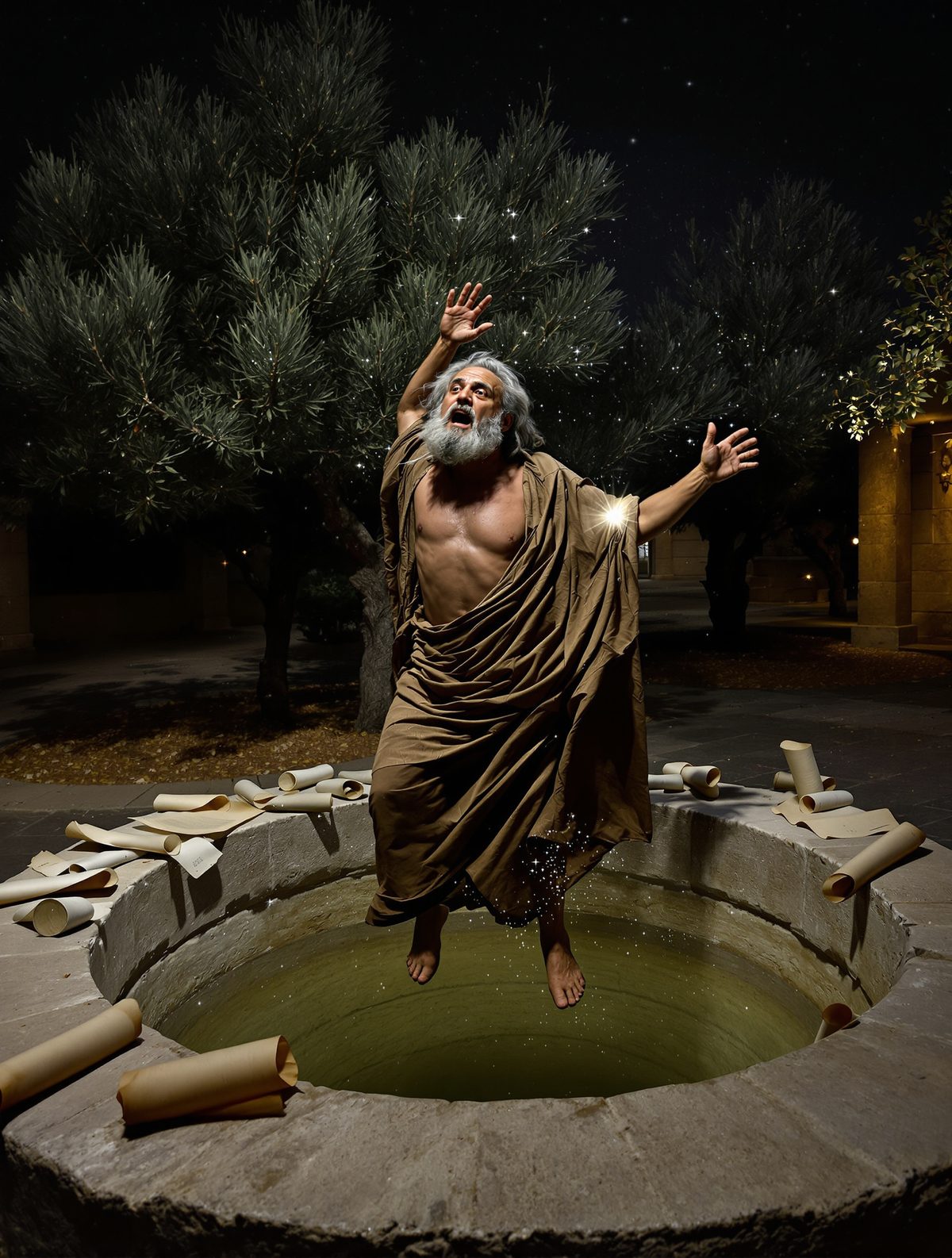
In the sweltering heat of a Persian summer in 522 BC, seven of the most powerful nobles in the Achaemenid Empire crept through the corridors of the royal palace at Sikayauvatis. Their mission was assassination—but with a twist that would have made even the most creative Hollywood screenwriter pause in disbelief. They were about to murder a man who was already dead.
The target of their midnight raid was Prince Bardiya, brother of the recently deceased King Cambyses II, who had dramatically returned from exile to claim the Persian throne. But as these conspirators were about to discover, the man sleeping in the royal chambers was nothing more than an elaborate fake—a doppelgänger whose resemblance to the real prince had fooled an entire empire for eight months.
What they didn't know, and what would shock them to their core, was that the real Bardiya had been rotting in an unmarked grave for over a year, secretly murdered by his own brother. This is the incredible true story of how one Persian prince managed to die twice, and how the greatest empire on Earth was ruled by an imposter whose very existence would reshape the ancient world.
The Brother's Dark Secret
To understand this extraordinary deception, we must first journey back to 525 BC, when King Cambyses II ruled over the largest empire the world had ever seen. Stretching from the Indus River to the Mediterranean Sea, the Persian Empire controlled roughly 44% of the world's population—an administrative nightmare that required absolute loyalty from the royal family.
But Cambyses harbored a dark paranoia about his younger brother, Prince Bardiya. The prince was beloved by the people, respected by the army, and—most dangerously—had a legitimate claim to the throne. In the Persian succession system, brothers could inherit just as easily as sons, and Bardiya's popularity made him a constant threat to Cambyses' rule.
So Cambyses did what any rational ancient despot would do: he had his brother quietly murdered.
The assassination was carried out with surgical precision. While Cambyses was campaigning in Egypt, consolidating Persian control over the Nile Delta, he sent secret orders back to Persia. A trusted executioner named Prexaspes carried out the deed, killing Bardiya in complete secrecy. The prince simply vanished from court life, and when nobles asked questions, they were told he had been sent away on royal business.
For months, this lie held. The vast bureaucracy of the Persian Empire continued to function, tributes flowed in from distant provinces, and life went on. Cambyses had eliminated his rival without anyone being the wiser. But in March of 522 BC, fate intervened in the most spectacular way possible.
The Magus Who Would Be King
Enter Gaumata, a Median priest whose life was about to become the stuff of legend. Gaumata was what the Persians called a magus—a member of the priestly class who performed religious ceremonies and interpreted omens. But this particular magus possessed something far more valuable than spiritual insight: he looked exactly like the dead Prince Bardiya.
The resemblance was so uncanny that it bordered on the supernatural. Same height, same build, same facial features, even the same mannerisms. In an age before photography or mass media, where most people knew their rulers only from stylized carvings and coins, Gaumata realized he held the ultimate winning lottery ticket.
While Cambyses was still fighting in Egypt, dealing with a disastrous campaign that was draining the royal treasury, Gaumata made his move. On March 11, 522 BC, he proclaimed himself to be Prince Bardiya, rightful heir to the Persian throne. His timing was perfect—Cambyses was hundreds of miles away, communication was slow, and the empire was war-weary and ready for change.
But here's the truly brilliant part: Gaumata didn't just look like Bardiya, he governed like him. The real Bardiya had been known for his concern for the common people, and Gaumata leaned into this reputation with remarkable political savvy. He immediately instituted a series of wildly popular reforms that would make any modern politician jealous.
The Imposter's Golden Reign
What followed were eight months that would later be remembered as some of the most prosperous in early Persian history. The fake Bardiya proved to be a remarkably effective ruler, implementing policies that won him support across the vast empire.
He granted tax relief to struggling provinces—a move that put money directly back into people's pockets. He declared a three-year moratorium on military service, allowing farmers and craftsmen to focus on rebuilding the economy rather than marching off to distant wars. Most revolutionary of all, he proclaimed religious tolerance throughout the empire, allowing conquered peoples to worship their traditional gods without persecution.
These weren't just empty gestures. Ancient tablets recovered by archaeologists show that tax collection did indeed decrease during this period, and there's evidence that construction projects—often forced upon local populations—were suspended or cancelled entirely. The fake Bardiya was essentially buying loyalty with real policy changes, and it was working brilliantly.
Meanwhile, the real situation was growing increasingly surreal. King Cambyses, learning of his "brother's" rebellion while still in Egypt, began marching home to confront the usurper. But in July 522 BC, fate intervened again. Cambyses died under mysterious circumstances—some sources say from an infected sword wound, others suggest poison or disease. With his death, any hope of exposing Gaumata's deception seemed to die with him.
The fake Bardiya was now the unchallenged ruler of the Persian Empire, and absolutely no one suspected the truth. Well, almost no one.
Unraveling the Perfect Crime
Otanes, one of the most powerful Persian nobles, began to smell something rotten in the royal palace. As a member of the inner circle of Persian nobility, Otanes had known the real Bardiya personally, and subtle differences in the new king's behavior were starting to add up.
The breakthrough came through an unexpected source: Otanes' daughter, Phaidyme, who had been married to both Cambyses and, after his death, to the man claiming to be Bardiya. Otanes devised a plan that would have made any detective proud.
He instructed his daughter to wait until the king was asleep, then carefully examine his ears. This wasn't random paranoia—Otanes remembered that the real Bardiya had both ears intact, but he suspected that Gaumata might have had his ears cut off as punishment for some crime, which was a common punishment for priests who violated sacred laws.
What Phaidyme discovered in the darkness of the royal bedchamber would change the course of history. The man claiming to be her husband had no ears at all—they had been completely severed, leaving only scars where they should have been.
The revelation sent shockwaves through the Persian nobility. Not only was their king a fraud, but they had been unknowingly living under the rule of a mutilated priest who had somehow managed to fool an entire empire for eight months.
The Conspiracy of Seven
What happened next reads like an ancient version of a political thriller. Otanes secretly contacted six other Persian nobles, including a young ambitious aristocrat named Darius (who would later become Darius the Great). Together, they formed what history would remember as the "Conspiracy of Seven"—a group determined to eliminate the imposter and restore legitimate rule to Persia.
The conspirators faced a seemingly impossible challenge. Gaumata was surrounded by loyal guards, protected in a fortified palace, and still enjoyed popular support throughout the empire. A direct assault would be suicide, but waiting risked exposure of their plot.
On September 29, 522 BC, they made their move. Using their legitimate access to the royal palace, the seven conspirators entered the fortress at Sikayauvatis where Gaumata was residing. What followed was a brief but brutal confrontation. According to Herodotus, who chronicled these events decades later, the fake Bardiya was killed along with several of his supporters in a fierce fight within the palace chambers.
With Gaumata's death, Prince Bardiya had now officially died twice—first as himself, murdered by his brother's paranoia, and second as an imposter, killed by nobles who discovered the deception. The Persian Empire, after eight months under false rule, was suddenly leaderless once again.
The Legacy of a Double Death
The aftermath of this incredible deception would reshape not just Persia, but the entire ancient world. Darius, one of the seven conspirators, maneuvered himself onto the throne and became one of history's greatest rulers. Under his reign, the Persian Empire reached its zenith, stretching from India to Greece and leaving architectural marvels like Persepolis that still amaze visitors today.
But the story of Bardiya's double death reveals something far more profound about the nature of power and legitimacy in the ancient world. For eight months, an empire containing millions of people was successfully ruled by a man whose only qualification was looking like someone else. Gaumata's policies were popular, his administration was effective, and his subjects were content. In many ways, he was a better king than many legitimate rulers.
This raises uncomfortable questions that echo through history to our own time: What makes a leader legitimate? Is it bloodline, popular support, or simply the ability to govern effectively? In our age of social media, deepfakes, and carefully crafted political personas, the story of the magus who became king feels surprisingly modern.
Perhaps most remarkably, Gaumata's brief reign demonstrated that successful leadership might be less about divine right or noble birth, and more about understanding what people actually need. His tax relief, military service moratorium, and religious tolerance weren't just clever political moves—they were genuinely progressive policies that improved people's lives.
The Persian prince who died twice reminds us that history's most fascinating stories often lie in the margins of empire, in the spaces between what officially happened and what people actually experienced. Sometimes the greatest truths come from the most elaborate lies, and sometimes an imposter can reveal more about leadership than a dozen legitimate kings.