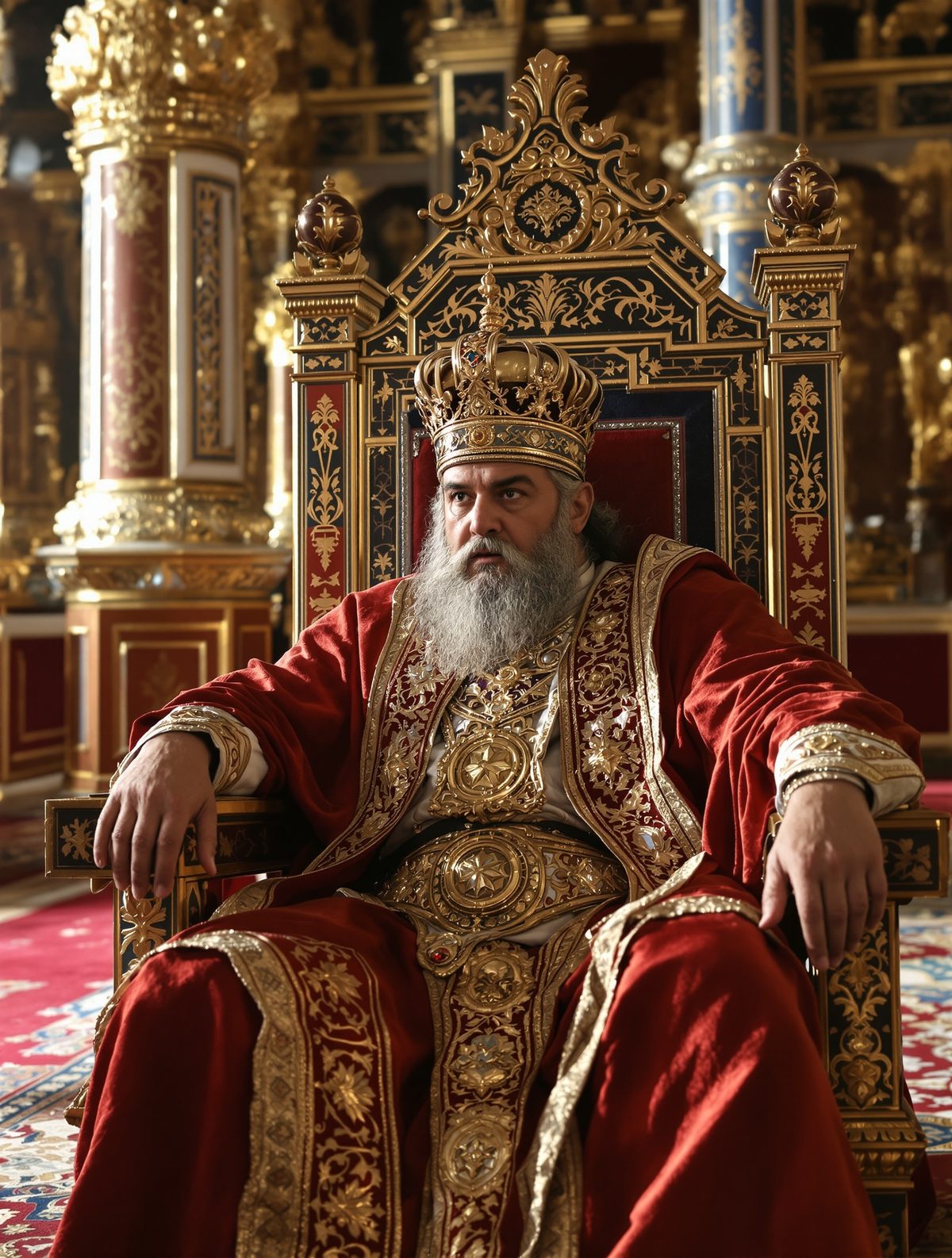
Picture this: a man so feared that kings trembled at his approach, yet he possessed no royal blood, commanded no armies, and had been castrated as a child. In the glittering palaces of ancient Persia, where golden columns reached toward heaven and the scent of frankincense filled marble halls, one eunuch held the power of life and death over the mightiest empire on Earth. His name was Bagoas, and between 358 and 336 BC, he orchestrated one of history's most audacious power grabs—murdering two kings with poison and nearly claiming the throne for himself.
This is the story they never taught you in school: how a castrated slave became the puppet master of an empire that stretched from India to Greece, and how his reign of terror finally met its match in a cup of his own deadly brew.
The Eunuch Who Ruled an Empire
In the Persian Empire, eunuchs weren't just servants—they were a parallel aristocracy, wielding influence that would make modern power brokers envious. Castrated in childhood, these men were considered ideal courtiers because they could never father dynasties to challenge the royal line. Or so the theory went.
Bagoas shattered that assumption spectacularly. Rising through the ranks during the reign of Artaxerxes III (who ruled from 358-338 BC), this cunning eunuch became something unprecedented: a kingmaker who treated monarchs like chess pieces. His official title was hazarapatis—roughly equivalent to "grand vizier"—but his real power far exceeded any formal position.
The Persian court was a labyrinth of intrigue where a whispered word could topple generals and a well-placed bribe could redirect the course of history. In this treacherous environment, Bagoas didn't just survive—he thrived. He understood that in a world where succession was often disputed and royal brothers routinely murdered each other for the crown, the man who controlled information, access, and the royal household's daily operations held the real power.
Here's what most people don't realize: Persian eunuchs often accumulated vast personal wealth, maintained private armies of servants and retainers, and lived in luxury that rivaled the royal family itself. Bagoas had all of this, plus something even more dangerous—an intimate knowledge of poisons that would make a Renaissance Borgia jealous.
The First Royal Murder: Artaxerxes III Falls
By 338 BC, the relationship between King Artaxerxes III and his once-trusted eunuch had soured beyond repair. The exact cause remains lost to history, but ancient sources suggest the king had begun to suspect Bagoas of corruption and was planning to strip him of power. For a man who had grown accustomed to being the true ruler of Persia, this was an unacceptable threat.
What happened next reads like a scene from a political thriller. One evening in 338 BC, as autumn winds swept across the royal city of Persepolis, King Artaxerxes III sat down for what would be his final meal. The king, now in his fifties and weakened by years of military campaigns, had no idea that his trusted eunuch had decided his fate.
The poison was likely administered through wine—the beverage of choice for Persian nobility and the perfect vehicle for deadly substances. Ancient historians don't specify which toxin Bagoas used, but given his later actions, he clearly had access to something both potent and relatively subtle. The king probably experienced what seemed like a sudden illness: perhaps stomach pain, difficulty breathing, and gradual weakness before succumbing within hours.
The audacious part wasn't just the murder—it was what came next. Rather than fleeing or attempting to seize power directly, Bagoas orchestrated a seamless transition that made him look like the grieving, loyal servant. He placed Artaxerxes III's youngest son, Arses, on the throne, presenting the eighteen-year-old prince as the rightful heir while positioning himself as the power behind the throne.
A Puppet King Who Wouldn't Dance
Young King Arses (also known as Artaxerxes IV) ascended to the throne in 338 BC, but his reign was doomed from the start. Bagoas had chosen him precisely because he seemed malleable—young, inexperienced, and grateful for the eunuch's support in claiming the crown. What Bagoas hadn't counted on was the possibility that even a teenage king might eventually rebel against being treated like a marionette.
For nearly two years, the arrangement worked perfectly. Bagoas issued orders in the king's name, controlled access to the royal person, and essentially ran the Persian Empire while Arses played the ceremonial role of monarch. The young king signed decrees he likely didn't fully understand, received foreign ambassadors who knew the real power lay with the eunuch standing beside the throne, and watched as his nominal subjects looked to Bagoas for real leadership.
But absolute power, as they say, corrupts absolutely—and it also makes people paranoid. By 336 BC, Bagoas had apparently concluded that King Arses was becoming too independent, asking too many questions, and showing signs of wanting to rule in reality rather than just in name. Perhaps the young king had begun making decisions without consulting his "advisor," or maybe he had started building his own network of supporters. Whatever triggered Bagoas's suspicion, the eunuch decided that his second king had outlived his usefulness.
The method was identical to the first murder: poison, probably administered during a royal meal. King Arses died in 336 BC after a reign of just twenty-one months, his death officially attributed to illness. With cold calculation, Bagoas had now murdered two kings within three years, and no one seemed able to stop him.
The Final Gambit: Enter Darius III
With two kings dead and the royal succession in chaos, Bagoas faced a crucial decision. He needed another puppet, but the pool of suitable candidates was shrinking. The eunuch's choice fell upon Darius III, a more distant member of the royal family who seemed unlikely to cause trouble.
Darius was no teenage prince like Arses. At around forty-five years old, he was a seasoned courtier who had served as satrap (governor) of Armenia. He possessed military experience, political acumen, and—most importantly—he appeared grateful to Bagoas for elevating him to the throne. Here's the detail that makes this story even more remarkable: Darius III would later face Alexander the Great in the battles that ended the Persian Empire, but his first and deadliest enemy was the eunuch who had made him king.
Initially, the arrangement seemed to follow the same pattern as before. Darius accepted the crown, acknowledged Bagoas's role in his elevation, and appeared ready to govern as another puppet monarch. But unlike his predecessors, Darius III was playing a longer game. He smiled, nodded, and bided his time while secretly building a network of supporters who were loyal to him personally rather than to the powerful eunuch.
The exact timeline is unclear, but within months of his coronation, Darius III had apparently decided that Bagoas posed an existential threat to his reign. Perhaps he had learned the truth about how his two predecessors died, or maybe he simply recognized that any king would eventually become expendable once the eunuch grew tired of sharing power.
The Poisoner's Final Cup
What happened next is one of history's most satisfying examples of poetic justice. When Bagoas decided that his third king had also become too independent, he prepared to administer the same deadly solution that had eliminated Artaxerxes III and Arses. But Darius III was ready for him.
The confrontation likely took place in 336 BC, in one of the private chambers of the royal palace where so much Persian history had been written in blood and whispers. Ancient sources suggest that Bagoas prepared a poisoned drink—probably wine mixed with whatever toxic substance had proven so effective in his previous murders.
But here's where the story takes its dramatic turn: instead of accepting the cup, Darius III revealed that he knew exactly what the eunuch had been doing. Whether through spies, loyal courtiers, or his own investigation, the king had uncovered the truth about the mysterious deaths that had brought him to power.
In a scene that would have impressed Shakespeare, Darius III forced Bagoas to drink his own poison. The king who had been chosen as a puppet had become the puppet master's executioner. The man who had murdered two monarchs and wielded the power of an empire died by the very method he had used to eliminate his enemies.
The irony was complete: Bagoas, who had spent years demonstrating that even kings were mortal, discovered that eunuchs were equally vulnerable to the poisons they prepared for others.
The Shadow of the Throne
Bagoas's story reveals uncomfortable truths about power that remain relevant today. In our modern world of political advisors, corporate consultants, and behind-the-scenes powerbrokers, we still see echoes of the Persian eunuch who proved that official titles often matter less than real influence.
The eunuch's rise and fall also illustrates a timeless principle: those who live by manipulation and murder rarely die peacefully in their beds. Bagoas's reign of terror lasted nearly twenty years, but his very success created the conditions for his downfall. By demonstrating that kings could be killed with impunity, he taught Darius III that eunuchs could be eliminated just as easily.
Perhaps most importantly, Bagoas's story reminds us that history is rarely made by the people whose names appear on official documents. While textbooks focus on kings and generals, the real power often belonged to advisors, courtiers, and administrators who understood that controlling information and access was more valuable than wearing a crown.
In boardrooms and political capitals around the world, modern Bagoases still wield influence from the shadows, shaping decisions that affect millions while remaining largely invisible to public scrutiny. The methods may have evolved, but the fundamental dynamics of power remain unchanged: sometimes the most dangerous person in the room is the one standing quietly beside the throne, holding a cup and waiting for the right moment to offer it.