He was a king feared across the ancient world. Yet instead of harvesting blood and territory alone, Ashurbanipal collected words—a pursuit as audacious as any military conquest.
In 668 BCE, in the heart of the Assyrian Empire, Ashurbanipal ascended to the throne. His capital, Nineveh, pulsed with power, its gates flung open to emperors and emissaries alike, as it stood at the pinnacle of prosperity and influence. Yet the young king, a maestro of troop maneuvers in the brutal theatre of war, harbored an ambition rarely found amongst warriors. He didn't merely wish to command lands; he aimed to command knowledge itself. Mindful of the transient nature of empires, Ashurbanipal embarked on an enduring endeavor, one likely more baffling than his military campaigns to his contemporaries. He sought to create a repository of the world's wisdom.
Ashurbanipal's orders resonated from the peaks of his empire's reaches; he sent scribes into every corner of his vast dominion with a singular command: find every tablet, copy every text, and bring the fruits of these endeavors back to Nineveh. With purpose carved in ancient clay, his messengers scoured Sumerian temples, Babylonian libraries, and private collections, each baked tablet promising its own sliver of enlightenment under Assyria's sun. Brick by brick, or rather, tablet by tablet, this compilation would transcend his temporal reign, encompassing varied subjects from divination to mathematics, medicine, hymns, and histories. It was a colossal scholarly structure, no less majestic than the fortified walls guarding his kingdom.
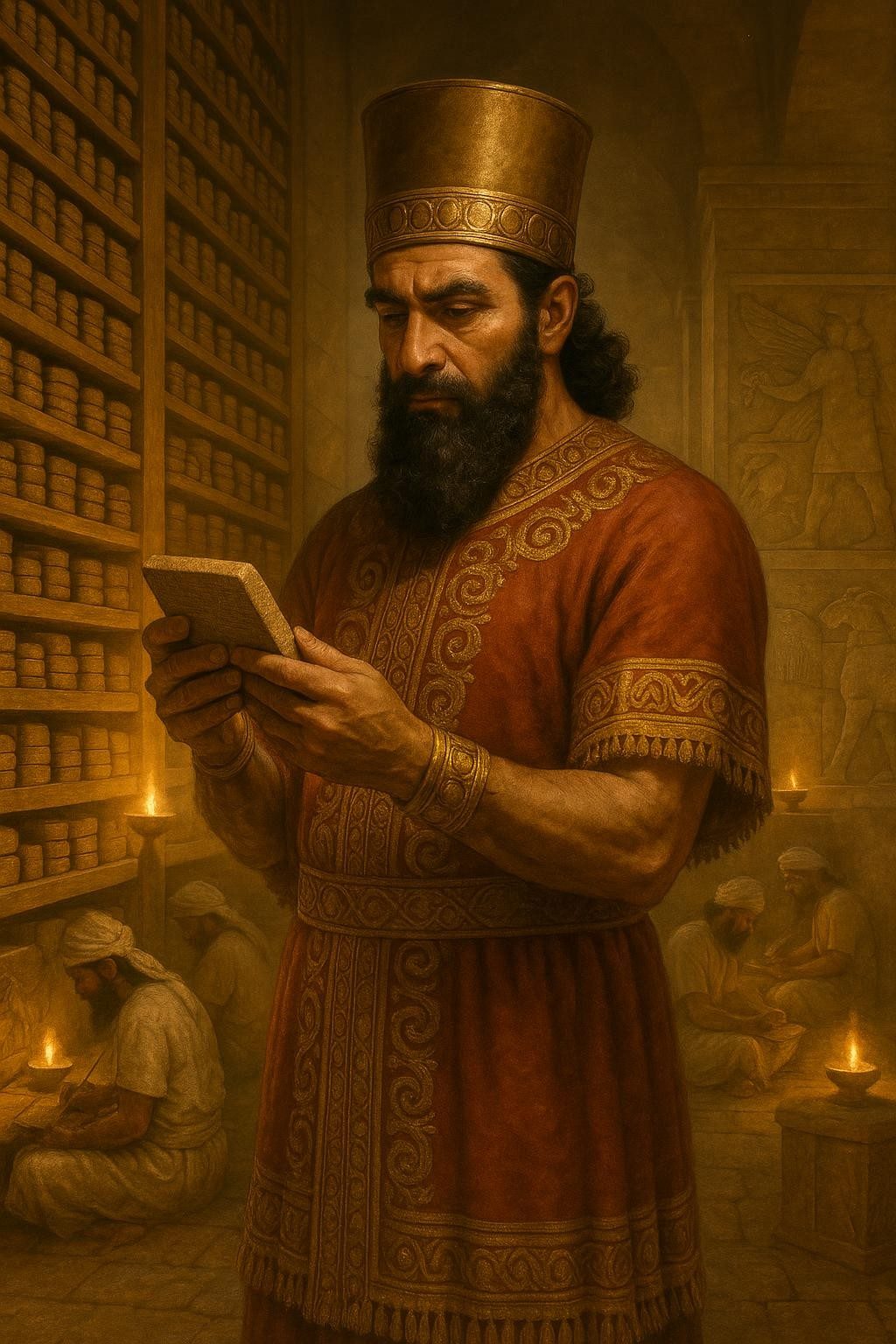
Nineveh's Library soon began to bloom, each tablet meticulously cataloged and preserved. The walls of this grandeur were lined not with shelves of scrolls, but with rows upon rows of clay tablets etched with the cuneiform script—an emblem of human civilization's nascent curiosity. A library not merely of Assyrian conquests but of the world: its poetry, its secrets, its dreams whispered into clay. This library, unlike others, was not merely a storage facility but a beacon of learning, luring scholars and scribes into its embrace, an ancient lighthouse guiding the Mediterranean intellectual seas.
Within Nineveh, silence reigned as lightly robed scribes kneeled on stone floors, their styluses dancing over wet clay with intentions of eternity. Here were gathered the Enuma Elish, the epic tales of Gilgamesh, and all manner of texts from across the conquered provinces. These were not just academic artifacts but keys to the civilizations that rose, stepped, and crumbled before the Assyrian might. This was Ashurbanipal’s silent war—a conquest over oblivion itself.
Though the size and scope of the collection may now be shrouded by the veil of time, some estimates suggest tens of thousands of tablets were housed within these ancient halls. Each held a whisper of the past, stamped with the urgencies of life centuries prior. The surviving fragments excavated from the ruins present a tantalizing glimpse of this king’s intellectual dominance, relaying medical recipes, administrative records, religious hymns, and legal decrees. They provide us with visions of everyday life, of claims of the divine, of treaties and tribulations.
Despite his formidable success with quill and clay, Ashurbanipal’s military legacy is undeniable. An adept general, he wielded power through Assyria’s legions, subduing neighboring lands with ruthless efficiency. Yet where other conquerors razed cities, Ashurbanipal preserved them in his own way, astonishingly binding conquered cultures within the careful etchings on clay tablets. In this library, Mesopotamian, Sumerian, and Babylonian voices harmonized rather than clashing beneath the chariot wheels of war.
The significance of Ashurbanipal’s collection extended beyond its immediate temporal contributions. While many other cities and their records succumbed to the relentless grind of time, the library’s remnants outlived their creator by more than two millennia. When Nineveh eventually fell in 612 BCE, it did so with the delicate poignancy of an ancient memory lost. The library's contents lay dormant beneath layers of earth until rediscovered in the mid-19th century. These discoveries sowed the seeds of modern Assyriology and revolutionized our understanding of the ancient Near East. Thus, the library of Ashurbanipal became an inadvertent gift to future generations, an unbroken thread to our distant ancestors.
Its echo continues to resonate, for it was not merely a local triumph but rather the dawn of a universal library, a radical notion long before the fabled Great Library of Alexandria. Ashurbanipal was not just a king; he was a pioneer of that most elusive conquest—the mastery over time. With every intricately inscribed tablet, he challenged the dying of day, turning faltering memories into inexhaustible legacies. Words may fade, languages may change, but in the enduring silence of Nineveh’s stones, Ashurbanipal’s audacious vision endures—with the voices of the ancient world echoing through eternity, awaiting the curious listener.