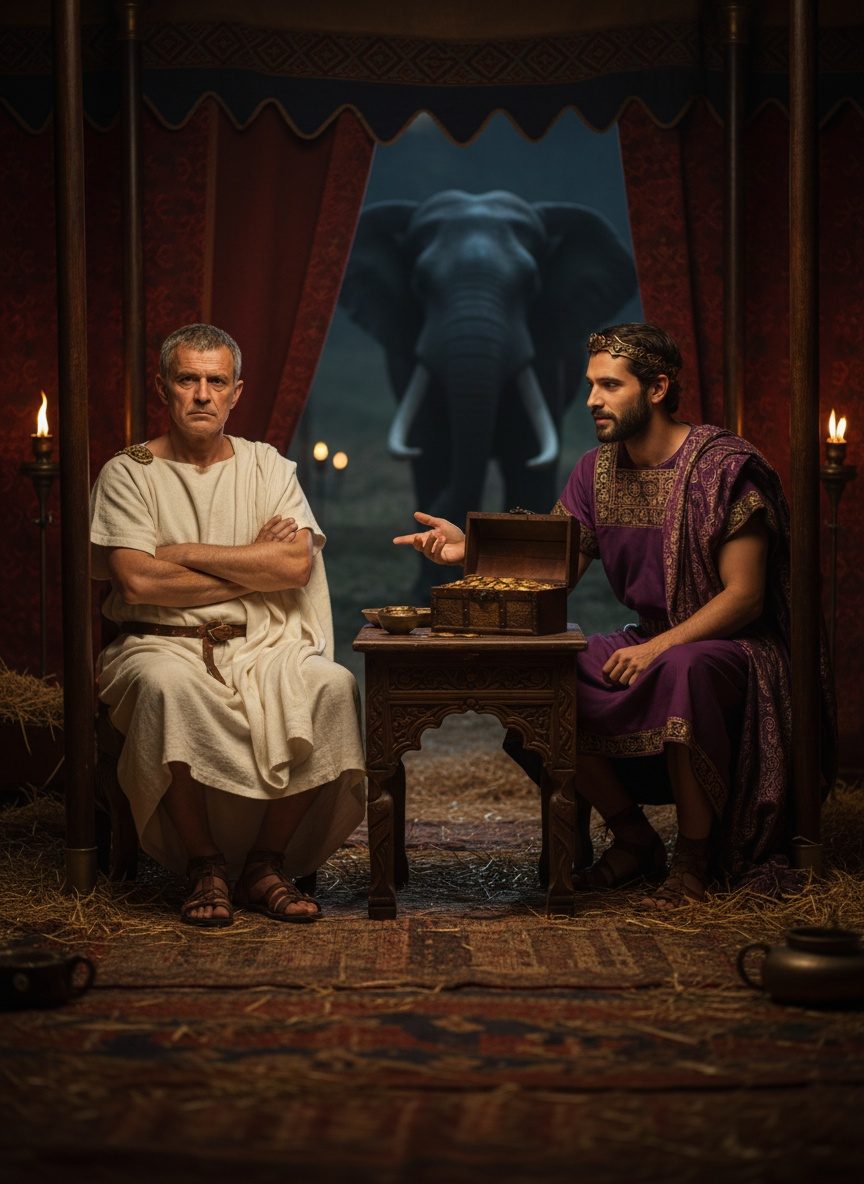
The flickering glow of torchlight danced across the stone walls of the tent as a chill wind swept through the camp of King Pyrrhus of Epirus. It was the eve of battle, the clamor of preparations creating a discordant symphony against the looming night. Outside, the distant murmur of soldiers and the low rumble of elephants gripped the air with tension. Yet in the heart of this pulsing camp sat two men, locked in a pivotal conversation that would resonate through the annals of history. It was about more than gold or glory; it was about the very soul of Rome.
An Offer of Gold and Glory
On one side of the heavy-laden table sat Pyrrhus, a seasoned warrior king known for his formidable strategy and undeniable charisma. Across from him was Gaius Fabricius, a Roman general famed less for tactical genius than for incorruptible virtue. The stakes were high: Pyrrhus sought a swift end to his conflict with Rome, an emerging power that was beginning to assert itself on the Italian peninsula. The king, confident in his ability to sway men with wealth and influence, believed he had finally met his match in diplomacy.
With patience, Pyrrhus unveiled his offers: chests of gold that glinted alluringly in the torchlight, promises of vast lands under the canopy of his unified kingdom, and the might of war elephants, creatures so rare in the lands of Rome that their mere presence shifted the tempo of any battle. The weapons, the wealth, the sheer grandeur — all were meant to bend the resolve of this Roman nobleman. Yet, as Pyrrhus observed Fabricius, he saw no flicker of greed nor glint in the eye that betrayed desire. In an era defined by personal gain, Fabricius's stoic refusal was something of a miracle.
The Intangible Power of Integrity
Fabricius, a man whose life centered around the austere virtues of Roman stoicism, viewed Pyrrhus's offerings as nothing more than hollow temptations. For him, integrity was the foundation of leadership, stronger than the strongest legion and more enduring than walls of stone. It was with quiet confidence that Fabricius declined each bribe. His refusal was courteous yet resolute, echoing a belief that the honor of Rome was not for sale. To Pyrrhus, accustomed to the bribery and shifting loyalties rampant in Greek politics, Fabricius's conduct was as astounding as it was frustrating.
Indeed, this uncompromising virtue from Fabricius set a precedent that rippled through the Roman state. His decision to return home with empty hands but a full heart spoke volumes to the Senate and to the people. It was a reminder that while Rome could build the roads and the aqueducts that shaped an empire, it was the character of men like Fabricius that formed the true backbone of its legacy.
Custodian of Roman Values
Gaius Fabricius's return to Rome was not marked by riches or titles but by the intangible wealth of a clean conscience and unassailable repute. While Pyrrhus may have wielded the power of kingdoms and armies, Fabricius held sway over something far more enduring in the Roman psyche — integrity. His refusal of the king's gifts became legendary, celebrated in forums and senate halls as an embodiment of the virtues Rome aspired to hold dear.
His service continued without the trappings of wealth. Twice, he was appointed consul, a testament to his esteemed standing and the trust the Republic placed in him. His legacy was not etched in marble or gold but written in the fabric of Roman society, inspiring generations to value the good of the state above personal gain.
A Test of Times to Come
The encounter between Pyrrhus and Fabricius was more than a meeting; it was a mirror held to the soul of Rome. As the Republic expanded, this episode served as a defining story about the character it aimed to cultivate. In an era dominated by conquests and shifting allegiances, Fabricius's choices bore lessons of integrity and steadfastness, echoing through time as Rome's sphere of influence widened to encompass vast territories.
Fabricius demonstrated that the most formidable battles are not always against external foes but within ourselves. His rejection of riches highlighted a crucial truth — that integrity, once compromised, may spell the downfall of empires as surely as military defeat. Through this narrative, Rome was time and again reminded that to hold power justly, one must first command oneself.
A Legacy of Unyielding Principle
The story of Gaius Fabricius and his encounter with Pyrrhus is a narrative of virtue against vice, of an individual's adherence to principle over the allure of personal gain. In every age, there are figures who remind us of the strength one finds in unwavering integrity, serving as beacons of hope amid the temptations of self-interest. His tale is not just about an ancient encounter in the tents of a Greek king but a reflection cast across centuries, standing as a testimony to the timeless value of integrity in leadership.
This story continues to resonate, urging us to consider what is truly valuable. As Rome grew from a city-state to a vast empire, the same principles embraced by Fabricius helped shape the ethos that built and sustained it. In our current world brimming with opportunities for gain, Fabricius's decision offers a powerful reminder: sometimes the greatest victory is the courage to walk away with nothing but the clarity of one's character intact.