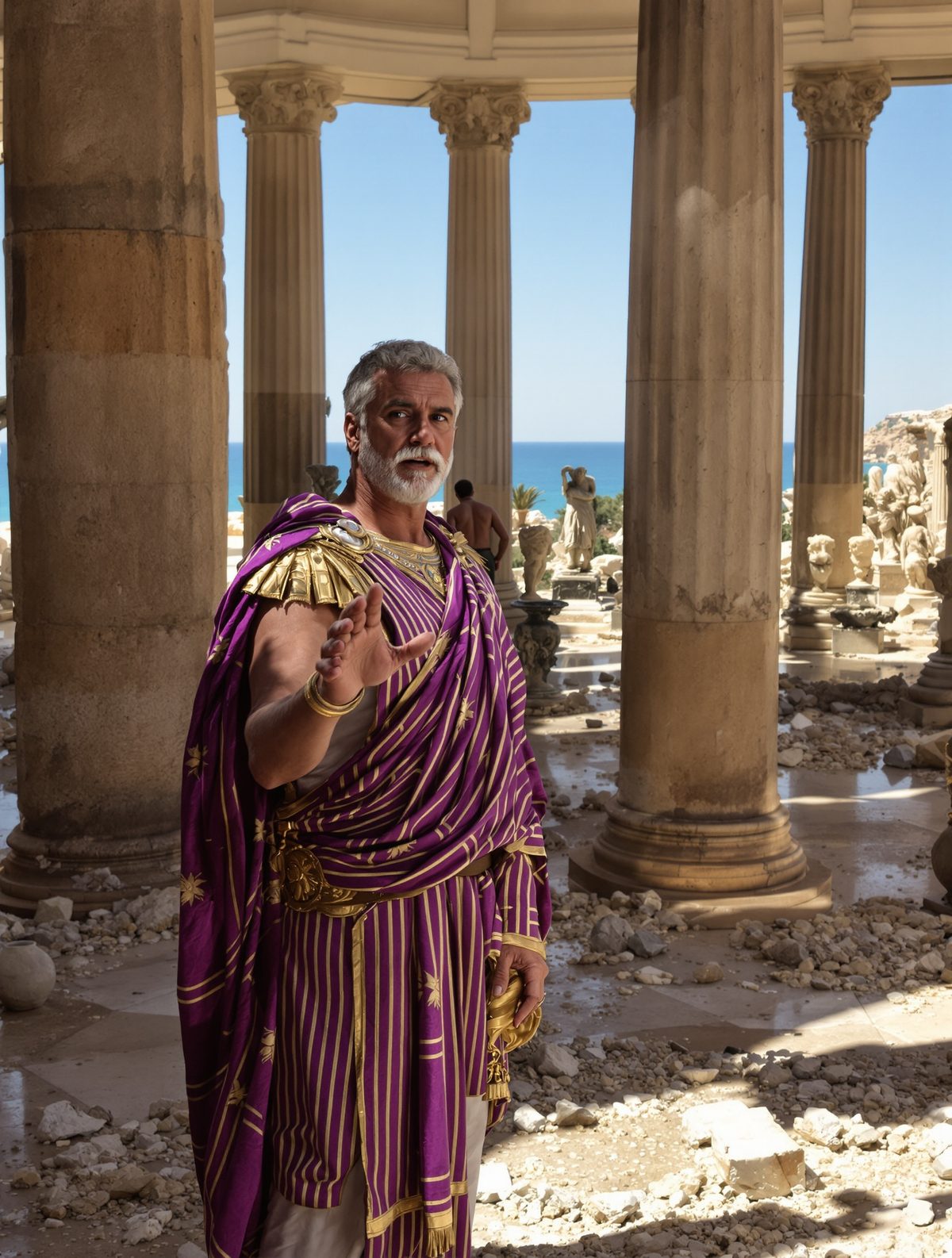
Imagine, if you will, sitting in a packed amphitheater carved into the slopes of the Athenian Acropolis, surrounded by 17,000 rowdy spectators. The year is 424 BC, and you're watching a comedy so brutal, so personally vicious, that it would make a modern roast comedian blush. On stage, an actor wearing an exaggerated mask portrays a real politician—one sitting just rows away from you—as a slave who steals from his master's household while screaming patriotic slogans. The crowd erupts in laughter, but the politician in question is decidedly not amused. Welcome to the world of Aristophanes, where comedy was a blood sport and the stage was a battlefield for democracy itself.
What happened next would create history's first recorded celebrity lawsuit, pitting artistic freedom against political power in a legal drama that would determine whether comedians could mock their leaders without consequence. The stakes couldn't have been higher: in ancient Athens, the penalty for certain forms of public humiliation could be exile—or worse.
The Master of Democratic Mockery
Aristophanes wasn't just any playwright—he was democracy's court jester with a poison pen. Born around 446 BC, he lived through Athens' golden age, when democracy was still a radical experiment and the city-state dominated the Mediterranean world. Unlike the sanitized political satire we know today, Aristophanes' comedies were weapons of mass humiliation, designed to destroy reputations and influence elections.
His plays didn't just reference politicians—they became them. Actors wore masks crafted to look exactly like real public figures, complete with their distinctive features and mannerisms. Imagine if Saturday Night Live not only mocked politicians but actually affected their ability to govern, and you begin to understand the power Aristophanes wielded. In fact, his comedies were performed during major religious festivals when nearly every Athenian citizen would be in attendance, making them the ancient equivalent of prime-time television.
The playwright had already earned a reputation for fearlessness. He had mocked the philosopher Socrates so mercilessly in The Clouds (423 BC) that Socrates himself would later claim the play contributed to his death sentence. He lampooned the tragedian Euripides so consistently that it became a running joke across multiple plays. But when Aristophanes set his sights on Cleon, he was taking on his most dangerous target yet.
Cleon the Demagogue: Democracy's Dark Side
Cleon the Tanner was everything Aristophanes despised about Athenian politics. Rising to power after Pericles' death in 429 BC, Cleon represented a new breed of politician—one who gained influence not through noble birth or military heroics, but by mastering the art of crowd manipulation. Ancient sources describe him as loud, crude, and theatrical, a man who would pace the speaker's platform, throw off his cloak for dramatic effect, and slap his thigh while delivering fiery speeches.
But Cleon was also undeniably effective. He convinced the Athenian assembly to raise the tribute demanded from allied city-states, personally led military campaigns, and captured an entire Spartan force on the island of Sphacteria—a victory that shocked the Greek world. The common people loved him; the aristocrats loathed him. To Aristophanes, Cleon embodied everything wrong with democracy: the triumph of passion over reason, of demagoguery over statesmanship.
The playwright's first major attack came in The Knights, performed at the Lenaia festival in 424 BC. The play portrayed Cleon as a slave named Paphlagon who manipulates his elderly master (representing the Athenian people) through flattery and lies. No mask-maker in Athens would craft Cleon's likeness for the production—they were too afraid of political retaliation. So Aristophanes himself played the role, smearing his face with wine lees to create a crude caricature of his target.
The Legal Battlefield: When Comedy Becomes Criminal
Cleon's response was swift and unprecedented. Rather than ignore the mockery or respond with his own theatrical counter-attack, he dragged Aristophanes into court on charges of publicly slandering Athenian officials. The specific charge was likely kakegoria—wrongful speech—which could result in heavy fines or loss of citizenship rights.
This wasn't just any lawsuit; it was a constitutional crisis in miniature. Ancient Athens had no formal bill of rights, no established precedent for protecting satirical speech. The very foundations of democratic discourse were at stake: could citizens freely mock their leaders, or did elected officials deserve protection from public humiliation?
The trial itself must have been extraordinary theater. Picture the same citizens who had laughed uproariously at Aristophanes' jokes now sitting solemnly as jurors, forced to decide whether that laughter had been criminal. Athenian juries were massive—typically 501 citizens for major cases—chosen by lot from volunteers. These weren't legal experts but ordinary citizens: farmers, craftsmen, merchants, and soldiers who had probably attended the very festival performances now being litigated.
Cleon, experienced in swaying crowds, likely delivered a thunderous prosecution speech about dignity, respect, and the damage that malicious comedy could inflict on democratic institutions. Aristophanes, for his part, had to transform himself from comedian to defendant, arguing for the right to hold power accountable through humor.
The Verdict That Shaped Free Speech
The jury's decision was decisive: they acquitted Aristophanes completely. But this wasn't just a legal victory—it was a cultural statement about the role of comedy in democratic society. The same citizens who comprised Aristophanes' audience became his protectors, establishing through their verdict that the right to mock power was fundamental to democratic governance.
The acquittal emboldened Aristophanes to even greater heights of satirical savagery. In subsequent plays, he portrayed Cleon as a dog being tried for stealing cheese (The Wasps) and continued his relentless mockery until Cleon's death in battle in 422 BC. Remarkably, ancient sources suggest that Cleon actually tried to prosecute Aristophanes multiple times, making this legal feud one of history's first ongoing celebrity court battles.
The precedent established by Aristophanes' acquittal had profound implications. It helped establish the principle that political figures, by virtue of seeking public office, opened themselves to public criticism—even harsh, personal ridicule. This concept would echo through history, from the satirists of Rome to the political cartoonists of democratic revolutions, all the way to modern late-night television.
The Comedian's Final Victory
Perhaps the most remarkable aspect of this ancient legal drama is its outcome's permanence. While Cleon's political achievements faded into historical footnote, Aristophanes' comedies survived as literary masterpieces. Today, we remember Cleon primarily through Aristophanes' hostile portrayal—the ultimate victory for the comedian who refused to be silenced.
The playwright's legal triumph also revealed something profound about Athenian democracy. Despite its flaws and limitations, this ancient system possessed a sophisticated understanding of the relationship between humor and power. The jurors who acquitted Aristophanes understood intuitively what political theorists would spend centuries articulating: that the ability to laugh at authority is essential to preventing tyranny.
Even more fascinating, archaeological evidence suggests that some of Aristophanes' political targets actually attended performances of plays mocking them—a testament to the accepted role of comedy in Athenian public life. This wasn't just tolerance; it was an expectation that public figures would endure satirical assault as part of their civic duty.
Ancient Lessons for Modern Times
The legal battle between Aristophanes and Cleon resonates powerfully today, when questions of free speech, public discourse, and the limits of satirical commentary dominate headlines. In an age of social media pile-ons, canceled comedians, and politicians threatening to sue late-night hosts, the ancient Athenian precedent offers both inspiration and warning.
The Athenian jurors understood something we sometimes forget: that democracy requires not just the right to vote, but the right to laugh—especially at those who would govern us. They recognized that humor, however harsh or unfair, serves as a crucial check on power's tendency toward self-importance and corruption.
Yet the story also reveals democracy's fragility. It took genuine civic courage for those jurors to protect a comedian who had made them laugh at the expense of a powerful politician. Their decision wasn't inevitable—it was a choice to prioritize free expression over political harmony, satirical truth over respectful discourse.
Perhaps most remarkably, this 2,400-year-old lawsuit reminds us that the tensions between comedy and politics, between irreverence and authority, between the right to mock and the right to dignity, are as old as democracy itself. The next time a politician threatens to sue a comedian, remember Aristophanes and Cleon—and be grateful that some battles for free speech were won long before we were born to fight them.