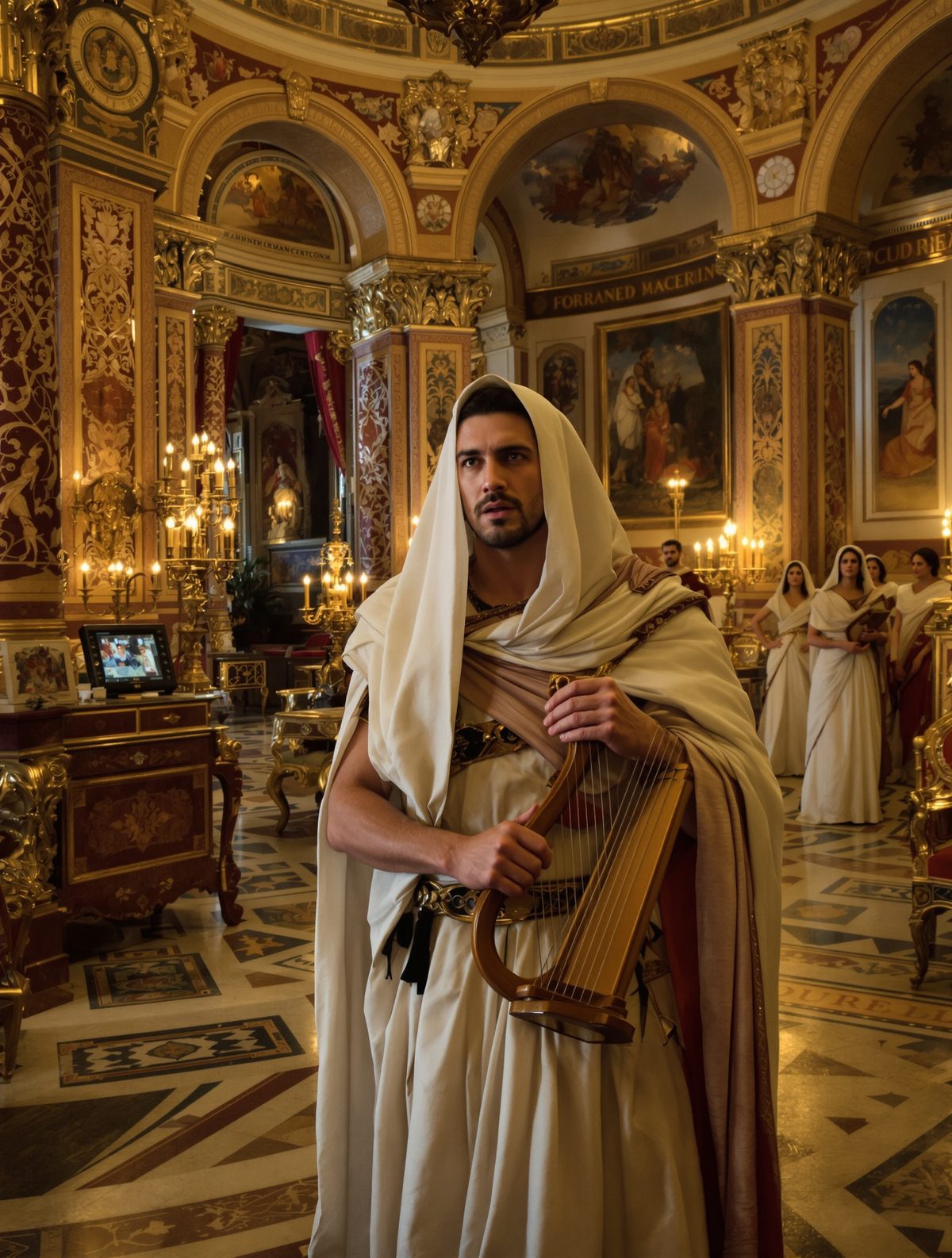
Picture this: It's a warm spring day in 456 BC, somewhere in Sicily. The greatest playwright who ever lived sits in the Mediterranean sunshine, perhaps penning his next tragic masterpiece. High above, an eagle circles with deadly patience, clutching a heavy tortoise in its talons. The bird spots what appears to be the perfect rock below—smooth, round, and gleaming in the sunlight. It releases its grip.
The tortoise plummets earthward with lethal velocity. But that "rock" isn't a rock at all—it's the bald head of Aeschylus, the father of drama himself. In an instant that would make even the gods laugh at its cruel irony, the man who survived epic battles and revolutionized theater dies from the most absurd accident in literary history.
This is the story they never taught you in school—how the greatest tragedian of ancient Greece met his end not on a battlefield or stage, but as the unwitting victim of an eagle's tragic case of mistaken identity.
The Titan Who Gave Fire to Theater
To understand the cosmic joke of Aeschylus's death, you first need to grasp the magnitude of what this man accomplished. Born around 525 BC into a noble family in Eleusis, near Athens, Aeschylus didn't just write plays—he invented drama as we know it.
Before Aeschylus, Greek theater was essentially a one-man show. A single actor would perform while a chorus sang and danced around him. It was Aeschylus who had the revolutionary idea to add a second actor, creating the possibility for dialogue, conflict, and genuine dramatic tension. Later, he added a third actor, establishing the template that would define Western theater for the next 2,500 years.
But Aeschylus wasn't just an innovator—he was a literary giant. Ancient sources credit him with writing between 70 and 90 plays, though only seven complete works survive today. His trilogy "The Oresteia" remains the only complete tragic trilogy from ancient Greece, a masterwork that explores themes of justice, revenge, and the evolution of civilization that still resonates in modern courtrooms and legislatures.
The man was also a master showman who understood that theater should assault the senses. He invented theatrical special effects, using elaborate costumes, painted scenery, and stage machinery that could make actors appear to fly. His plays featured ghosts rising from tombs, chariots racing across the stage, and choruses dressed as everything from wasps to Furies. One of his productions was so terrifying that pregnant women in the audience reportedly miscarried, and children fainted from fright.
A Warrior-Poet's Battlefield Glory
Here's what makes Aeschylus's eventual death so ironic: this was a man who had stared down death on some of history's most famous battlefields and lived to tell the tale. When the Persian Empire decided to crush the upstart Greek city-states, Aeschylus didn't cower behind his writing desk—he picked up a spear and shield and marched to war.
At Marathon in 490 BC, Aeschylus stood shoulder-to-shoulder with his fellow Athenians as they faced impossible odds. The Persians had landed with perhaps 25,000 warriors, while the Greeks could muster only about 11,000. Yet in one of history's most stunning military upsets, the Greeks routed the Persian force, killing over 6,000 enemies while losing fewer than 200 of their own men.
But Marathon was just the opening act. Ten years later, when the Persian king Xerxes returned with a massive invasion force that ancient sources claim numbered over a million men, Aeschylus was there again. At the naval battle of Salamis in 480 BC, he watched as the Greek fleet demolished the Persian navy in the narrow straits between the island of Salamis and the Attic mainland.
The playwright may have also fought at Plataea in 479 BC, the final land battle that ended the Persian threat forever. According to some accounts, his brother Cynegeirus died heroically at Marathon, his hand severed by a Persian axe as he tried to prevent an enemy ship from escaping.
These weren't distant events that Aeschylus heard about secondhand—they were lived experiences that shaped his worldview and informed his art. His play "The Persians," performed in 472 BC, drew directly from his battlefield memories and remains the oldest surviving Greek drama.
The Prophet's Shadow and Sicily's Call
Now here's where the story takes a turn toward the supernatural—or at least the superstitious. According to ancient sources, Aeschylus had received a prophecy that he would die when something fell from the sky. Whether this came from the Oracle at Delphi, a local soothsayer, or simply emerged from the gossip mill of Athenian society, the prediction apparently troubled the great playwright enough that he took precautions.
Some versions of the story claim that Aeschylus began spending more time outdoors, reasoning that open sky was safer than being indoors where roof tiles or building materials might fall on him. Others suggest he avoided walking near construction sites or under trees. The irony, of course, is that his attempts to avoid falling objects may have put him directly in harm's way.
Around 458 BC, Aeschylus left Athens for Sicily, specifically the court of Hieron I in Syracuse. This wasn't unusual—many Greek intellectuals and artists found generous patronage in the wealthy courts of Magna Graecia, the Greek colonies scattered across southern Italy and Sicily. Aeschylus had visited Sicily before, and his plays were popular there.
But some scholars suggest the move wasn't entirely voluntary. Aeschylus had recently been defeated in a dramatic competition by a younger playwright named Sophocles, and Athenian audiences were increasingly gravitating toward a new style of drama. Perhaps the aging master was seeking fresh audiences, or maybe he was simply ready for a change of scenery in his twilight years.
The Eagle, the Tortoise, and the Tragic Mistake
And so we come to that fateful day in 456 BC, somewhere near the city of Gela on Sicily's southern coast. The details vary depending on which ancient source you consult, but the basic story remains remarkably consistent across multiple accounts written centuries apart.
Lammergeiers—massive eagles native to the Mediterranean region—have a unique hunting strategy when dealing with tortoises. These birds can't crack open a tortoise shell with their beaks alone, so they've learned to carry their prey high into the air and drop them onto rocks, shattering the shell and exposing the meat inside. It's a behavior that's been observed and documented for thousands of years.
On this particular day, one such eagle had captured a tortoise and was searching for a suitable rock to serve as its anvil. From high above, the bird spotted what appeared to be a perfect target: a smooth, round, stone-like object gleaming in the Mediterranean sun.
What the eagle couldn't know was that its "rock" was actually the bald head of Aeschylus, who was reportedly sitting in an open area, possibly working on a new play or simply enjoying the warm Sicilian afternoon. The bird released the tortoise, which plummeted downward with enough force to kill the playwright instantly.
The ancient biographer Valerius Maximus, writing in the first century AD, recorded the incident with typical Roman matter-of-factness: "When he was sitting in the open air, an eagle flying overhead with a tortoise in its claws—for these birds break the shells by dropping them from a height onto rocks—mistook the man's bald head for a stone and let the tortoise fall upon it, killing him."
Death Becomes Him: The Ultimate Dramatic Irony
The cosmic joke of Aeschylus's death wasn't lost on the ancient world. Here was a man who had survived spear thrusts and arrow volleys, who had dodged Persian scimitars and witnessed ships explode in flames, only to be killed by a confused bird and an unlucky reptile.
But perhaps there's something fitting about such an absurd end for the inventor of dramatic irony. Aeschylus had spent his career exploring the capricious nature of fate, the thin line between comedy and tragedy, and the gods' habit of delivering justice in unexpected ways. His plays are filled with characters who meet their doom through seemingly random events that, upon closer inspection, reveal deeper patterns of cosmic justice.
The playwright was buried in Gela, where his tomb became a site of pilgrimage for later generations of writers and theater enthusiasts. The epitaph reportedly made no mention of his literary achievements, focusing instead on his military service at Marathon—perhaps a final reminder that even the greatest artists are, in the end, merely mortal.
Later Greek and Roman writers couldn't resist embellishing the story. Some claimed that Aeschylus had been warned specifically about death from above. Others suggested that the tortoise was enormous, or that the eagle was acting on orders from jealous gods. But the basic tale remained consistent enough across multiple sources to suggest that, however improbable it might seem, something very much like this actually happened.
When Life Writes Better Drama Than Art
Why does the death of Aeschylus still fascinate us more than two millennia later? Perhaps because it reminds us that reality often scripts better dramatic irony than any playwright ever could. In an age of calculated risks and safety protocols, there's something both terrifying and darkly amusing about the randomness of Aeschylus's fate.
His death also speaks to the eternal human struggle against the absurd. This was a man who had dedicated his life to finding meaning in chaos, to creating art that made sense of senseless suffering. Yet in the end, he became the victim of a meaningless accident that wouldn't have been out of place in a comedy by Aristophanes.
Today, when we speak of "dramatic irony," we're using a term that describes techniques Aeschylus helped pioneer. Every time actors deliver dialogue while the audience knows something they don't, every time a story's outcome contradicts its characters' expectations, we're witnessing the dramatic DNA that Aeschylus embedded in Western culture.
Perhaps that's his real immortality—not the survival of seven plays out of seventy, but the fact that he taught us how to see our lives as stories worth telling, even when they end with flying tortoises. In a world that often seems random and absurd, Aeschylus reminds us that sometimes the best response to life's contradictions isn't despair, but a kind of cosmic laughter at the elaborate joke the universe seems to be playing on us all.