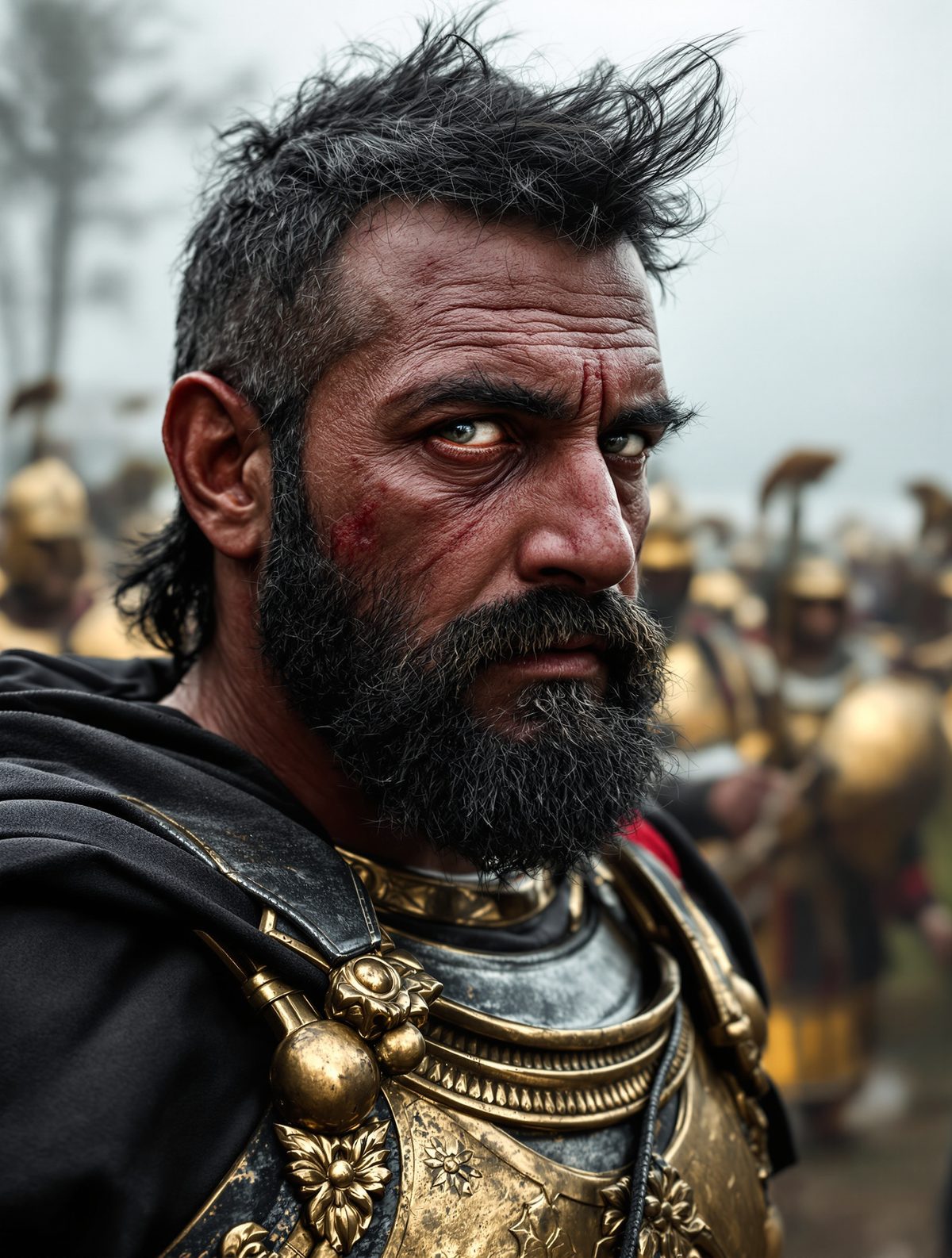
Picture this: a British general stands in a Belgian trench in 1916, casually gnawing on his own mangled fingers because the field medics are too busy with other wounded soldiers. When they finally reach him, he's already bitten off two of his own digits rather than wait for proper medical attention. This wasn't a moment of desperation—it was just another Tuesday for Lieutenant Colonel Adrian Carton de Wiart, quite possibly the most indestructible human being who ever lived.
While most people would consider losing an eye, a hand, and surviving multiple plane crashes enough adventure for several lifetimes, de Wiart saw these experiences as the highlights of what he called "the most enjoyable time" of his life. In an era when shell shock was breaking men's minds and poison gas was melting their lungs, this Belgian-born British officer was having the time of his life getting shot, blown up, and crashed—repeatedly.
The Making of an Immortal Warrior
Born in Brussels in 1880 to a Belgian father and Irish mother, Adrian Carton de Wiart seemed destined for an unconventional life from the start. Despite his Belgian birth, he would serve the British Crown with a devotion that bordered on the fanatical. His path to legendary status began not in the trenches of France, but in the dusty hills of South Africa during the Second Boer War in 1899.
At just 19 years old, de Wiart had already demonstrated the peculiar relationship with authority that would define his career. He had dropped out of Oxford—not because he was failing, but because he was bored. The Boer War offered excitement, so he enlisted under a false name. When a bullet shattered his groin and stomach during his first engagement, most young men might have reconsidered their career choices. De Wiart was merely annoyed at the interruption.
But it was in Somalia in 1914 where de Wiart earned his first truly distinctive battle scar. During the Somaliland Campaign against the forces of the so-called "Mad Mullah" Mohammed Abdullah Hassan, a Dervish bullet caught him square in the face. The shot destroyed his left eye and left him permanently disfigured. Rather than invaliding him out of service, this injury seemed to invigorate him. From that day forward, his black eye patch would become as much a part of his identity as his Victoria Cross.
The Somme: Where Heroes Go to Die (But Not This One)
July 1, 1916—the first day of the Battle of the Somme—remains the bloodiest day in British military history. In a single day, the British Army suffered 60,000 casualties, with nearly 20,000 men killed outright. It was the kind of mechanized slaughter that would haunt survivors for decades. For Lieutenant Colonel de Wiart, commanding the 8th Battalion Gloucestershire Regiment, it was Tuesday.
During the horrific fighting around Thiepval, de Wiart's left hand was mangled beyond repair by shrapnel. With characteristic pragmatism, he instructed the medical corps to amputate it entirely, reasoning that a clean amputation would heal faster than trying to save the destroyed appendage. When they hesitated, he famously attempted to remove his own damaged fingers with his teeth—a story that would become legend among the ranks.
But losing a hand didn't slow him down. If anything, it seemed to make him more effective. Throughout 1916 and 1917, de Wiart continued leading from the front with a reckless abandon that both inspired and terrified his men. At the Battle of Passchendaele, he was shot through the skull—the bullet entering behind his left ear and exiting through his jaw. He was back in action within weeks, sporting fresh scars and an apparently undiminished appetite for combat.
The Tally of Destruction
By war's end, de Wiart's medical file read like a catalog of human destruction. Beyond the obvious losses—his eye and hand—he had been shot through the skull, ankle, leg, hip, and ear. He'd survived being buried alive by shell explosions on multiple occasions, suffered countless minor wounds from shrapnel, and had been gassed more times than he bothered to count. Military historians estimate he was wounded at least eleven separate times during World War I alone, though de Wiart himself lost track of the exact number.
What made his survival even more remarkable was his complete disregard for military medical advice. He routinely discharged himself from hospitals before his wounds had properly healed, often forging documents or simply walking out against direct orders. On one occasion, he appeared at the front lines with his arm still in a sling, claiming he felt "perfectly fit" despite having been shot in the hip just days earlier.
His attitude toward his injuries baffled medical personnel and fellow officers alike. When asked about the pain, he would typically respond with variations of "what pain?" or express genuine confusion about why anyone would consider his wounds particularly noteworthy. To de Wiart, being shot was simply an occupational hazard, like a carpenter hitting his thumb with a hammer.
Beyond the Western Front
While World War I ended for most people in November 1918, de Wiart's war continued. He was immediately dispatched to Poland as part of the British Military Mission, where he spent two years fighting Bolsheviks in a conflict most people have never heard of. Even in this forgotten war, his talent for attracting enemy fire remained undiminished.
During World War II, his reputation for indestructibility was tested once again. While serving as Winston Churchill's personal representative to Yugoslavia, his plane crashed in the Mediterranean. At age 61, de Wiart spent hours in the water before being rescued, then resumed his mission as if nothing had happened. Later, when captured by Italian forces, he promptly escaped from his prisoner-of-war camp—twice—before finally being exchanged through diplomatic channels.
Perhaps most remarkably, he survived multiple plane crashes throughout his career. In addition to the Mediterranean incident, he crashed in Libya in 1941 (captured), crashed again in Burma in 1943 (walked away), and survived at least three other aviation mishaps that would have killed ordinary mortals. His comment after one particularly spectacular crash landing was simply: "Rather bumpy landing, what?"
The Man Who Loved War
What truly set de Wiart apart wasn't his physical indestructibility—though that was remarkable enough—but his genuine enthusiasm for combat. In an era when war poetry focused on the horror and futility of mechanized warfare, de Wiart's memoirs, titled "Happy Odyssey," read like adventure stories. He described the Battle of the Somme with the same fondness most people reserve for holiday memories.
"Frankly, I had enjoyed the war," he wrote in his autobiography. "It had given me many bad moments, I admit, but even they were a change from the humdrum of peace." This wasn't bravado or post-war romanticism—contemporary accounts confirm he maintained this attitude even in the trenches, often joking with his men while under heavy bombardment.
His soldiers found his attitude simultaneously inspiring and slightly unnerving. Here was a commanding officer who seemed genuinely disappointed when battles ended, who treated enemy machine gun fire as a minor inconvenience, and who appeared to view each new wound as an interesting addition to his collection rather than a brush with death.
The Immortal's Legacy
Adrian Carton de Wiart died peacefully in his bed in 1963, at the age of 83—a fate that probably surprised him more than anyone. For a man who had actively sought out danger for over half a century, dying of old age must have seemed like an oversight by the universe.
His story raises uncomfortable questions about human nature and our relationship with violence that remain relevant today. In an age when we're increasingly aware of PTSD and the psychological costs of warfare, how do we understand someone who genuinely thrived in conditions that broke other men? Was de Wiart a hero, a madman, or simply a product of his time and class?
Perhaps the answer matters less than the reminder he provides: that human beings are capable of surviving almost unimaginable hardship, and that our assumptions about what constitutes trauma or resilience may be far more limited than we realize. In a world that often feels fragile and uncertain, there's something oddly comforting about knowing that someone like Adrian Carton de Wiart once walked among us—scarred, battered, indestructible, and inexplicably cheerful about the whole bloody business.