He had never left Egypt. Yet, sitting in the Library of Alexandria, Eratosthenes of Cyrene mapped the Earth without ever traveling its breadth. With a stick and the sun, he measured the unimaginable.
The Librarian and His Shadow
In the bustling heart of ancient Egypt, Alexandria was a city of light and learning in 240 BCE. The world's greatest minds gathered here, under the patronage of the Ptolemaic dynasty, to explore the edges of human understanding. Among them was Eratosthenes, a man whose curiosity burned more fiercely than the midday sun that would aid him in his groundbreaking endeavor.
Eratosthenes was not just any scholar; he was the chief librarian at the renowned Library of Alexandria, a repository of knowledge unmatched in the ancient world. This position afforded him the luxury of time and access to an array of scrolls that contained the combined wisdom of the known world. But it was not dusty tomes alone that inspired him; rather, it was a simple observation in Syene (modern-day Aswan) that spurred his pursuit of knowledge beyond the conventional horizons.
Syene, located directly south of Alexandria, was known for a peculiar phenomenon observed during the summer solstice: the sun cast no shadow and shone directly down into a well. Intrigued by this, Eratosthenes deduced a fundamental relationship between the position of the sun and the curvature of the Earth. He pondered: if the sun was directly overhead at Syene, what would the shadow look like in Alexandria at that same moment?
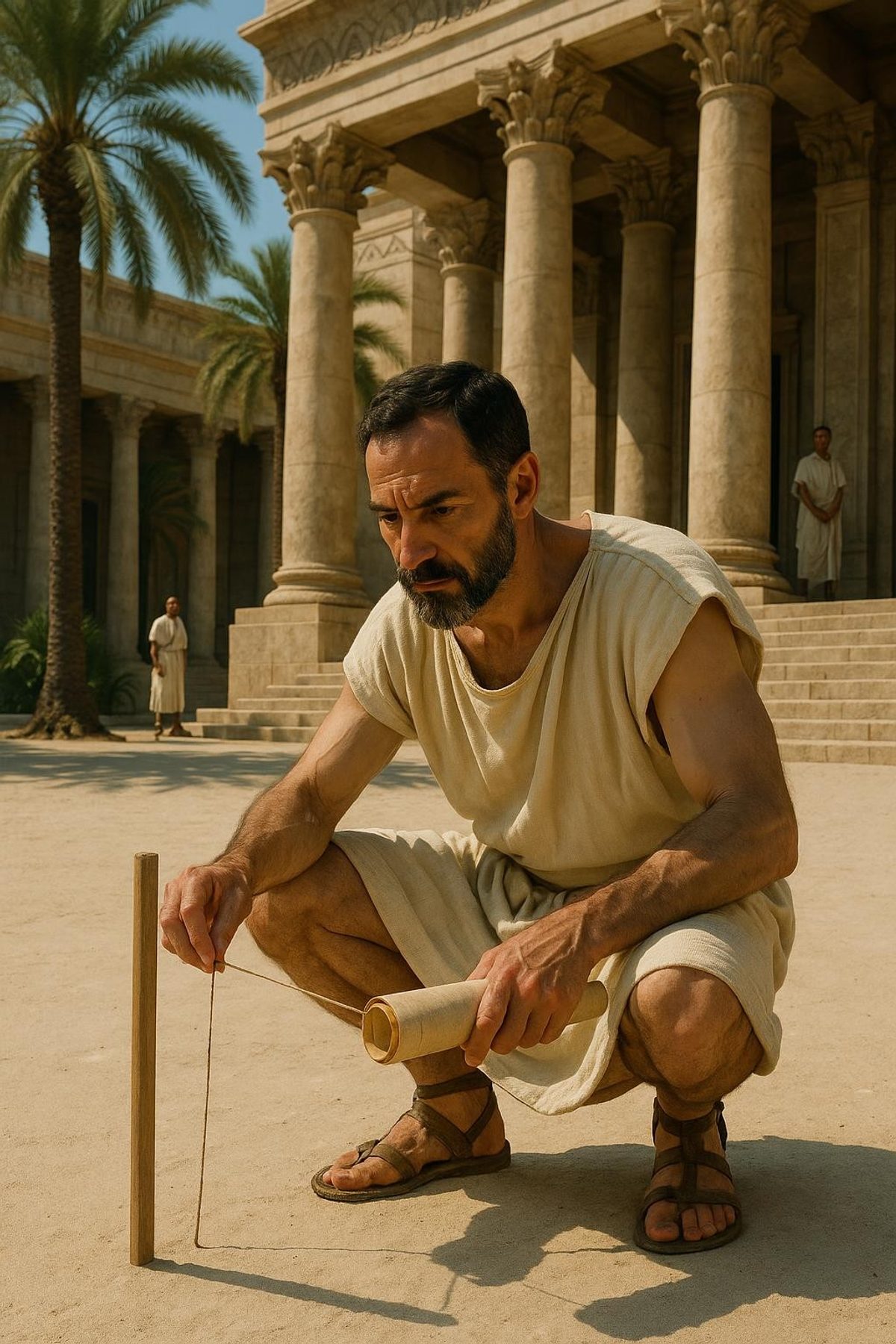
When the solstice arrived, Eratosthenes placed a stick — a gnomon — into the ground in Alexandria and measured the shadow it cast at noon. He found it to be approximately seven degrees, or one-fiftieth of a complete circle. Using elementary geometry, Eratosthenes compared the angle of the shadow to the distance between the two cities, inferring that the Earth was round and remarkably, calculating its circumference with a breathtaking accuracy that history would take millennia to match.
Geometry's Leap Forward
The ingenuity of Eratosthenes lay not just in his realization but in his application of simple geometric principles to the vastness of the Earth itself. Armed with the angle measured in Alexandria and the distance to Syene, he employed the concept of a circle and proportionality, ultimately deriving an estimate for the circumference of the globe.
The distance between Alexandria and Syene was known to be approximately 5,000 stadia — this unit of measurement used in Ancient Greece could vary, but for Eratosthenes' calculations, the variation was immaterial. By establishing that the shadow in Alexandria corresponded to a fiftieth of the 360 degrees encompassing a circle, he multiplied the distance by fifty to estimate the Earth's total circumference.
The simplicity of his experiment belied the immense mental leap it represented. Eratosthenes' work was an early testament to the power of deduction and the human capacity to understand the world through observation and reason rather than reliance on myth or superstition. While others speculated on the form of the Earth, Eratosthenes offered concrete evidence grounded in empirical data, transforming abstract theory into measured reality.
Eratosthenes' result astounded his contemporaries, establishing a newfound precision in the sciences of geography and astronomy. The notion of a measurable Earth challenged prevailing misconceptions and advanced human understanding. Here was a man who had, in essence, mapped the world from a distance, drawing unseen lines across lands he might never traverse.
A World Measured by Shadows
In a world still defined by flat cartographies and mystical speculation, Eratosthenes' realization reshaped intellectual pursuits. It prompted questions about navigation, exploration, and the nature of the cosmos itself, igniting a desire to explore and quantify the unknown.
Despite his accomplishments, Eratosthenes remained a humble seeker of knowledge, rather than a conqueror of lands. Alexandria continued to serve as his compass, its library his sanctuary of learning. His willingness to question and test the unknown, using only the simplest of tools, showcased the essence of scientific inquiry — a legacy that would inspire future generations long after him.
Though his exact calculations were lost to time, the spirit of Eratosthenes' method endured. In the centuries that followed, no significant improvement on his calculation would emerge until the development of advanced tools in the age of exploration. Eratosthenes' shadow-watching anticipated the precision of modern geography, proving his foresight and intellectual bravery to be as bold as any adventurous fleet leaving for the horizon.
In his tale, we find the intersection of curiosity and innovation; a narrative that unites past with present, reminding us that the boundaries of what is known are always poised to be expanded. Through Eratosthenes, we discover that sometimes, it only takes a shadow to illuminate the vastness of the world and inspire the restless pursuit of understanding that defines humanity’s journey through time.