Æthelflæd of Mercia was not a queen. But she did what no English queen ever had.
Frontier Steward and Fortress Architect
In the early misty mornings of tenth-century Mercia, while the borders trembled under the threat of Viking incursions, Æthelflæd's deft hand shaped the destiny of a beleaguered land. The daughter of Alfred the Great and sister to Edward the Elder, she inherited a realm riddled with vulnerabilities. These were no mere royal duties—this was survival at the precipice of chaos. As a noblewoman left to her own devices while her husband Æthelred suffered a debilitating illness, Æthelflæd wielded power in a way no woman before her had dared. The Mercian territory she governed was not just a political entity but the very line of defense against Viking forces seeking to carve out their own kingdoms in England.
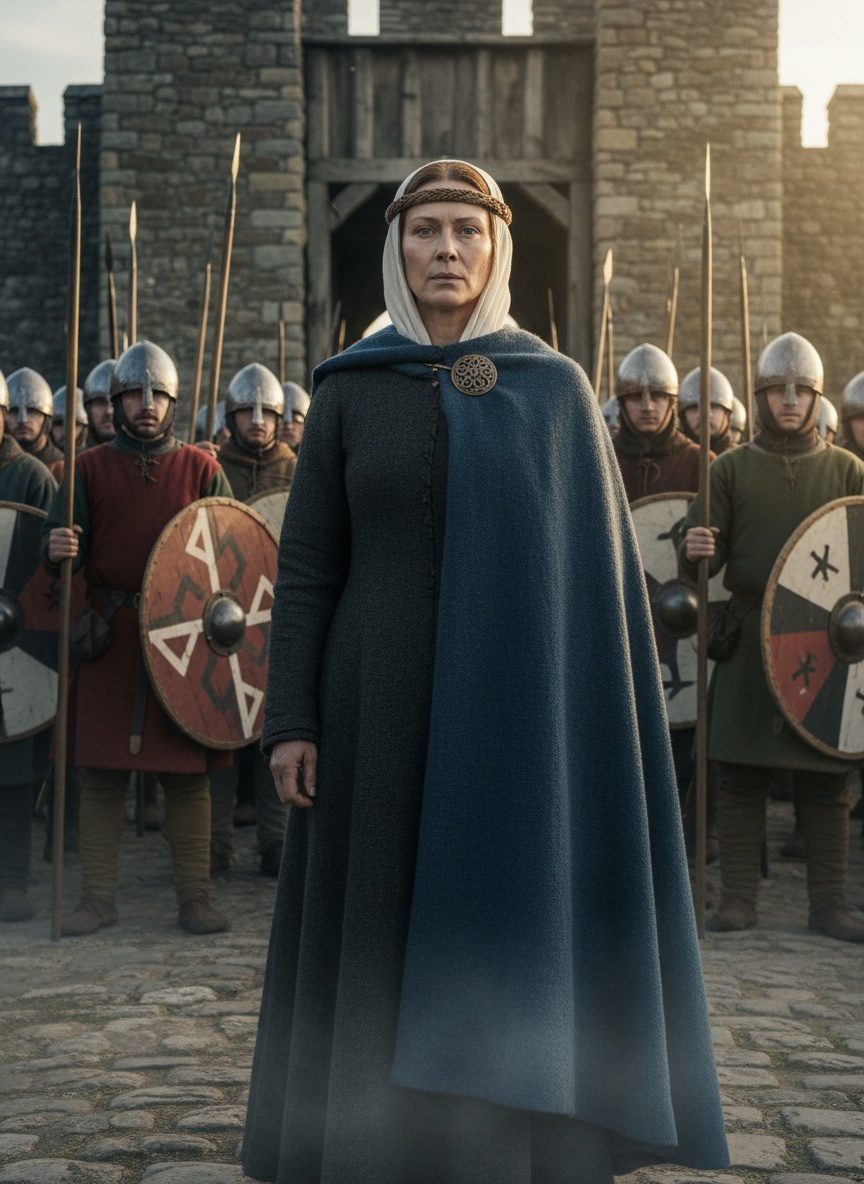
Æthelflæd's strategic vision manifested in a swift and formidable military response to the Viking threat. She fortified towns along the frontier, erecting a series of burhs—defensive strongholds that transformed the landscape into an ironclad defense network. These were not merely walls of wood and earth; they were symbols of unyielding resolve and bastions of hope for the war-weary Mercian populace. From Chester to Runcorn, the iron bond of protection tightened around the borderlands. The burhs housed garrisons and became sanctuaries for villagers, who could no longer afford the luxury of underestimating the northern menace.
While history barely hushed her name, Æthelflæd’s legacy thrived every time a burh repelled an invasion, every time a family slept in peace. Her astute governance was like a silent guardian that toiled tirelessly, night after vigilant night. Her rule was practical, decisive, and without the flamboyance of courtly life, allowing her to focus purely on the survival and prosperity of her people.
The Siege and the Lost Name
In a time when women were expected to be seen, not heard, Æthelflæd did more than make her presence known—she made it felt across the land. Her moment of ultimate testing arrived when the Viking forces concentrated their fury on reclaiming a valuable Mercian stronghold that dared to resist their thunderous assault. This was more than a battle for land; it was a battle for the very soul of Mercia.
Amid the clamor of war horns and the relentless beat of hostile feet at their gates, the city's inhabitants felt a creeping despair slink into their homes. Yet as the Viking legions surged, a resolute figure emerged not upon the battlements, but in the cobbled streets and the bustling markets. Æthelflæd, weaving through the throngs, directed not just the city's defenses but its very heartbeat. Her command was a choreography of order amid chaos—watchtowers fortified, food stores allocated with precision, every guard post manned under her watchful eye.
The siege waged on, acrid smoke smothering the horizon. Still, the people endured, galvanized by the quiet faith of a leader who refused to yield. Daily, her presence bored into the collective consciousness of a city under siege, forging an unspoken contract of resilience among her people. But as remarkable as her achievements were, they slipped silently into the shadowed corners of history. While men of war and kings plastered their names upon monuments and chronicles, Æthelflæd's, too often, faded with the passing of time.
The Legacy Uncelebrated
Any tale of a woman of such caliber as Æthelflæd invariably begs the unforgiving question: why is she not mentioned in the same breath as other medieval titans? The truth is, she was a victim of both her gender and her era, a woman who forged her path in a man's world but without the official acclaim that seems so inherent in male lineage. The brittle parchment of history barely whispers her existence, as if under a concerted effort to silence a crescendo that rightfully belonged alongside her male contemporaries.
Æthelflæd's story, though muted, resounds with ripples that reach across centuries. She turned back tides of invaders with courage and cunning and created a template for defensive warfare that would be emulated across the continent in later years. Her mercantile efforts and alliances with Welsh and other Anglo-Saxon realms showed a diplomatic craftiness not merely confined by battle prowess. But society at the time, insistent on patriarchal lineage and heroics detached from female leadership, allowed her narrative to slip quietly into the annals of obscurity.
Even so, in her lifetime, the people of Mercia knew her impact intimately. With towns fortified, trade routes secured, and Viking war bands repulsed, they had Æthelflæd to thank for their daily peace—a woman both leader and legend, whose name history forgot but whose deeds fortified a realm. In a world where names and faces fade, the enduring testament of actions sculpted the ever-resilient spirit of Mercia, echoing, as it does in history's quieter moments, that heroism transcends gender, crowns, and titles.