He was thirty-six years old. He had never dreamed of ascending the throne in the midst of his father's greatest monument, now whispering tales of glory and legacy carried by time itself.
From Shadow to Sovereign
Pakal the Great, the ruler of Palenque, a magnificent Maya city, cast an immense shadow across time. His reign, known for architectural marvels and intellectual advancements, defined a golden era for the Classic Maya civilization. Upon his death in 683 AD, the fate of Palenque rested on the shoulders of his son, Chan Bahlum. Often overshadowed by the enormity of his father's achievements, Chan Bahlum's ascent to power was a moment of profound transition—a moment where the past and future danced on the knife's edge of legacy and identity.
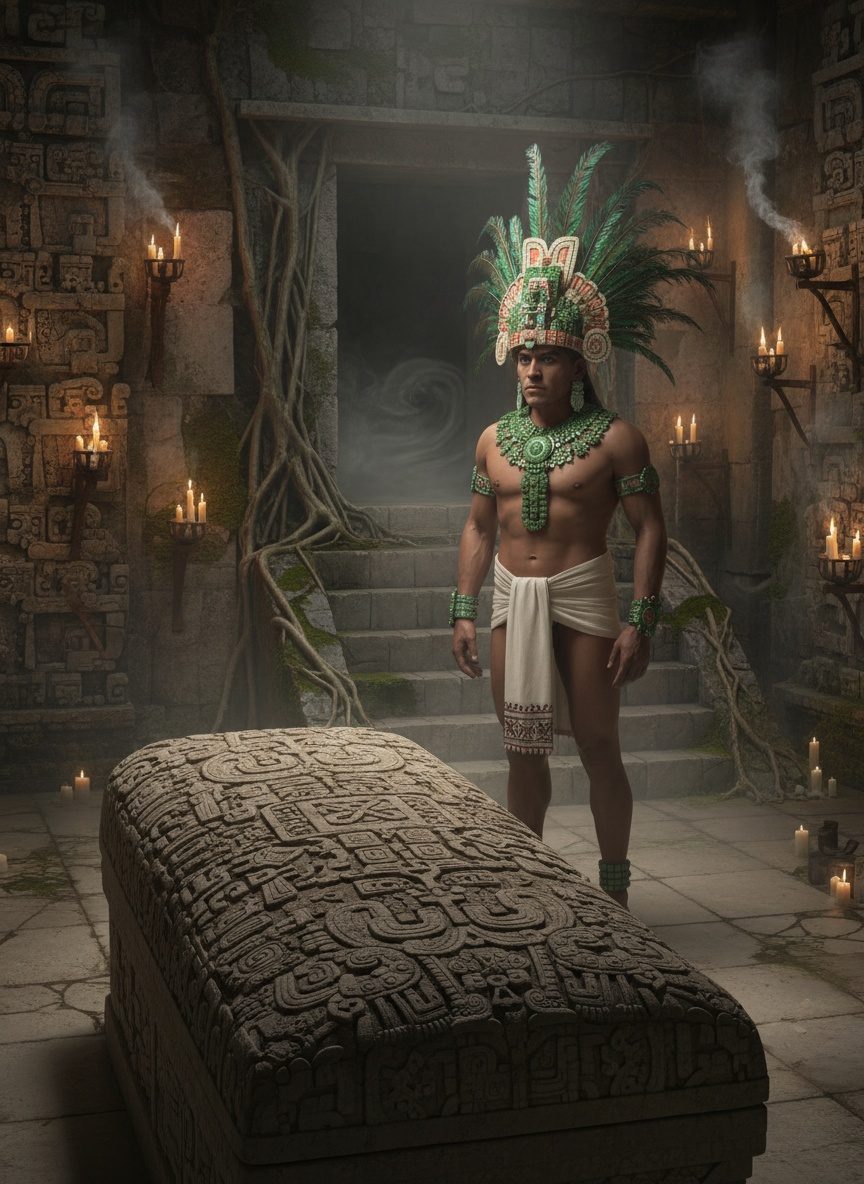
Chan Bahlum's journey began in the heart of Pakal's final masterpiece: the Temple of the Inscriptions, where his father's tomb was sealed. The temple itself was an emblem of Maya architectural genius, its nine levels symbolizing the nine tiers of the Maya underworld. In the dim sanctity of this crypt, amidst the frescoes and glyphs recounting Pakal's triumphant reign, Chan Bahlum lingered in the solitude of his thoughts. Tears traced silent paths down his cheeks as he faced overwhelming expectations, crushed by grief yet emboldened by duty.
As the new king, Chan Bahlum approached his responsibility with reverence. Yet, rather than seeking to eclipse his father's legacy, he sought to complete it. Tradition dictated that a new ruler would assert dominance by heralding his own reign through monumental works, but Chan Bahlum turned this expectation on its head. Instead of singular glory, he sought continuity. By meticulously carving Pakal's visage into the walls of structures throughout Palenque, Chan Bahlum honored the shared journey of heritage and future—the past relinquishing its hold only to grace the coming era.
The Sky-High Journey of a Builder King
Yet, more than just carving his father's face into the stones, Chan Bahlum committed to a vision that reached for the heavens. His ambitious architectural projects pushed the boundaries of Maya capabilities. Among these, the Temple of the Sun and Temple of the Cross complexes stand as testament to his aspiration—striking constructs that weren't merely architectural feats but astral icons, reflecting the celestial order cherished by the Maya. Each edifice exemplified the cosmic connection between humanity and the divine, a theme resonating deeply through Chan Bahlum’s constructions.
The artistic depictions within these temples didn't glorify a solitary reign but intertwined narratives. Scenes illustrating divine dialogues and cosmic battles adorned the limestone, transforming Palenque into a sacred canvas of shared memories. In a world where rulers' achievements were immortalized through stone, Chan Bahlum employed the voice of generations—pasts interwoven with futures. This exploration of temporal duality manifested, not as a retirement of Pakal's paradigm, but as a continuation that championed evolution over erasure.
His father's achievements set the precedent for grandeur; Chan Bahlum's vision expanded the blueprint into realms of cosmic spirituality. The king didn't just build higher; he delved deeper into the conceptual symbolism pervading Maya rituals and histories—therefore crafting a harmonious blend of terrestrial and celestial domains. Such profound dedication did not merely enhance the allure of Palenque; it entrenched the city as a beacon of intellectual and cultural magnificence within the fertile lands of Mesoamerica.
Legacy of a Monumental Embrace
Chan Bahlum's legacy reflects a ruler's determination to uphold and transcend his heritage, where filial reverence interlaced with sovereign ambition. Each stone humbly placed atop ancestral foundations resonated not only with the story of a son fulfilling kingly duties but also with the infinite potentialities of progress. Where time might erode structures, it cannot erode the metaphorical afterimage left behind by innovative peacekeepers like Chan Bahlum, whose brilliance lay not in singular triumphs but in the continuum of artistic expressions and human experiences.
In the grand story of the Classic Maya era, Chan Bahlum's reign illustrates a narrative often overlooked—a narrative championing unity over division, collaboration over competition. Such lessons remain relevant today as we interpret the past and confront the complexities of defining and redefining legacies. By understanding Chan Bahlum's profound contributions, modern admirers witness not only historical ingenuity but also the timeless resonance of shared human endeavors. It's an embrace across generations, an invitation to forge anew without forsaking roots—a mosaic history etched irrevocably by those willing to embrace both shadow and illumination.