The early morning mist clung to the dense tropical foliage like an ethereal shroud, casting a soft veil over the sprawling city of Palenque. The ancient stone edifices that pierced the undergrowth glistened with dew, each telling silent tales of grandeur and decline. The air was rich with the scent of damp earth and distant wood smoke, and the sounds of howler monkeys echoed through the forest, a natural chorus rising with the sun. Beneath this canopy, a significant moment in history measured not just in heartbeats but in the enduring legacy of one resolute boy who would defy all odds.
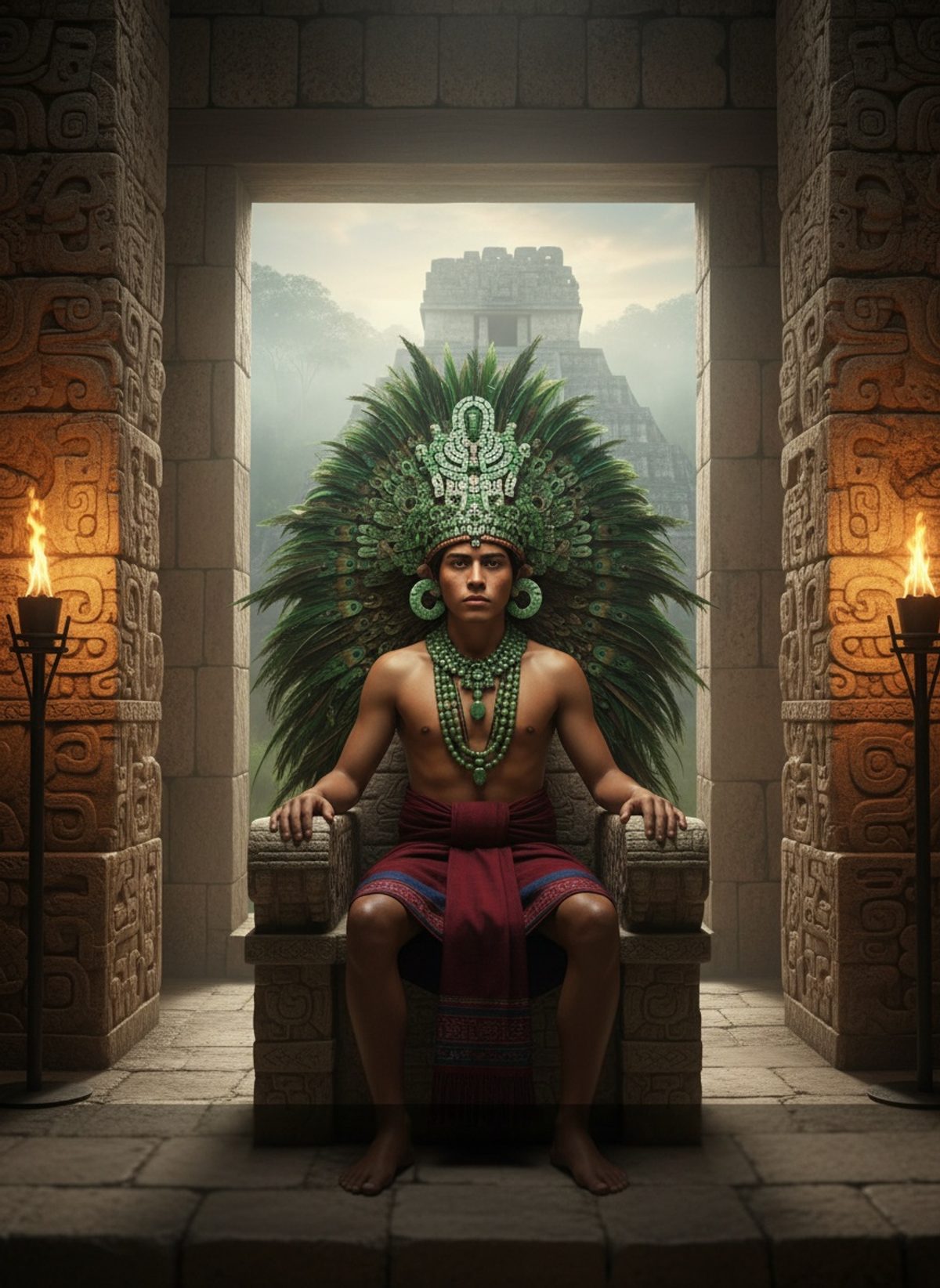
In 615 AD, amid whispers from the jungle, the drumbeats of ceremonial rituals rolled like thunder through the city's stone grandeur. The people of Palenque gathered to witness a coronation that would carve out its place in Maya history. K'inich Janaab' Pakal, a mere boy of twelve, ascended the throne. To surrounding city-states, it must have felt like an omen of impending chaos—a puppet king presiding over a realm on the brink. Yet, as the onlookers and would-be usurpers would soon discover, this boy was anything but ordinary.
Pakal, as he would be fondly remembered, inherited more than just a crumbling kingdom. He took on the mantle of a people beleaguered by rivalry and the encroaching shadows of domination from neighboring powers. In this era of formidable city-states, where alliances were as fragile as the tropical morning mist, leadership demanded more than regal birthright; it required cunning, ambition, and foresight. The Mayan civilization, with its written language, monumental architecture, and sophisticated understanding of astronomy and mathematics, set a stage where only those with extraordinary vision could truly thrive.
The young king's early years were marked by consolidation—strategically marrying politics with religion to fortify his position. Pakal understood the soul of his people and the sacred symbiosis between their beliefs and their rulers. He deftly melded this knowledge into his reign, proclaiming his divine right to rule not just through words but through stone. Temples and palaces rose from the earth, each adorned with intricate carvings that chronicled the story of his ascent and the gods' alleged favor—a strategy that moved beyond mere propaganda and into the realm of cultural allegiance.
Palenque itself, nestled at the foothills of the Tumbalá mountains, grew under Pakal's massive undertaking. As the years passed, he transformed it from a beleaguered town into a beacon of civilization. Through Pakal's enduring reign of 68 years, the city-state flourished architecturally and intellectually, its echoes fanning out to influence the broader Mayan world. Canals and aqueducts threaded through the landscape, bringing life-giving water to his burgeoning city and showcasing an engineering brilliance that astounded future generations.
The heart of this transformation was the Temple of the Inscriptions, a masterful construction that served as both his legacy and his resting place. This temple, which rose like a stepped pyramid, was not just a mausoleum; it was a chronicle of celestial events and divine mythology. Within its stone confines, Pakal's sarcophagus, etched with symbols of rebirth and the eternal journey, lay sealed amidst a chamber laden with offerings. These relics spoke to a deeper understanding of life beyond death, capturing the profound interplay between the temporal and spiritual realms that the Mayans so cherished.
Pakal's influence extended beyond the stone and into the ethereal. He adopted and integrated the advanced astronomical understanding of his people, charting the stars and calendars not only for guidance but for power. Tying celestial events to key political and religious dates, he wielded the cosmos as a tool of governance, intertwining politics with the heavens in a cosmic dance that affirmed his omnipotence—a tactic both innovative and deeply resonant with a populace attuned to the stars.
As the years turned into decades, Pakal's reign saw Palenque thrive even as the Classic Maya period edged toward its decline. He witnessed the ebb and flow of rival city-states, outlasting adversaries with a mixture of diplomacy, strategic marriage alliances, and military prowess. His legacy was not just the tangible resplendence of the city but a stable culture vibrant with art, music, and rites that harmonized under his long and attentive vigilance.
By the time he drew his final breath, Pakal had become much more than a ruler—he was an embodiment of endurance and strategic brilliance. The ancestors veiled in legend, his memory persisted ensconced in stone and lore, shielded by time and mystery until modern archaeologists uncovered his resting place a thousand years later. The tomb itself, revealed in 1952, set off fervent scholarly debate, igniting imaginations worldwide with its breathtaking carvings and the complexity of its construction, a testament not only to Pakal's reign but to the architectural prowess of the Maya civilization.
In the grand narrative of human history, Pakal’s story isn't merely an ancient footnote. It serves as a reminder of the resilience and ingenuity at the core of human potential. His ability to rise above his early detractors, to transform his city during times of turmoil, and to leave an indelible mark—a lesson not just in survival but in the power to thrive against the most trenchant of odds—resonates beyond the boundaries of time and culture. His life and legacy invite reflection on leadership, the intersections of art and power, and the ways in which cultures both past and present forge paths in the face of adversity.