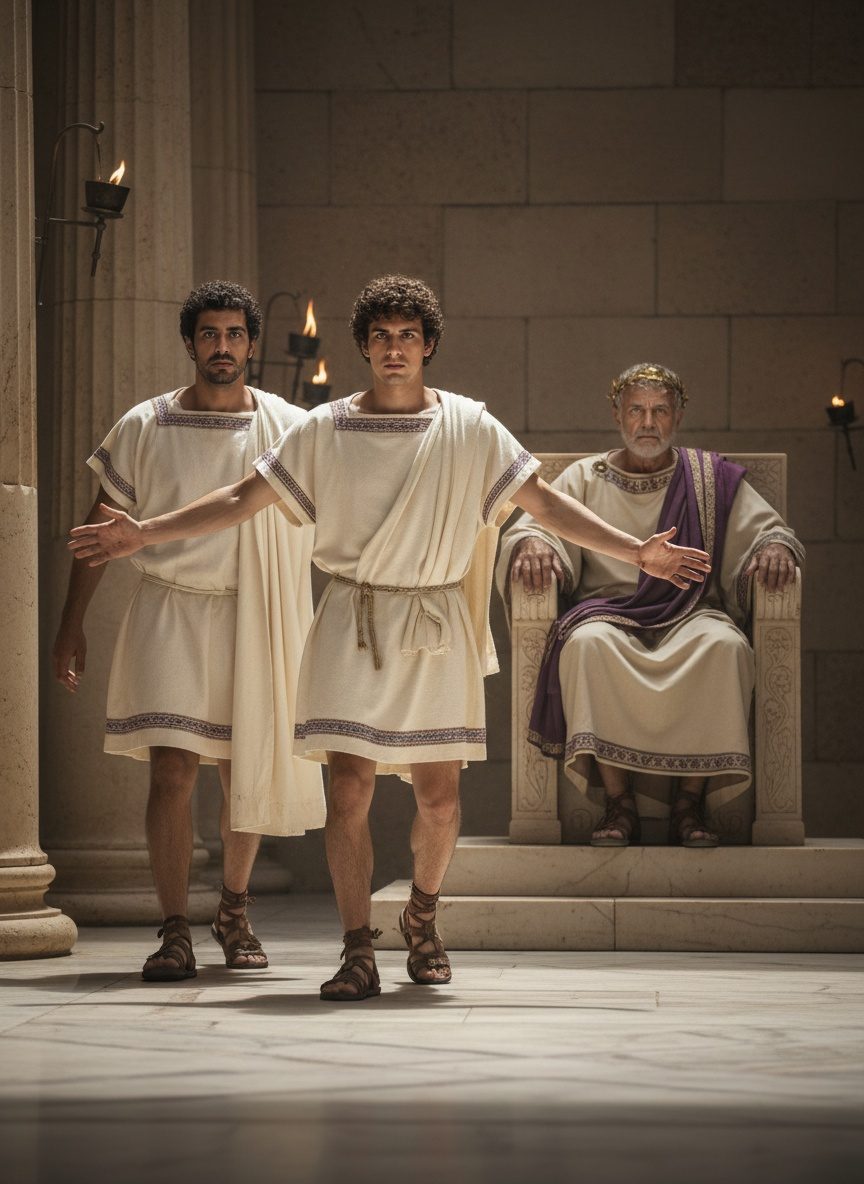
The moonlight glinted off the Mediterranean as a small group of figures moved stealthily through the winding streets of Alexandria. The air was thick with tension. Ahead, the great library — the city's heart of learning — stood silent under the night sky. But the library would soon lose its brightest star.
The Philosopher of Alexandria
In a city renowned for its scholars, Hypatia stood out — not just for her brilliance but for her unique approachability and dedication to the pursuit of knowledge. Born in the rich intellectual milieu of Alexandria, she was the daughter of Theon, a distinguished mathematician and philosopher who instilled in her a love of learning that would shape her destiny. From an early age, she was groomed to excel and exceed the boundaries typically placed upon women of her time.
Hypatia's niche was a blend of mathematics, astronomy, and Neoplatonic philosophy, a potent cocktail that drew students from across the Roman world. Her school was not defined by masonry or wood but by the groups of eager minds she shepherded through the complex reasoning of mathematics and the infinite wonders of the universe. Her lectures, delivered in her own home or in the public spaces of Alexandria, were a blend of rigorous logic and open-ended questions, encouraging lively debates.
Remarkably, Hypatia’s classroom knew no sectarian division; Christians and pagans alike flocked to her to revel in the intellectual freedom only she could provide. To many, her teachings were a harmonious reconciliation between pagan philosophy and the burgeoning Christian thought, an essential bridge in a city deeply divided by strife and religious tension. Known across the Roman Empire, her reputation alone held the fractious intellectual community of Alexandria together, if only for a time.
Darkness Descends
However, the stability she offered was as precarious as a flickering candle in a storm. The political and religious tensions in Alexandria were merely waiting for a spark to ignite them into a raging inferno. The city had become a boiling pot of Greek, Egyptian, and Roman influences, and with the ascent of Christianity to the official religion of the empire, tension with the pagan past was inevitable.
Conflicts were not merely confined to philosophical debates; they spilled into the streets with terrifying violence. Cyril, the Patriarch of Alexandria, held substantial influence over the city's Christian population. His rivalry, particularly with the Roman governor Orestes, a known associate of Hypatia, simmered beneath the surface, threatening to boil over. For the radical faction within Cyril's following, Hypatia became a symbol of what they despised — a powerful woman and a pagan who dared to keep her door open to debate and inquiry.
To this faction, her role as a mediator, offering wisdom and counsel in religiously charged disputes, seemed a direct challenge to their authority. Such a challenge could not be tolerated. Her very life became the spark that lit ancient hatreds aflame. A mob, fervently seeking to erase what they misunderstood and feared, would soon set their sights on her. Her teachings and role as a beacon of knowledge and tolerance threatened to be extinguished forever.
The End of an Era
Alexandria was a city hanging precariously on the edge when that fateful day came in 415 CE. As Hypatia traveled her usual path to the library, her destination was no longer a place of sanctuary but a scene of her impending doom. The mob, incited by fervent religious zeal, intercepted her chariot in the chaotic streets, tearing her from the familiar comforts of her scholarly routine and into an unfathomable tragedy.
There are scant details about the brutality that ensued, but what is clear is that Hypatia was murdered by her attackers. Her death marked not just the loss of a brilliant mind but the loss of an era of enlightenment. Her demise signaled the waning of Alexandria's cultural and intellectual dominance, a city that slipped into its long twilight of decline.
Many historians view the murder of Hypatia as the moment when Alexandria's golden age of learning began to unravel. Her death was more than a personal tragedy; it was a cultural wound from which the city’s intellectual community never fully recovered. Without her unifying presence, the library lost its role as the crucible of learning it once was; its scholars disbursed, its light dimmed.
Hypatia's story is a stark revelation of the fragility of knowledge in the face of fear and intolerance. It reminds us of the perniciousness of ignorance and the tragedy that unfolds when enlightenment is met with violence. In today’s world, where divisions and intolerance still simmer, the echoes of Hypatia’s life and untimely death continue to serve as a sobering reminder of what we stand to lose when we forsake wisdom and understanding for prejudice and brutality.