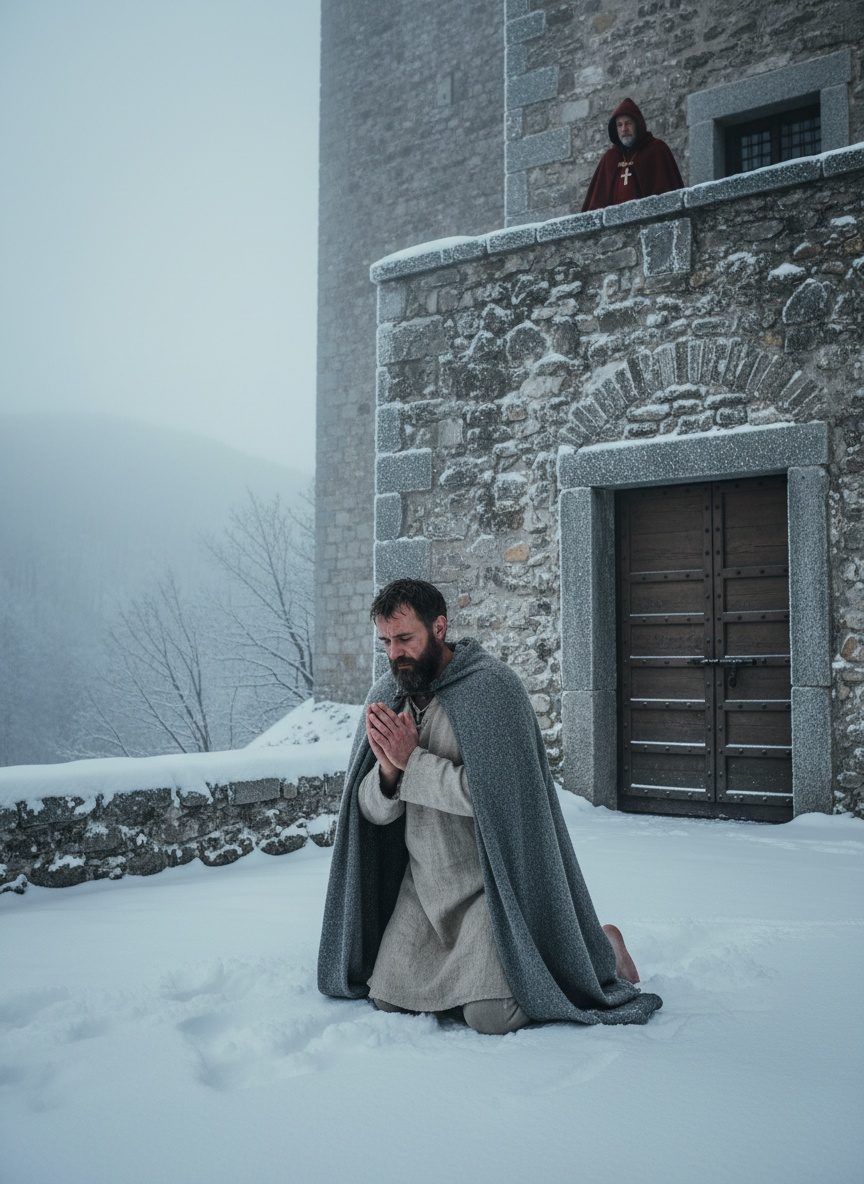
He had never been a humble man. Yet there he stood, humbled and alone, on a frigid January morning. In the winter of 1076, the Holy Roman Emperor, a figure of immense power and authority, found himself stripped of all but a thin layer of penitence and raw human vulnerability. Henry IV, in a show unheard of for someone of his stature, begged for forgiveness from Pope Gregory VII, a man whose very office had been challenged by Henry himself.
The trek to Canossa was not just a physical journey but a dramatic manifestation of the intense power struggle between the papacy and the Holy Roman Empire. Henry's excommunication had rocked Europe, severing the sacral bond between emperor and the divine. He had been deemed unfit to rule by the spiritual leader of Christendom, casting a shadow of illegitimacy over him. This public disgrace wasn't just a political inconvenience; it threatened the very foundation of his reign. Legend has it that his desperate pilgrimage, crossing the Alps in the harshest of winters, was as much about survival as it was about penance. Canossa Castle, perched on the Italian mountaintop like a sacred sentinel, became the improbable stage for this medieval drama.
For three days and nights, Henry stood utterly exposed to the elements. The winter winds showed no mercy as they whipped across the solitary semi-circle of the mountain, a stark contrast to the warmth he might have enjoyed within the walls of his imperial palace. The snow was relentless, blanketing the scene in an oppressive silence, disturbed only by the crackling of the ice underfoot and the soft murmur of his entourage, who watched, helpless. In this quiet limbo, Henry refused shelter, sustenance, or solace. His self-imposed penance was a tableau vivant that spoke louder than any decree or proclamation.
The gates of Canossa, behind which Pope Gregory VII deliberated, might as well have been the gates of Heaven itself, with the Emperor's soul hanging in the balance. For Gregory, this was not merely a matter of forgiveness. It was about asserting the independence and supremacy of the Church over secular rulers, a point often forgotten amid the grand narrative of political chess. The pope’s ascetic resolve and his commitment to the reforms that sought to purify the clerical hierarchy were as ironclad as the emperor's stubbornness was legendary.
But then there was what neither expected: the transformative impact this moment would have on the political fabric of Europe. The confrontation at Canossa was far more than a personal vendetta between two powerful men; it symbolized the age-old struggle between church and state, God’s law versus man’s rule. Canossa became a double-edged sword. For Henry, it scarred his pride but regained him a kingdom. For Gregory, it affirmed his authority, but sowed seeds of discord that would eventually fracture the unity he hoped to achieve.
And yet, within the walls of Canossa, the drama unfolded with all the pomp and secrecy of a medieval courtier's tale. It remains remarkable that the stalemate was eventually broken not by force, but by the persistence of human frailty. On the third day, Gregory, perhaps moved by divine inspiration or mortal compassion, decided that Henry had suffered enough. The gates were opened, lifting the burden of excommunication, restoring Henry to the fold of the Church, and ultimately to the throne of the empire.
The scene within the castle must have been as strange as it was unforgettable. Surrounded by stone walls alive with the whispers of political intrigue, Henry IV and Gregory VII faced each other once more—not as mortal enemies but as repentant sinner and forgiving father. The ceremony of absolution would have been solemn, infused with the incense of hope and humility mingled with the cold drafts of compromise. If there was any triumph here, it lay not in victory but in reconciliation, however fragile it proved to be.
Canossa was a harbinger of changes that rippled through the corridors of medieval power. The Investiture Controversy, of which this poignant episode was a part, would continue to smolder and occasionally ignite into fierce confrontations for decades. It enshrined the notion that kings might be humbled by a power greater than their own—a revolutionary idea with reverberations felt long into the future, reaching the thrones of Europe and the conscience of the church.
As the era of empires rose and fell, reshaping the charred landscape of medieval Europe, the memory of Henry IV’s penance at Canossa lingered on as both warning and inspiration. It was a story not just about power but about the malleability of authority and the often-unbearable weight of leadership—all etched irreversibly into the annals of history by the whims of weather and willpower.
Each flutter of the papal banner atop Canossa, each whisper of the icy winds in the surrounding pines, proclaims a subtle truth in their rustling: power is a delicately poised balance, apt to tip and transform with the stride of a crown-bearing monarch or the utterance of a sovereign pontiff. The echoes of that winter in 1076 remind us that even the mighty must sometimes walk through snow and storm to find their place in history.