May 1945. The ridge loomed stark and unforgiving against the Okinawan sky, its raw face scarred with the marks of war.
The Reluctant Warrior
Desmond Doss, a quiet man from Virginia, stood out in Company B of the 77th Infantry Division not because of his prowess on the battlefield but precisely because he refused to bear arms. A devout Seventh-day Adventist, Doss didn’t fit the traditional mold of a soldier. His deep religious convictions dictated that he couldn't carry a weapon, a stance that drew skepticism and scorn from his fellow soldiers. They labeled him a coward, unable or unwilling to take up the arms necessary in war. Nevertheless, he was driven by a different kind of courage—the kind that compelled him to serve as a medic, offering help and hope amidst the din and desperation of battle.
The Battle of Okinawa was among the bloodiest in the Pacific Theater, crucial for the Allies’ strategic approach towards Japan. Hacksaw Ridge, a steep, rocky escarpment on the island, became the site of intense conflict. The U.S. aimed to secure it as a vital foothold, while the Japanese defenders were entrenched in a series of formidable positions, ready to defend their ground to the death. This seemingly impassable ridge was not just a geographic obstacle but a symbol of unyielding defense, demanding every ounce of strength and strategy from the men who fought to take it.
For Doss, the battle was not about overcoming an enemy with bullets or bayonets but about preserving life amidst chaos. He was often dismissed by those around him, viewed with suspicion even by his commanders who doubted his philosophy could endure the brutality of war. Yet, as the battle unfolded, it was Doss’s grit that shone through—his mission was clear: save lives at any cost.
Night at the Ridge
On that pivotal day in May 1945, the chaos and ferocity at Hacksaw Ridge reached unprecedented heights. Under the relentless barrage of Japanese artillery and gunfire, American forces found themselves embroiled in a desperate fight. As the sun dropped below the horizon, the terrain became a chaotic maze of smoke, noise, and blood. Ordered to retreat, most of the American troops pulled back, scrambling for safety. But not Desmond Doss.
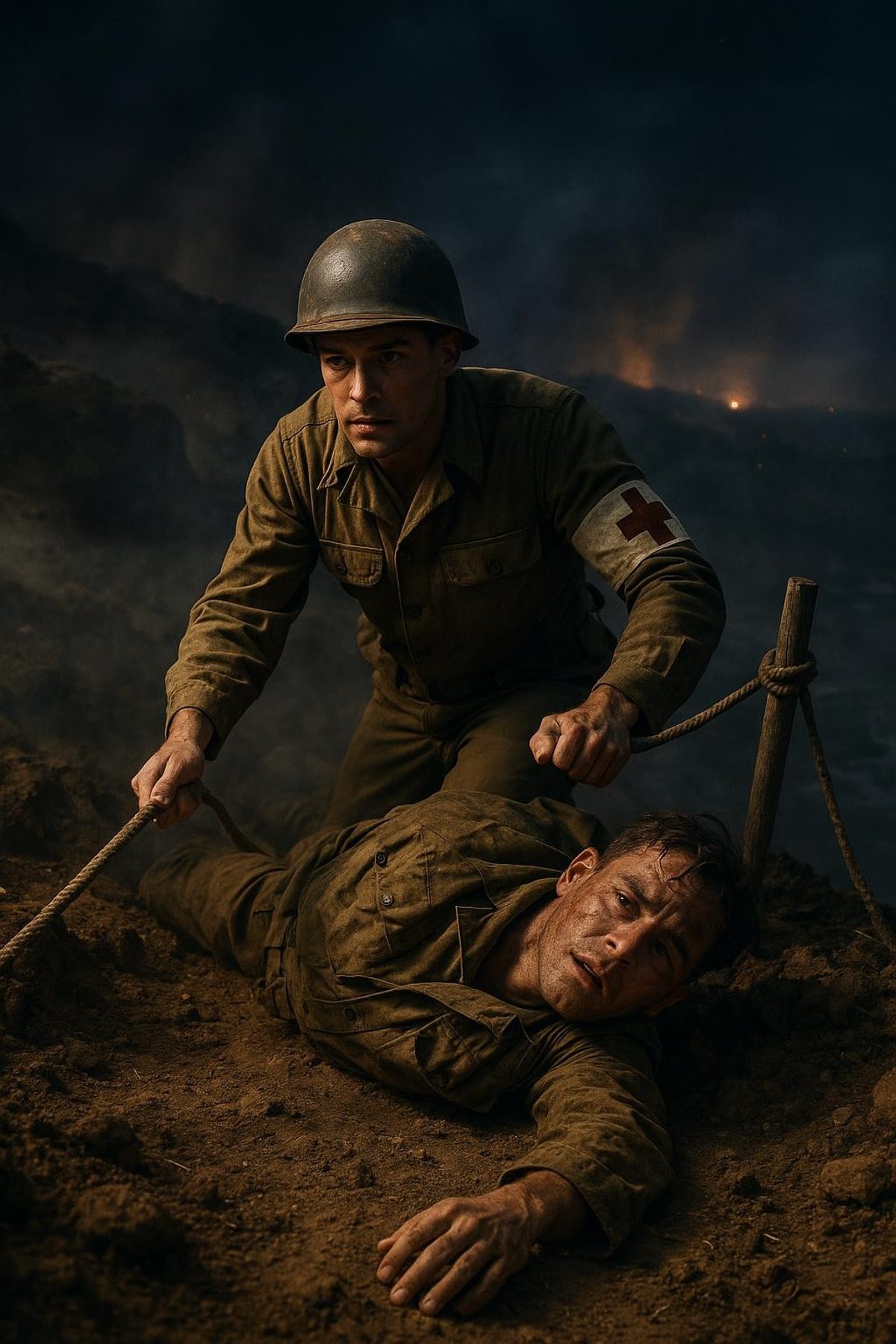
Alone atop the ridge, Doss made a decision that seemed to defy common sense. Rather than seeking refuge, he chose the harder path. He had no weapon to shield him, no ally to support him, only his unwavering belief that he could make a difference. One by one, he began to locate the wounded, pulling, dragging, and carrying them to the edge of the escarpment. The task was herculean, both physically and emotionally straining, as each journey back into the fray carried the risk of never making it out again.
Doss’s actions transcended traditional heroism; he exhibited an unwavering commitment to his fellow soldiers. With keel-nerved determination, he fashioned makeshift stretchers and used improvised ropes to lower each injured man down the cliffside to safety. All through the night, amidst the deafening noise of explosions and the wails of the injured, his hands worked tirelessly. Quiet reassurances and prayers flowed from his lips, comforting those who lay close to death.
Seventy-five times he repeated the process, each descent a testament to his resolve and faith. He implored, “Lord, help me get one more.” And with each soul he saved, Doss carved an indelible legacy of courage, demonstrating that one need not wield a weapon to be a warrior.
A Legacy Carved in Bravery
The sun rose over Hacksaw Ridge, casting light upon a transformed battlefield. Desmond Doss stood amidst this harrowing landscape, humbled and exhausted, yet triumphantly embodying the spirit of selfless service. His deeds had turned a potential massacre into a tale of miraculous survival, subverting the perception of cowardice into a defined expression of valor.
The bewildered disbelief that initially greeted him from his peers turned into profound respect. The same men who questioned his resolve now hailed him as a hero. Doss's unyielding faith and determination had won not just the lives of his fellow soldiers but also the admiration of nations. He became the first conscientious objector—the term hardly suffices to encapsulate his battlefield resolve—to be awarded the Medal of Honor, the United States military’s highest and most distinguished personal decoration.
The story of Desmond Doss resonates far beyond the scarred land of Hacksaw Ridge. It challenges our understanding of bravery, forcing us to rethink the essence of heroism. Doss showed us that true strength lies not in the ability to destroy but in the will to heal and protect. His legacy endures, reminding us of the power within each of us to impact others positively, even in the darkest times. In a world often marked by conflict and division, Doss’s story stands monumentally—an enduring beacon of the value of human life, courage, and compassion.