The air was crisp under the late afternoon sun in Corinth, casting long shadows over the bustling marketplace. The hum of activity draped the city like a living tapestry, each thread a tale of ancient Greek commerce and life. In the bright, relentless light, the rocky terrain of this historic land seemed as if soaked with the warmth of the gods themselves. Nearby, nestled amidst the clamor and chaos, stood a figure by the simplest of shelters—a humble barrel. It was here, on this unassuming stage, that history recorded an encounter between a barrel-dwelling philosopher and the most powerful man of the time—a compelling convergence of profound simplicity and imperial ambition.
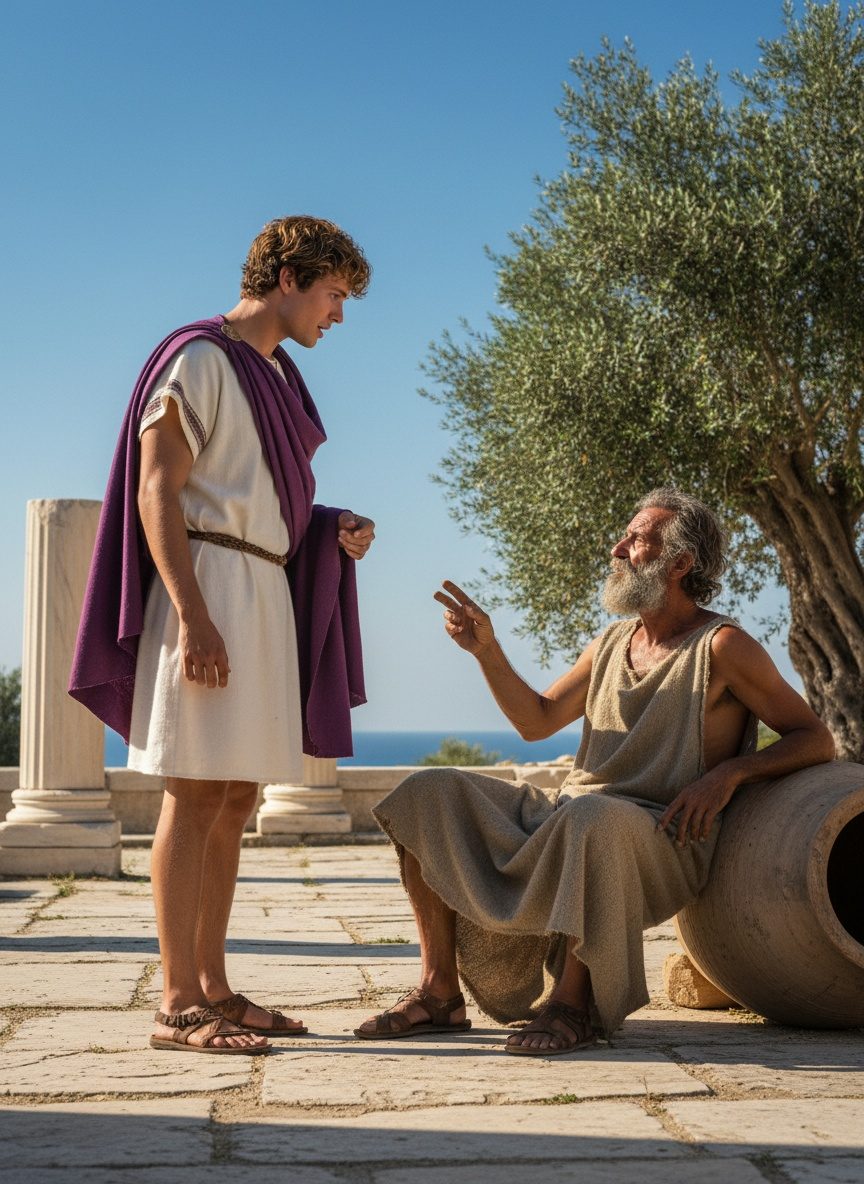
Alexander of Macedon, known to history as Alexander the Great, was a man whose name resonated with the weight of conquest. Having swept across territories from Greece to Persia, his empire sprawled half the known world, a testament to his unmatched military might and strategic genius. Yet, for all his achievements, Alexander found himself intrigued by tales of a peculiar philosopher residing in Corinth—a man of utter indifference to wealth and power known simply as Diogenes. Diogenes of Sinope had sheltered himself within a clay jar, living a life stripped of all that tethered men to desire, and Alexander's curiosity was piqued.
On the day they met, Alexander approached the sunbather with the magnanimity of an emperor who believed himself magnanimous in spirit as well as name. There, beneath a canopy of sunlight, an encounter unfolded, equal parts absurd and profound. With the crowd likely falling silent, anticipating either a display of imperial generosity or reprimand, Alexander greeted Diogenes with an offer befitting a king. "Ask of me what you wish," Alexander proclaimed, his voice echoic amidst the murmuring awestruck crowd.
Diogenes, unperturbed and untouched by the grandeur of the offer, opened his eyes to fix his gaze on the mighty king, not in reverence, but with the serene countenance of one who had long transcended such vanities. His request was as simple as it was audacious: "Move, you are blocking my sunlight."
In those few words, Diogenes articulated a truth that both endeared and indicted the onlookers. Here was a man unshackled by fame or fortune, who saw even the gifts of an emperor as mere shadows. Alexander, in that moment of confrontation with the raw authenticity of a cynic's philosophy, laughed heartily. It was an unexpected reaction, yet borne out of an intrinsic recognition of Diogenes' uncompromising freedom, "If I were not Alexander," declared the king, "I would be Diogenes."
Few encounters are so timeless that they transcend the very structure of empires as does this seemingly simple exchange. Diogenes stood as a living paradox in a world obsessed with wealth and dominion—embracing deprivation while brandishing disdain for cultural pretensions. His philosophy of Cynicism, a life in harmony with nature and virtue over societal constructs, was personified yet again in this encounter. Despite Alexander's power, it was Diogenes who seemed to wield the greater influence over how one should measure true contentment.
While many details of daily life in ancient Greece have been lost to time, this tale survives to provoke reflection on the nature of existence and the human spirit. From an unassuming sunlit patch in Corinth, Diogenes presented a challenge to every observer: to question the sincerity of their own pursuits and possessions. His philosophy has echoed through millennia, finding resonance in subsequent movements that advocate simplicity and critical examination of societal norms.
As for Alexander, the meeting with Diogenes was but one note in his grand symphony of campaigns. Yet, it was this encounter that imparted a philosophical mirror to the conqueror of worlds, casting shadows of doubt upon the fleeting power and prestige he commanded. Perhaps Alexander saw in Diogenes the ultimate freedom he could never attain, bound as he was by the responsibilities of empire.
This timeless narrative whispers through the ages, not merely as an anecdote or philosophical curiosity but as a profound statement on the eternal conflict between power and freedom. It compels us to grapple with questions that persist across epochs: Where does true contentment lie, within the grasp of empire, or in the embrace of simplicity? In a world where the desires of the many are ceaselessly pursued, do we dare to seek fulfillment in the unabashed candidness of a Cynic's sunbath?