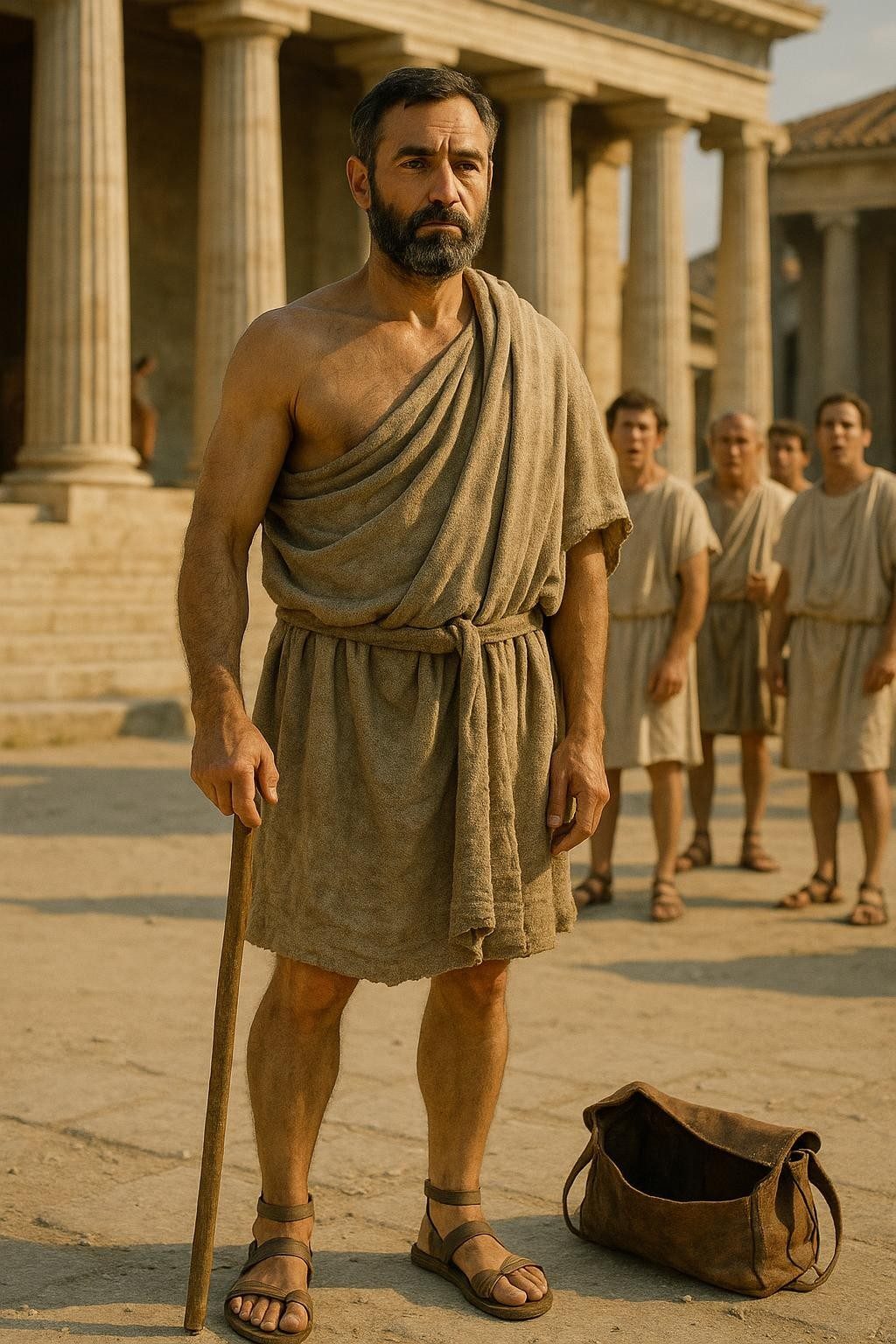
Crates of Thebes had everything a man could want in ancient Athens. Yet, he chose to walk away from it all.
The Wealthy Philosopher of Athens
In 320 BC, Athens was a bustling metropolis of culture and commerce. Amidst the grandeur of towering marble columns and the echo of Socratic voices, lived Crates of Thebes, one of Greece’s most affluent individuals. Having accumulated substantial wealth through inheritance, Crates was not only financially prosperous but also well-educated and widely admired within Athens' elite circles. He often participated in philosophical discussions and debates—an esteemed pastime of the learned Greeks. However, beneath the surface of opulence and intellect, Crates nurtured a restless spirit, eager to transcend the materialistic ideals of his time.
Ancient Greece revered wealth and status, seeing them as pillars of success and happiness. For many, Crates epitomized the ideal Athenian life. His wealth granted him respect and influence in a city where public life revolved around monetary prowess and philosophical wisdom. Yet, despite this revered position, Crates saw himself ensnared by the chains of material possession, yearning for a freedom that lay beyond the gilded confines of his prosperous world.
The Day Everything Changed
One day, without warning, Crates made a decision that stunned Athens to its core. He sold every asset he possessed—lands, homes, and goods—and donated the entire fortune to the city. The incredible gesture was not an impulsive act of rebellion but a calculated decision borne of philosophical resolve. Fully aware of the consequences, Crates relinquished his luxuries, left with nothing but a cloak and a staff, and stepped into the street as an outsider to the life he once knew.
Athens' response was one of disbelief and curiosity. Why would a man possessed of so much wealth and privilege choose poverty? According to Crates, it was the gateway to true freedom. In an era where possessions defined one's identity and social worth, Crates sought enlightenment through the shedding of material bonds. By walking away, he expressed a profound indictment of society's conventional values—a willingness to trade gilded shackles for the liberty to pursue a deeper understanding of happiness.
A Life of Cynicism and Simplicity
After abandoning his riches, Crates embraced the philosophical doctrine of Cynicism, which advocated for asceticism and virtue as pathways to authentic freedom. Influenced by the teachings of Diogenes, a fellow Cynic who famously lived in a barrel, Crates dedicated his life to challenging the ideologies that tethered people to superficial success. With little more than a humble cloak, he roamed Athens and other parts of the Greek world, turning the public space into his platform of philosophical discourse.
The transformation from affluent socialite to ascetic philosopher was met with both awe and scrutiny. Some admired his bravery and philosophical sincerity, while others viewed his choice as eccentric, bordering on madness. Despite differing opinions, Crates' decision reverberated through the cultural landscape of Athens, prompting a reevaluation of what it meant to lead a meaningful life.
Crates' lifestyle further embodied the Cynic's belief in living harmoniously with nature, seeking contentment through inner virtue rather than external wealth. His presence in public forums, where he posed challenging questions and engaged in heated debates, won over several followers, most notably Zeno of Citium, who would later become the founder of Stoicism—giving testament to Crates' enduring influence.
Why Crates' Story Matters Today
Although long past, Crates of Thebes' story forces a modern audience to question what society truly values. His radical choice invites reflection on the pursuit of wealth and the definition of success. By turning away from a life of easy abundance, Crates demonstrated courage and conviction—a willingness to defy social norms for a chance at personal enlightenment. The question he posed over two millennia ago remains relevant: Is true freedom found in the accumulation of wealth or in the liberation from its pursuit?
In an age where material success is often equated with happiness, Crates' narrative challenges us to consider the intangible riches of life. Perhaps in our examination of the ideals behind Crates’ journey, we find an echo of our own quest for meaning in a world that often confuses worth with wealth. By stepping away from everything, Crates of Thebes illustrated that sometimes, the path to fulfillment begins not with acquisition, but with the artful act of letting go.