The sound of gunfire echoed across the murky waters of the Irrawaddy River, mingling with the shouts of orders and the urgent clatter of metal against metal. Under the cover of darkness, the Royal Engineers worked with the precision of a well-oiled machine, sweat mingling with fear and determination as they began the near-impossible task of bridging a mile-wide river under the enemy's gaze. The year was 1945, the place — Burma, an often overlooked theatre of World War II where the strategic Chindwin and Irrawaddy rivers became both barriers and lifelines.
The Engineer's Gamble
In February 1945, with the Allied forces pressing their advantage in Southeast Asia, the 14th Army faced the daunting challenge of crossing the mighty Irrawaddy River. Nearly a mile wide at this point, the river was a natural fortress defended with precision by the Japanese Imperial Army. Every approach seemed poised to become a death trap. Yet, Major-General Giffard Martel, head of the Royal Engineers, was renowned for his audacity. His sappers were no strangers to danger, their reputation built on audacious feats in the most impossible conditions. Perhaps none more audacious than bridging this perilous expanse of water directly in the line of enemy fire.
The crossing was integral to Operation Capital, an offensive designed to propel Allied forces into the heart of Burma and expel Japanese troops once and for all. The entire operation hinged on the sappers’ ability to build a pontoon bridge rapidly and stealthily. The clock was ticking. Patience wore thin. The fate of thousands rested on their expertise and sheer nerve.
Building the Impossible
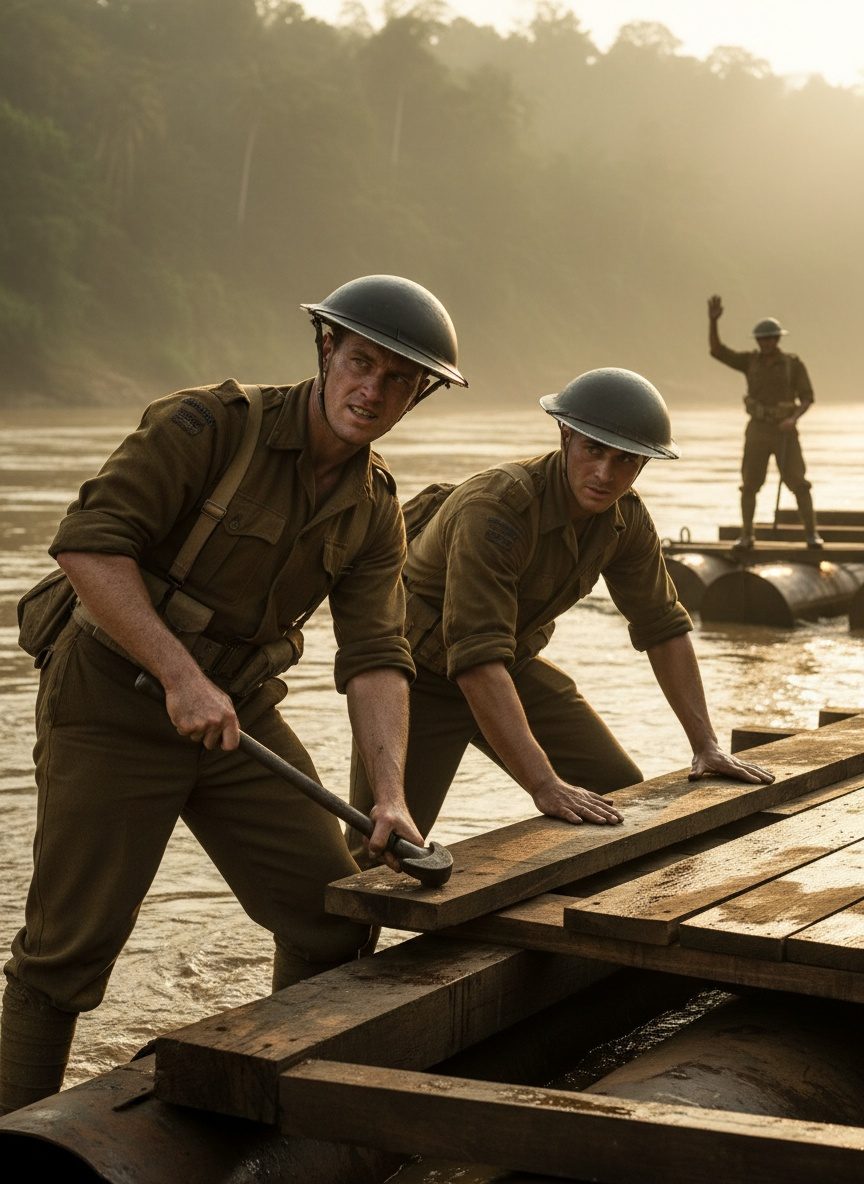
Using Bailey bridge components — an ingenious modular system developed during WWII — the Royal Engineers set about crafting their strategy. The modularity of the Bailey equipment allowed for rapid assembly, essential when every minute counted. Their objective was clear, but execution required split-second timing and flawless precision. The river itself, swollen by seasonal rains, weakened undercurrents that could easily unravel the best-laid plans.
In collaboration with local laborers familiar with the terrain, the engineers began their night's work. Under the cover of darkness, pontoons were floated into position, held steady by the grim determination of those who understood that failure was not an option. As gunfire lit the sky, the engineers remained steadfast, their expertise and grit a testament to their training and resolve.
Time blurred as the structure took shape. Onlookers described the operation as a mechanical symphony, with every piece falling into place with clockwork precision. Yet, behind this facade of seamlessness lay the gritty reality of labor under fire. Every sound was calculated; every light was shuttered to avoid detection. They worked in whispers, their lives hanging on the thinnest veil of secrecy.
The Bridge of Their Lives
By the fourth night, the bridge stood completed, a slender thread stretching defiantly across the mighty Irrawaddy. In the bitter silence just before dawn, under gunfire that punctuated the night like a grim metronome, British forces began to cross — thousands of soldiers, tanks, and vehicles, weapons at the ready, eyes fixed on the far shore.
The eerie music of bridge decking clanging beneath boots, vehicles rumbling onto the structure, and the distant echoes of the Irrawaddy's flow would forever be burned into the memories of all who were there. Soldiers crossing the span whispered prayers as they set foot on the precarious path above the water, their lives suspended in the balance between ingenuity and war’s unpredictable chaos.
The successful crossing was a turning point. With the Royal Engineers' bridge paving the way, Allied forces launched a powerful offensive against the entrenched Japanese units. The 14th Army, once constrained by natural barriers and enemy defenses, surged forward, marking a significant step in the Allied campaign to reclaim Burma.
The Stories They Left Behind
The Irrawaddy Bridge was dismantled after the war, a temporary construction with an enduring legacy. The men who built it went on with their lives, many returning to anonymity, their stories part of a legacy rarely told in grand histories of World War II. This was a story of ordinary heroes performing extraordinary deeds under circumstances that defied human limits.
The courage and technical brilliance demonstrated by the Royal Engineers during this campaign stand as a remarkable achievement of military engineering and personal valor. The mission was not just about bridging a physical divide but about overcoming the overwhelming challenges of war, geography, and entrenched adversarial forces. It was a testament to human tenacity in the face of seemingly insurmountable odds, a feat that echoed quietly across the chapters of history.
This tale of bravery and ingenuity challenges us to reconsider the hidden elements of conflict, the unheralded feats that tip the balance, enabling seismic shifts in historical momentum. As we look back on the forgotten theaters and unsung contributions of World War II, it reminds us that history is more than the tales bound in textbooks — it's lived in the stories whispered across battlefields and brought to life by those who dared to change the course of destiny.