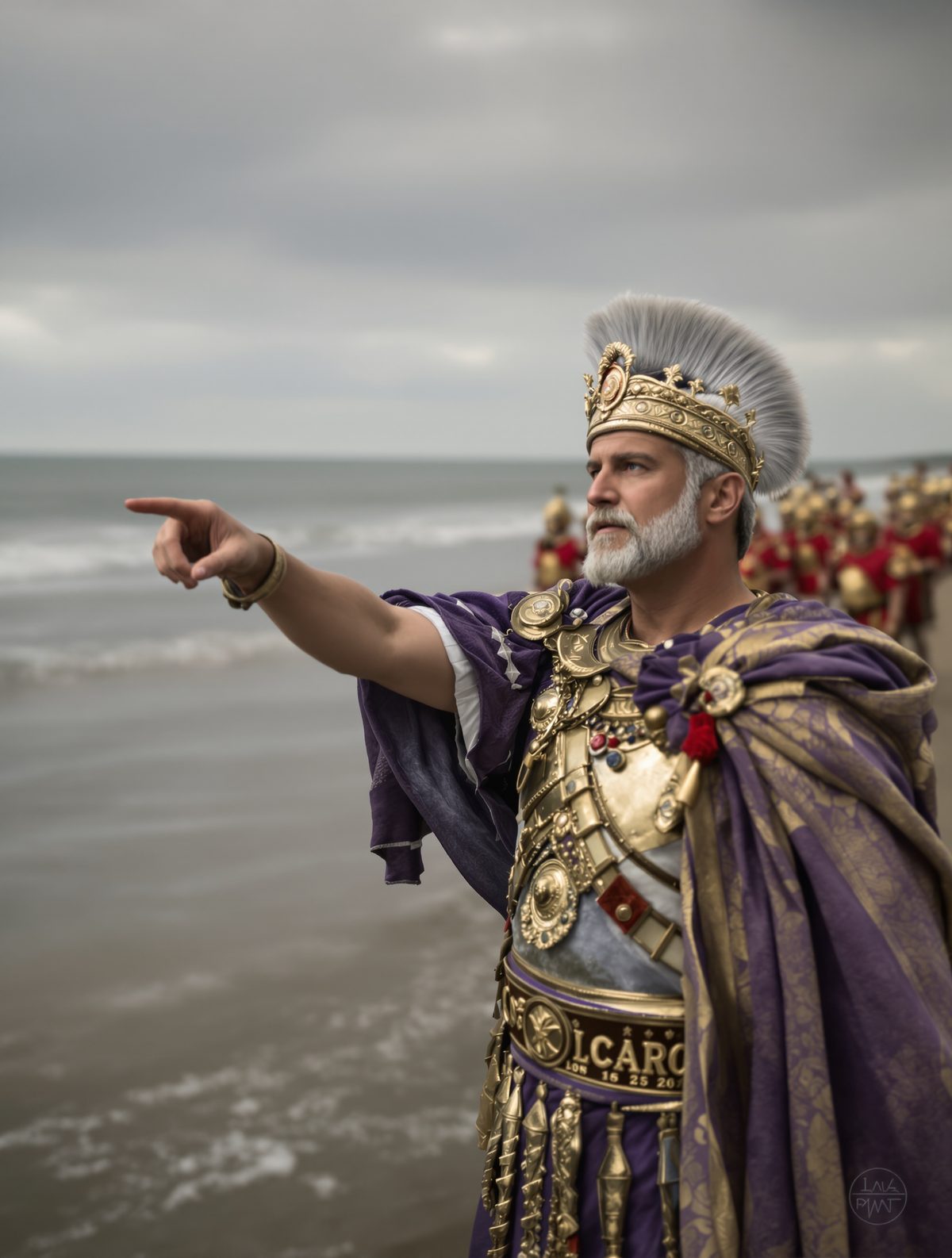
Picture this: a young Roman aristocrat, barely 25 years old, stands on the deck of a pirate ship somewhere in the Mediterranean. The Cilician pirates who've just captured him are congratulating themselves on their prize—a highborn Roman who'll fetch a handsome ransom. They demand 20 talents of gold, equivalent to about half a million dollars today. Instead of pleading for his life or negotiating a lower price, the young man bursts into laughter.
"Twenty talents?" he scoffs. "You clearly don't know who I am. Make it fifty."
The pirates think they've caught themselves a madman. They have no idea they've just kidnapped the future ruler of the Roman Empire—and that his casual response will reveal the terrifying blend of charisma, arrogance, and ruthless ambition that will one day reshape the ancient world.
The Making of a Future Dictator
In 75 BC, Gaius Julius Caesar was nobody special by Roman standards. Born into a patrician family with more noble blood than actual wealth, he was just another ambitious young Roman trying to climb the cursus honorum—the ladder of political offices that led to real power. He'd held minor positions and was sailing across the Aegean Sea to study rhetoric in Rhodes, hoping to sharpen the oratorical skills essential for Roman political success.
What Caesar didn't anticipate was running straight into the most dangerous waters of the ancient Mediterranean. The coastlines of modern-day Turkey were controlled by Cilician pirates, who had turned kidnapping into a thriving industry. These weren't the romanticized pirates of Hollywood—they were sophisticated criminal enterprises that had effectively carved out their own maritime empire.
The Cilicians operated with near impunity from their mountain strongholds and island bases, commanding fleets that could challenge naval powers. They'd grown so bold that they regularly raided Roman territory, once even capturing two praetors—high-ranking Roman officials—right from the port of Rome itself. For decades, Roman politicians had been too busy fighting civil wars to deal with the pirate problem effectively.
So when Caesar's ship was intercepted near the island of Pharmacusa, it was just another day at the office for his captors. They had no way of knowing they'd just grabbed a future conqueror of Gaul, or that this particular prisoner would refuse to play by the usual rules.
The Prisoner Who Refused to Act Like One
What happened next reveals everything we need to know about Caesar's personality—and why he would later become one of history's most successful and feared leaders. When the pirates announced their ransom demand of 20 talents, Caesar didn't just negotiate upward for the sake of his pride. He was genuinely offended by the low amount.
To put this in perspective: 20 talents represented roughly 1,200 pounds of gold, enough to buy several large estates or fund a small army for months. It was more than most Romans would see in a lifetime. But Caesar understood something the pirates didn't—that in Roman society, your ransom price was a direct reflection of your importance and future potential. Twenty talents suggested they saw him as merely another minor aristocrat.
Caesar knew better. Even at 25, he possessed an almost supernatural confidence in his own destiny. He'd already survived Sulla's murderous purges by refusing to divorce his politically inconvenient wife, showing a willingness to risk death rather than compromise his principles. He'd served with distinction in the military and had his eyes set on the highest offices in Rome. Twenty talents was an insult to what he planned to become.
So he demanded fifty—and remarkably, the pirates agreed. They may have thought he was mad, but they weren't about to turn down extra money. What they didn't realize was that Caesar had just played them perfectly, demonstrating the same psychological warfare that would later make him legendary on battlefields across Europe.
The World's Most Terrifying Houseguest
While they waited for the ransom to be collected—a process that took 38 days—Caesar transformed from prisoner into the pirates' worst nightmare. But not in the way you might expect.
Rather than plotting escape or cowering in captivity, Caesar essentially took over. He treated the pirate ship like his personal yacht and the crew like his servants. When they made too much noise while he was trying to sleep, he ordered them to be quiet—and they obeyed. When he wanted to exercise, he made them clear space for him. He composed speeches and poetry, then forced the pirates to listen to his recitations.
Here's where the story gets truly bizarre: Caesar apparently criticized his captors' literary appreciation. When they failed to properly appreciate his poems and speeches, he called them barbarians and philistines to their faces. Most prisoners try to avoid antagonizing their captors. Caesar was giving them performance reviews.
But the most chilling part of his behavior was how casually he discussed their future deaths. Caesar repeatedly told the pirates that once he was free, he would return and have them all crucified. He said it so often and so cheerfully that they began treating it as a running joke. They'd laugh and slap him on the back, thinking their charismatic prisoner was just showing off his Roman sense of humor.
They had no idea he was making them a promise.
A Promise Kept in Blood
When Caesar's ransom finally arrived, the pirates released him at the port of Miletus, probably expecting never to see their entertaining captive again. They should have known better. Caesar had spent 38 days studying their methods, their routes, and their weaknesses. The moment he was free, he began planning their destruction.
Remember, this was 75 BC—Caesar held no significant military command and had no legal authority to pursue pirates. A normal person would have gone home, filed a complaint with the Senate, and hoped someone else would eventually deal with the problem. Caesar was not a normal person.
Instead, he went directly to Marcus Juncus, the governor of Asia, and demanded ships and men to hunt down his former captors. When Juncus hesitated—probably wondering what authority this young aristocrat thought he had—Caesar took matters into his own hands. Using his family connections and personal charisma, he raised a private fleet and recruited volunteers for what was essentially a vigilante expedition.
The hunt didn't take long. Caesar knew exactly where to find the pirates because he'd spent over a month listening to their conversations and observing their habits. His improvised fleet caught them at their base near Pharmacusa, the same island where he'd been captured.
The pirates were completely unprepared for an attack. They'd grown comfortable with Roman inaction and never expected their former prisoner to return with warships. Caesar's forces captured the entire band along with their treasure—including, presumably, his own ransom money.
Justice, Roman Style
What happened next reveals both Caesar's sense of honor and his capacity for ruthless violence. He recovered his 50 talents and could have simply handed the pirates over to Roman authorities for trial. Instead, he kept his promise.
Caesar had the entire pirate crew crucified, just as he'd cheerfully told them he would during those 38 days of captivity. However, in what he probably considered a gesture of mercy, he had their throats cut before the crucifixion—making their deaths quicker than the usual slow agony of the cross.
This detail is crucial to understanding Caesar's character. He wasn't a sadist who enjoyed suffering for its own sake, but he was absolutely implacable when it came to keeping his word. The pirates had treated his threats as jokes; he wanted to ensure that no one would make that mistake again.
The message was clear: Caesar meant what he said, whether he was promising friendship or threatening destruction. It was a lesson that would serve him well in the political snake pit of Rome, where a reputation for keeping both promises and threats could be more valuable than armies.
The Birth of a Legend
When news of Caesar's private war against the pirates reached Rome, it caused a sensation. Here was a young man who had refused to accept the government's inaction, raised his own fleet, and single-handedly solved a problem that had plagued the Mediterranean for decades. It was exactly the kind of bold, decisive action that Romans admired—and exactly the kind of unauthorized military adventure that made the Senate nervous.
The pirate incident became the first glimpse of the man who would later cross the Rubicon with a single legion, conquer Gaul against overwhelming odds, and ultimately destroy the Roman Republic. It showed Caesar's willingness to break rules when they didn't serve his purposes, his ability to inspire loyalty in strangers, and his terrifying combination of charm and ruthlessness.
Perhaps most importantly, it revealed Caesar's fundamental belief that he was destined for greatness. Most people captured by pirates would focus on survival and escape. Caesar was offended that they'd undervalued his future importance and turned his captivity into an opportunity to demonstrate his natural authority.
The young man who laughed at a pirate ransom and then crucified his captors would go on to conquer territories larger than modern France, defeat Pompey the Great in civil war, and accumulate more power than any Roman before him. Looking back, we can see that Caesar's response to the pirates wasn't just youthful arrogance—it was an accurate prediction.
In our modern world of political calculation and focus-group-tested responses, there's something almost alien about Caesar's absolute confidence in his own destiny. He lived in an age when individual will and charisma could reshape civilizations, and he understood intuitively that perception often becomes reality. By refusing to be treated as a minor prize, he forced the world to recognize his true worth—a lesson in personal branding that would be impressive even today.
The pirates who laughed at Caesar's threats learned too late that some jokes aren't funny. The rest of the world would spend the next three decades learning the same lesson.