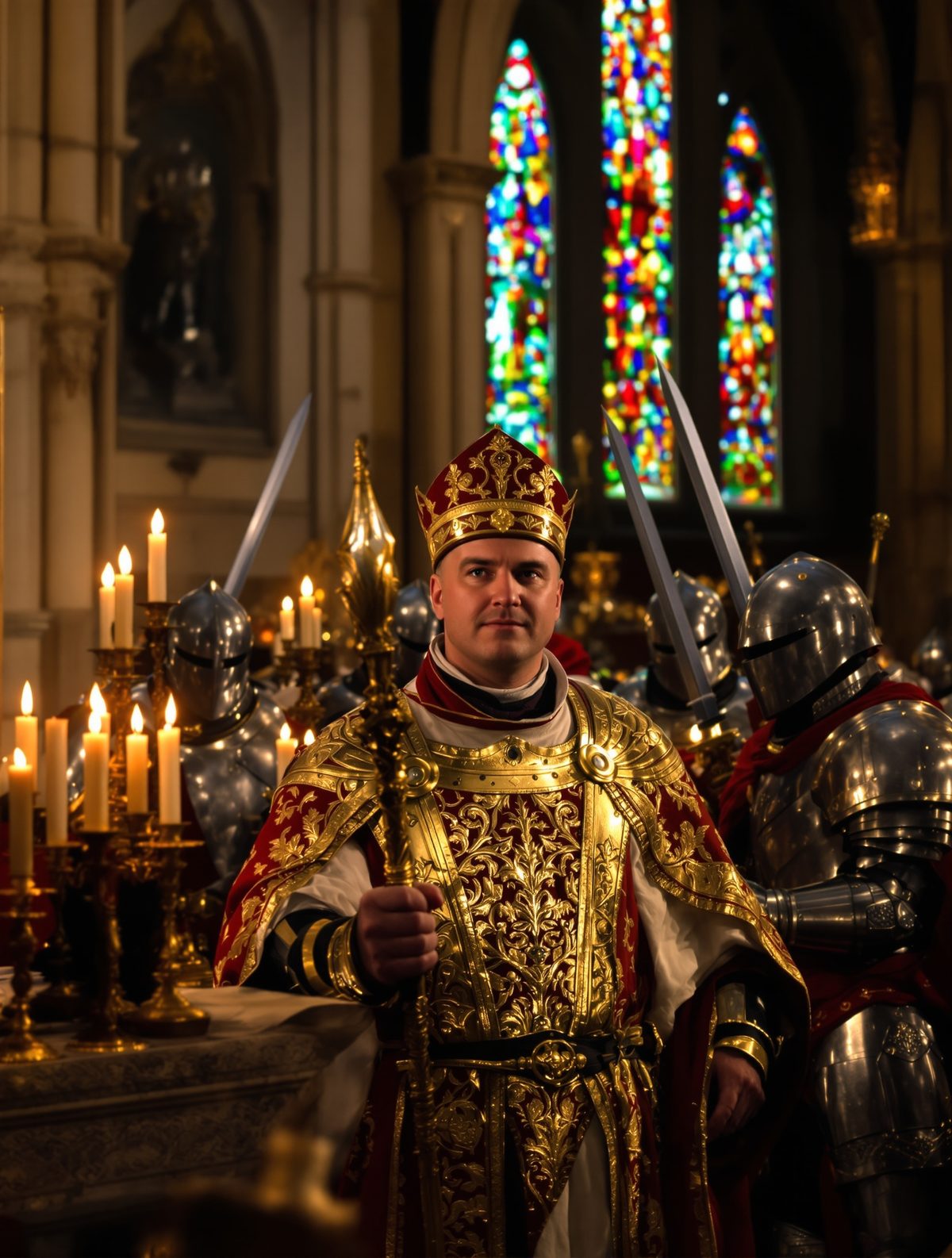
Picture this: It's May 1045, and in the marble halls of the Lateran Palace in Rome, the most powerful religious leader in the Christian world is haggling like a merchant in the marketplace. But Pope Benedict IX isn't selling relics or indulgences—he's selling the entire papacy. The price? 1,500 pounds of pure gold, enough to fill several treasure chests. The buyer? His own godfather, a priest named John Gratian, who would become Pope Gregory VI. It was the most brazen act of simony in Church history, and it was about to get much, much worse.
What happened next would split the Catholic Church into three competing factions, each claiming divine authority, and would ultimately require the intervention of the Holy Roman Emperor to sort out the mess. This is the story of how a 20-year-old pope turned the most sacred office in Christendom into a commodity—and then tried to steal it back.
The Boy Pope Who Scandalized Rome
Benedict IX wasn't supposed to be pope—at least, not at age 20. Born Theophylactus of Tusculum around 1012, he was thrust onto the papal throne in 1032 through the machinations of his powerful family, the Tusculani, who had been pulling strings in Rome for decades. His father, Alberic III, and his uncles had already installed two previous family members as pope. When Benedict's predecessor, John XIX (his uncle), died, the family saw an opportunity to maintain their stranglehold on papal power.
The chronicles of the time paint Benedict as everything a medieval pope shouldn't be. The German chronicler Hermann of Reichenau described him as "a disgrace to the Chair of Peter," while other contemporary sources accused him of hosting orgies in the Lateran Palace, practicing witchcraft, and even murder. Whether these accusations were entirely true or exaggerated by his political enemies, one thing was clear: Benedict IX was more interested in the luxuries of power than its spiritual responsibilities.
By 1045, after thirteen tumultuous years on the papal throne, Benedict had made himself so unpopular with the Roman nobility and clergy that his position had become untenable. Riots had broken out in the streets of Rome, and powerful families were openly calling for his removal. It was then that Benedict came up with a solution that would have made Judas Iscariot blush: he would simply sell the papacy to the highest bidder.
The Deal That Shocked Christendom
The buyer was John Gratian, Benedict's own godfather and a respected archpriest who genuinely believed he could reform the Church. Gratian was wealthy, pious, and—crucially—willing to pay Benedict's asking price of 1,500 pounds of gold. To put this sum in perspective, it was enough money to fund a small army for months or build several churches. Some historians suggest the equivalent buying power today would be millions of dollars.
On May 1, 1045, the transaction was completed. Benedict IX abdicated, John Gratian was installed as Pope Gregory VI, and the gold changed hands. For a brief moment, it seemed like the Church might actually benefit from this unprecedented arrangement. Gregory VI was everything Benedict wasn't—scholarly, moral, and genuinely committed to church reform. Even the great reformer Peter Damian initially praised Gregory's election, seeing him as a potential savior of the papacy.
But there was one problem with buying the papacy from a corrupt pope: it made you corrupt too. The act of simony—buying or selling church offices—was considered one of the gravest sins in medieval Christianity, punishable by excommunication and eternal damnation. Gregory VI may have had noble intentions, but he had tainted his papacy from the very first day.
The Return of the Seller
Benedict IX, meanwhile, had taken his golden retirement fund and settled into a comfortable life outside Rome. But gold, it turned out, couldn't buy contentment. Whether driven by genuine religious conviction, political ambition, or simple buyer's remorse, Benedict began to have second thoughts about his historic transaction. By late 1045, less than eight months after selling the papacy, he was claiming that his abdication had been forced and therefore invalid.
In a move that would have made modern contract lawyers weep, Benedict simply declared himself pope again. He marched back into Rome with armed supporters, seized control of several key churches, and began issuing papal bulls as if nothing had happened. Gregory VI, understandably confused and outraged, refused to recognize Benedict's claims and continued acting as pope from his own power base in the city.
Rome now had two men claiming to be the one true successor to Saint Peter, each with their own supporters, their own churches, and their own claim to divine authority. The situation was unprecedented in Church history, but it was about to get even more complicated.
And Then There Were Three
As if two competing popes weren't enough chaos for one city, a third man now threw his hat into the ring. The powerful Roman Crescentii family, longtime rivals of Benedict's Tusculani clan, saw an opportunity in the confusion. They installed their own candidate, Bishop John of Sabina, as Pope Sylvester III in January 1045—technically before Benedict had even sold the papacy, but during a period when Benedict had been temporarily driven from Rome.
By early 1046, Rome was witnessing the ultimate ecclesiastical farce: three men simultaneously claimed to be the Vicar of Christ on Earth. Benedict IX controlled the Lateran Basilica and claimed legitimacy through his original election. Gregory VI held the papal treasury (what was left of it after paying Benedict) and had the support of church reformers. Sylvester III commanded loyalty from the powerful Roman families who had installed him.
Each pope celebrated mass, issued decrees, and excommunicated his rivals. Pilgrims arriving in Rome didn't know which papal court to visit. Church officials across Europe received conflicting orders from multiple "popes." The situation had moved beyond scandal into pure chaos, threatening the very foundations of Church authority across Christendom.
The Emperor Steps In
News of Rome's tri-papal crisis reached the court of Holy Roman Emperor Henry III, who was deeply committed to church reform and horrified by the spectacle unfolding in the eternal city. In December 1046, Henry crossed the Alps with an army and called the Synod of Sutri, essentially putting all three papal claimants on trial.
The emperor's solution was characteristically direct: he deposed all three. Sylvester III was stripped of his titles and sent to a monastery. Gregory VI, despite his reformist credentials, was forced to abdicate due to the simony involved in his election—he reportedly confessed his guilt with tears streaming down his face. Benedict IX was also deposed, though he would make several more attempts to reclaim "his" throne over the following years, finally being definitively removed in 1048.
Henry then appointed his own candidate, the German Bishop Suidger, who became Pope Clement II. For the first time in months, Rome had only one pope, and the Church could begin to heal from what had become known as the "pornocracy"—the rule of corrupt and sexually immoral pontiffs that had plagued the early 11th century.
When Sacred Becomes Commodity
The bizarre tale of Pope Benedict IX offers more than just medieval entertainment—it reveals what happens when sacred institutions are treated as personal property. Benedict's willingness to sell the papacy wasn't just about his individual corruption; it reflected a broader crisis in which the Church had become indistinguishable from any other political and economic power structure.
In our own age of institutional scandals and crises of authority, the story of the pope who sold his office resonates in unexpected ways. It reminds us that even the most seemingly permanent and sacred institutions can be corrupted when personal gain trumps public trust, and that the consequences of such corruption ripple far beyond the individuals involved.
Perhaps most remarkably, the Church survived this ultimate degradation of papal authority. The reforms that followed would eventually produce some of the most respected popes in Church history. Sometimes, it seems, an institution must reach rock bottom before it can begin the hard work of rebuilding trust, credibility, and moral authority—one honest transaction at a time.